
Powells falkenhafte Rede erschüttert Zinssenkungserwartungen – globale Märkte stehen vor einem „neuen Sturm“!

 Powell sagte an diesem Tag in einem von der Dallas Fed mit lokalen Wirtschaftsführern veranstalteten Dialog: „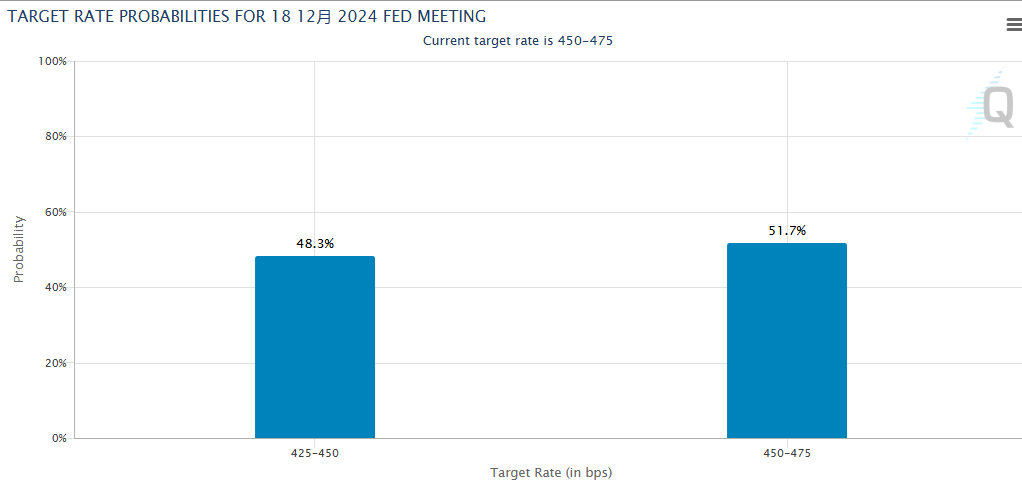
① Powell stated in his latest speech that the Federal Reserve is not in a hurry to cut interest rates in a strong economy; ② This hawkish rhetoric quickly stirred up a storm in the global market.
On November 15th, Caixin Media (Editor Xiaoxiang) reported that following the speech by Federal Reserve Chairman Powell in the early hours of Friday Beijing time, Powell stated that the Federal Reserve is not in a hurry to cut interest rates in a strong economy. This hawkish rhetoric quickly stirred up a storm in the global market.
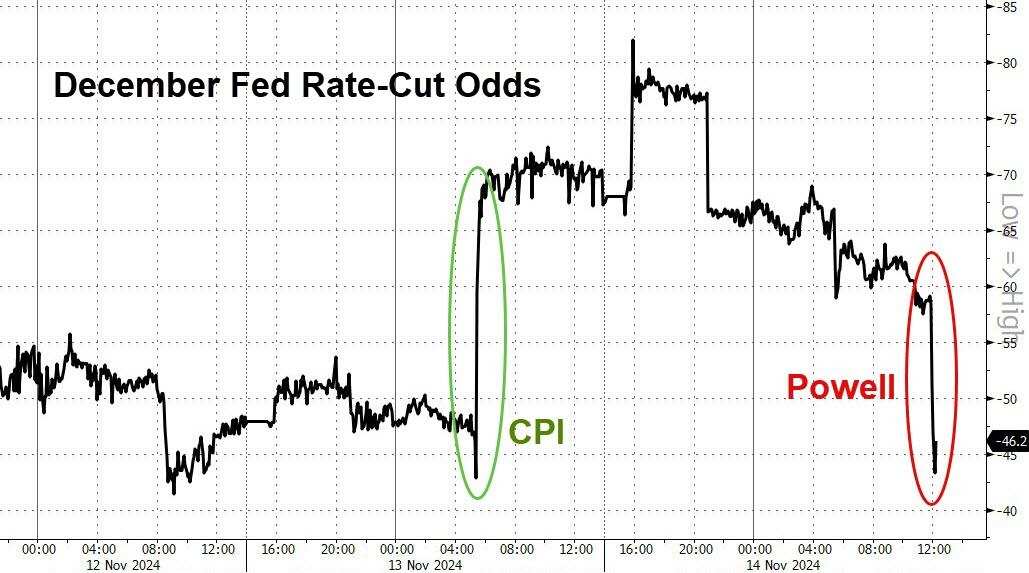
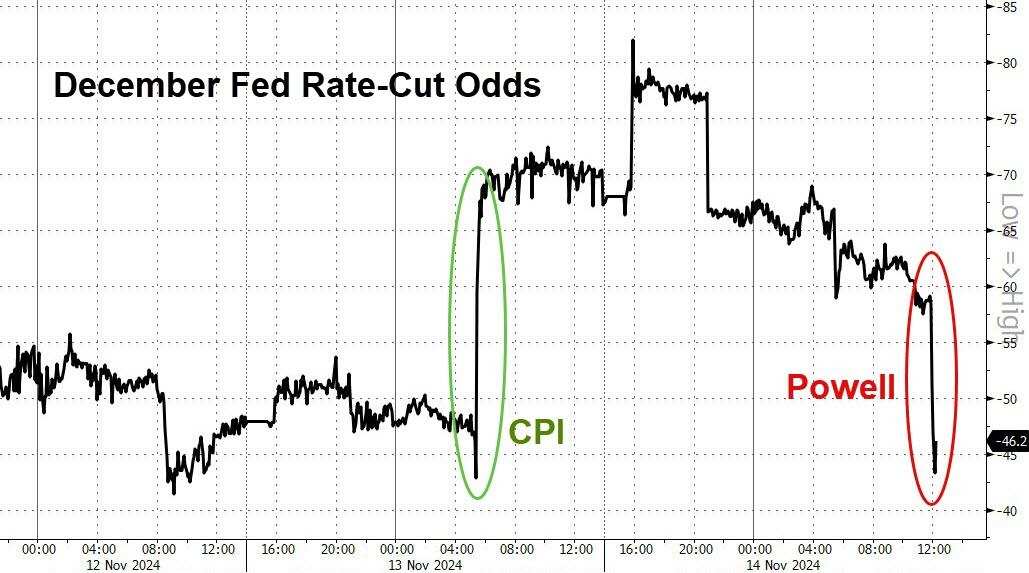
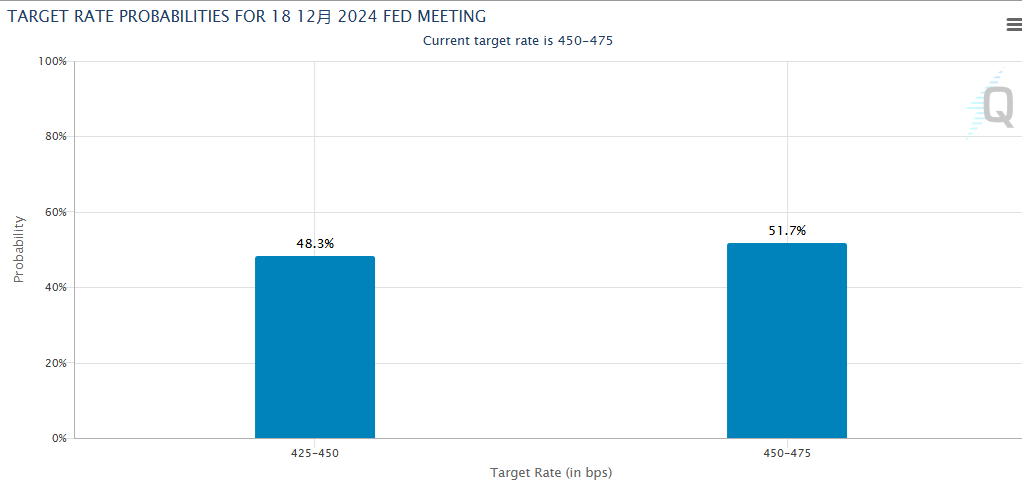
After Powell's speech, the US stock market closed near intraday lows, and the US dollar surged along with US bond yields, with the ICE US Dollar Index hitting a one-year high. Traders reduced the probability of a December rate cut from 80% the previous day to around 50%, sharply contrasting with the CPI release day before.
 During a dialogue with local business leaders hosted by the Dallas Fed, Powell said, "The economy has not shown any signals that require an urgent rate cut. A good economic situation gives us the ability to act prudently when making decisions."
Regarding inflation, Powell pointed out, "The inflation rate is getting closer to our long-term target of 2%, but has not yet been achieved. We are committed to this mission. With the labor market roughly balanced and inflation expectations well anchored, I expect the inflation rate to continue to trend towards the 2% target, albeit with some fluctuations."
To combat inflation, the Fed raised rates to the highest level in 20 years last year and then kept rates at that level for over a year to ensure that price pressures do not return. Since mid-2023, although US inflation has significantly decreased, the slowdown in price growth is sometimes uneven, including in the past two months.
Powell reiterated that the Fed's policy rate path will depend on upcoming data and the evolution of the economic outlook, closely monitoring core indicators of goods and services inflation, excluding housing, which have been declining over the past two years.
The Fed has cut rates in the last two meetings, first making a significant 50 basis point cut in September when there were signs that the labor market might be weakening. At the meeting last week, officials cut the benchmark rate again by 25 basis points to a range of 4.5% - 4.75%.
The next meeting of the Federal Reserve will be held on December 17-18. In his latest speech, Powell did not comment on the possibility of a rate cut at the December meeting. However, his remarks clearly dealt a significant blow to the market's expectations for a rate cut next month. The CME FedWatch Tool shows that the likelihood of the Fed achieving a third consecutive rate cut next month has once again become uncertain.
And market traders undoubtedly also quickly reacted to the news.
Global markets face a "new storm".
Most maturities of US Treasury yields rose after Powell's speech overnight, especially short-term yields surged, with the 2-year Treasury yield rebounding 8 basis points to 4.36% at one point.
Major US stock indexes also fell in response. The Dow fell by 0.5%. The S&P 500 index and the Nasdaq both fell by 0.6%, marking the largest single-day decline of the month.
In the forex market, the dollar further strengthened against major currencies on Thursday, with the ICE Dollar Index breaking above the 107 level, reaching a new high in a year, and rising for the fifth consecutive trading day.
Zachary Griffiths, director of credit investments and macro strategy at CreditSights in the US, said, "Powell's speech leans more towards hawkishness, with his future monetary policy bias towards risk management."
"Powell's speech is hawkish," Neil Dutta, Head of Economic Research at Renaissance Macro Research, also pointed out, "I believe they will still cut rates in December because the interest rate policy is still restrictive, and they aim to achieve the neutral rate setting. However, despite this, I think Powell (and the broader consensus) are complacent on the economic front. The downside risks in the short term are greater than people realize."
In fact, even aside from Powell's hawkish speech, a series of recent US economic data does not seem to support a rate cut much. As shown in the chart below, the number of initial jobless claims in the US has now dropped to a six-month low, and inflation data is generally stronger than expected. The economic and inflation situation still seems to face the risk of "not landing".
Market strategist at Murphy & Sylvest, senior wealth advisor Paul Nolte, said that based on the data of the past two days (consumer prices, producer prices, and weekly initial jobless claims), Powell would also find it difficult to become super dovish. All information indicates that job growth remains significant, and inflation continues to exceed the 2% target.
This also raises a question: if the scenario of "Trump comes to power, and Powell suspends rate cuts" really occurs (currently it seems very likely that the Fed will slow down its easing pace early next year), how angry would the "understanding king" who is always unhappy with Powell be?
Michael Feroli, Chief US Economist at JPMorgan, expects that Powell's speech may imply that the Fed will slow down its rate cuts before March next year. He wrote: "We still believe that the FOMC may cut rates in December. But today's speech has opened the door to slowing down the easing pace as early as January next year."
Editor / jayden
Haftungsausschluss: Der Inhalt dieses Artikels gibt ausschließlich die Meinung des Autors wieder und repräsentiert nicht die Plattform in irgendeiner Form. Dieser Artikel ist nicht dazu gedacht, als Referenz für Investitionsentscheidungen zu dienen.
Das könnte Ihnen auch gefallen
Die „Erleuchtung“ im Ausland: Didi hat endlich seinen „Durchbruchstag“ erlebt
Das 500-Milliarden-Finanzierungsprogramm von Nvidia für KI birgt versteckte Risiken, Trump-Berater warnen vor Überangebot an "dunklen GPUs"
Trumps Technologieberater David Sacks warnte in einem Podcast, dass das größte Risiko beim 500-Milliarden-Dollar-AI-Finanzierungsplan von Nvidia eine Überkapazität an Rechenleistung sei. Er verglich dies mit der „dunklen Glasfaser“-Krise nach der Internetblase – sollten GPUs in großem Umfang ungenutzt bleiben und die Preise zusammenbrechen, würde dies die gesamte Investitionskette der AI-Infrastruktur schwer treffen. Gleichzeitig wies er darauf hin, dass politischer Widerstand beim Bau von Rechenzentren Überkapazitäten vielleicht verhindern könnte.
Nvidia plant, 3 Milliarden US-Dollar in SB Energy von Softbank zu investieren und setzt dabei auf das OpenAI-Datenzentrum-Projekt in Ohio.
Nvidia soll Berichten zufolge Gespräche führen, um bis zu 3 Milliarden US-Dollar in SB Energy, eine Tochtergesellschaft von SoftBank, zu investieren. Dies ist Teil einer unterstützenden Maßnahme für eine Kreditfazilität in Höhe von rund 100 Milliarden US-Dollar für das OpenAI-Datenzentrumprojekt in Ohio. Die Investition soll in zwei Schritten erfolgen: Bei Vertragsunterzeichnung werden 1,5 Milliarden US-Dollar investiert, weitere 1,5 Milliarden US-Dollar fließen bei dem Börsengang von SB Energy, der bereits nächsten Monat beginnen und mindestens 5 Milliarden US-Dollar einbringen soll.
Der „Aktienauswahl-Mythos“ an der Wall Street verblasst weiter: In den vergangenen zehn Jahren haben nur 13 % den Index übertroffen.
Laut den neuesten Daten von Morningstar haben in den zehn Jahren bis Ende Juni 2026 nur 13 % der aktiv verwalteten US-amerikanischen Large-Cap-Aktienfonds nach Abzug der Gebühren ihren Benchmark-Index übertroffen; selbst im vergangenen Jahr lag dieser Anteil nur bei 27 %. Gleichzeitig wird erwartet, dass die Nettozuflüsse in passive ETF in diesem Jahr erstmals die Marke von 1 Billion US-Dollar überschreiten, und das verwaltete Vermögen passiver Fonds ist inzwischen fast doppelt so groß wie das der aktiven Fonds.
Krypto-Preise
Mehr


