
The 10-year U.S. Treasury yield hits a 24-year high, suppressing gold prices; strategists say the long-term value preservation logic of gold remains unchanged

Huitong Network, October 6 — The yield on the 10-year US Treasury has risen to 5.32%, reaching a 24-year high, boosting the returns on fixed income products and temporarily suppressing the price of spot gold. Michael Khouw, Chief Strategist at YieldMax, believes that higher interest rates create an asset substitution effect, but the underlying logic for gold’s store of value remains intact. Inflation persists, rooted in America’s fiscal problems. As gold prices pull back and volatility declines, long-term capital may be attracted; gold remains an excellent asset for diversified allocation.
On October 1, the yield on the 10-year US Treasury climbed to 5.358%, hitting a 24-year high. As cash and fixed income products now offer considerable returns, rising bond yields present direct competition to gold. However, market strategists believe that persistent inflation keeps eroding the purchasing power of fiat currencies, so the fundamental case for holding gold remains valid.
High-yielding assets divert funds, short-term gold prices under pressure
Michael Khouw, Chief Strategist at YieldMax, stated that higher interest rates will suppress gold in the short term, as investors can earn steady returns on principal, reducing the attractiveness of gold. He said, "The pressure on gold prices is not surprising. When rates rise to a sufficient level, investors may not calculate real yields in detail, but this ultimately impacts physical assets negatively."
Khouw noted that investors don't need to calculate inflation-adjusted returns precisely to feel the appeal of high-yield assets. Money market accounts and other liquid products now yield around 5%, which is very appealing for investors needing cash flow. He said, “Once rates offer real value, a substitution effect arises, irrespective of whether investors have carefully measured returns.”

Inflation is persistent, gold’s store of value foundation remains unchanged
In his view, the competition from fixed income products does not erase the fundamental reasons for investors to hold gold. Investors buy precious metals with the knowledge that fiat currencies will see long-term depreciation of purchasing power; inflation essentially acts as a hidden tax on savings, creating market demand for physical assets that preserve value. He said, “Investors buy gold knowing that the dollar and other fiat currencies are not stores of value and their purchasing power will continue to dilute. They vaguely sense their real purchasing power is slipping away and hope to use physical assets as a hedge.”
Khouw also mentioned that the recent rate hike is, in fact, a correction for past policy delays that caused market imbalances. Years ago, inflation had already shown persistence, but policymakers at the time described rising prices as a temporary phenomenon. Now, the price environment has structurally changed, and the inflation baseline will be higher than the market previously expected. He said, "There was sufficient evidence five years ago that inflation was real, but four years ago officials still insisted it was only temporary. This new inflation regime is unlikely to fall below 2%, and will most likely hover above 3%. The market is now pricing in this reality, which has led to a gold price pullback, but the underlying problem has not changed."
Fiscal problems are the root cause, gold remains a quality diversification asset
Although the high US Treasury yields reflect market concerns about inflation, Khouw believes that high Treasury rates mask deeper fiscal challenges. Monetary policy is largely a passive response to inflation pressure, while the root cause lies in government spending and fiscal policy. Only a significant improvement in US fiscal health will change the outlook for inflation and rates; without fiscal adjustment, inflationary pressures will be hard to quell.
He also noted that the recent pullback in gold prices and normalization of volatility will refocus long-term investors on the gold market. Historically, gold is not a highly volatile speculative asset, and steady market conditions help long-term, stable capital return to the precious metals sector.
YieldMax's investment portfolios consistently include precious metals and mining stocks as important tools for asset diversification. He said: "
Conclusion
In summary, the substitution effect from short-term high US Treasury yields is suppressing gold prices, with funds flowing into higher-yielding fixed income products. However, structural inflation and America's persistent fiscal risks continue to erode the purchasing power of fiat currencies. The long-term value of gold as a hedge against devaluation and diversification remains unchanged, and the short-term adjustment may even attract long-term capital to the sector.
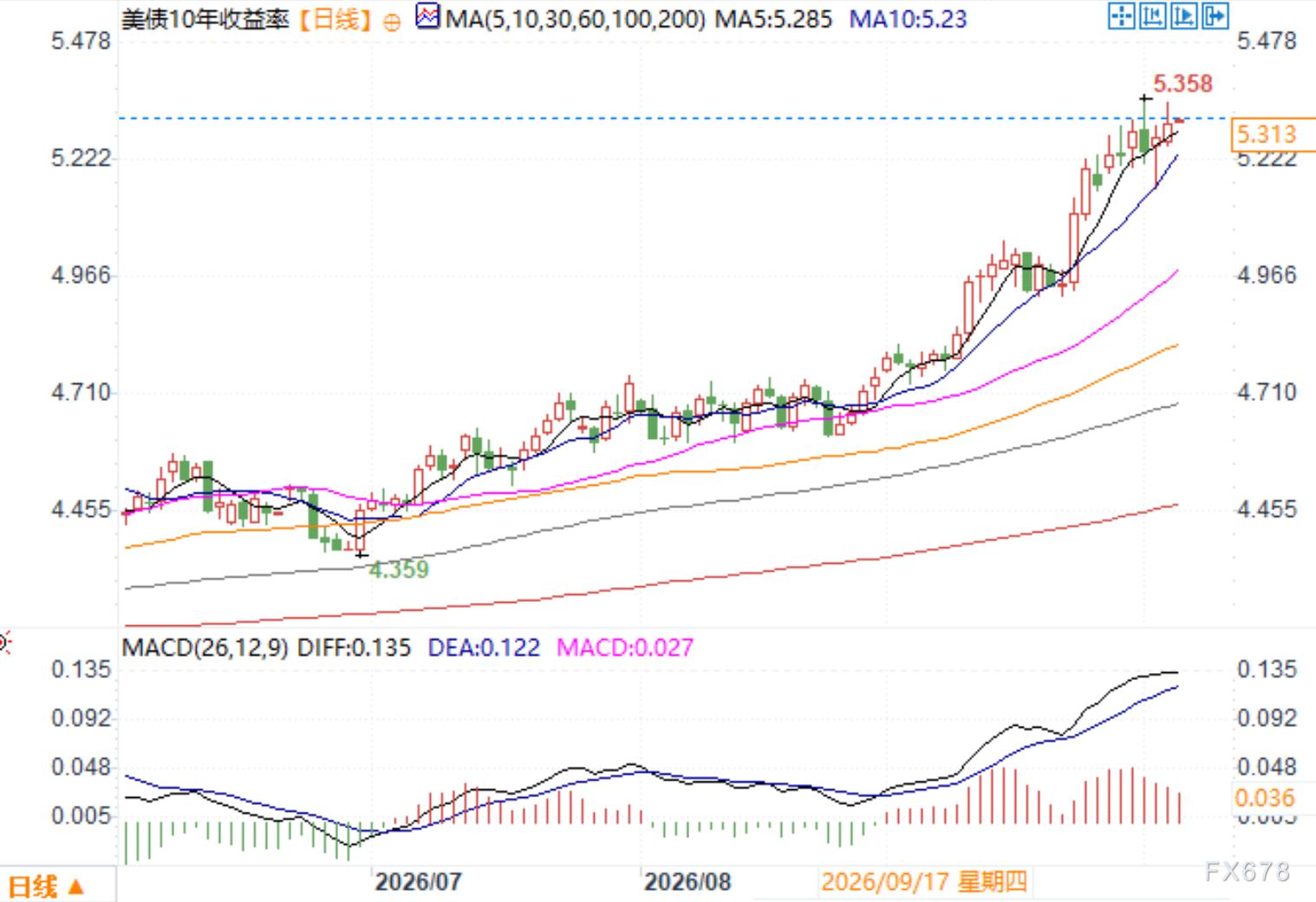
10-year US Treasury yield daily chart Source: Yihuitong
Eastern Time Zone, October 6, 9:34 am, 10-year US Treasury yield reported at 5.313%
Disclaimer: The content of this article solely reflects the author's opinion and does not represent the platform in any capacity. This article is not intended to serve as a reference for making investment decisions.
You may also like
Avalanche Price Prediction October 2026: Can AVAX Reach $13 or Fall to $9 in October?
NEAR Traders Are Pleased to See the Altcoin Break Above $5 and Trade Above, Will This Momentum Hold?

After Toshiba reported news of HDD production expansion, Morgan Stanley turned more bullish rather than bearish.
Morgan Stanley’s research indicates that the market has seriously overestimated Toshiba’s expansion scale — the doubling of capacity at its Philippines plant over two years translates to an annualized growth rate of about 30%, which is similar to the overall industry supply growth rate and far lower than demand growth. More importantly, channel checks show that Seagate and Western Digital have no intention of following suit with capacity expansion, and there are no signs of loosening in industry pricing.
BitMine lifts ETH holdings to 6 million as price holds above $2,700

Crypto prices
More


