21 financial institutions, among them Goldman Sachs, Bank of America, Citi, Deutsche Bank and UBS, have announced the formation of a joint company. The major banks want their joint dollar stablecoin to appear in the first half of 2027.
A stablecoin is a cryptocurrency whose price stays pegged to a fiat currency. Reserves cover the supply at a ratio of 1:1. Such tokens thus work as a means of payment and settlement without price risk. The announced venture bundles that function into a bank-owned special purpose company. Consequently, the participating institutions build their own infrastructure instead of turning to third parties such as Tether or Circle. At first, the group counted ten banks in October 2025. Meanwhile it counts 21 members from North America, Europe, East Asia, the Middle East and Africa. The token is furthermore intended to run on public blockchains. Later the consortium wants to cover additional G7 currencies, beginning with the euro.
Ten banks grow into a 21-member consortium
Since the first announcement in October 2025, the circle has more than doubled. Altogether, ten of the 21 members come from North America. These include Bank of America, Capital One, Citi, Fidelity Investments and Goldman Sachs. Further North American members are PNC Financial Services, Scotiabank, TD Bank Group, Wells Fargo and WisdomTree. Europe adds another eight institutions: Banco Santander, BBVA, Commerzbank, Crédit Agricole, Deutsche Bank, Lloyds Banking Group, Rabobank and UBS. The remaining three finally cover other regions. MUFG Bank represents East Asia, Sirius International Holding the Middle East and Standard Bank Africa.
Not all members are banks, however. With Fidelity Investments and WisdomTree, two asset managers likewise belong to the group. North America and Europe together account for 18 of the 21 institutions. East Asia, the Middle East and Africa, in contrast, contribute one member each. The weight therefore sits in the transatlantic space, although the group presents itself as global.
The announcement came as a collective statement from the group. A spokesperson quoted by name from an individual bank was absent. The company itself is due to emerge in 2026, with the token following only a year later. The essentials also remain open. Neither the name of the company nor the name of the token has emerged. In addition, the consortium has not disclosed the blockchain networks it will use. The custodian of the reserves, the governance structure and the final redemption terms also stay undisclosed. The formation moreover depends on the usual closing conditions. So the timeline is a statement of intent, not a fixed launch date.
Dollar and euro camps form separately
At the same time, a second banking alliance is forming around the euro. A separate consortium of 37 financial institutions has founded the company Qivalis for that purpose. It wants to launch a euro stablecoin as early as 2026. That would consequently put it in the market before the dollar group. In numbers, the European camp exceeds the dollar group, which has 21 institutions. Overall, both projects pursue the same aim, namely bank-owned settlement in the respective reserve currency.
One overlap stands out, because BBVA belongs to both alliances. The Spanish bank keeps both routes open. The dollar consortium intends to extend its token to further G7 currencies later anyway, with priority for the euro. So far the group names no timeline for that expansion. Both camps are therefore heading toward the same currency area over the medium term. Whether the two ventures cooperate or compete still remains open.
Stablecoin infrastructure is becoming a competitive field between banking groups. Until now, mainly crypto issuers competed with each other in this segment. In the short term the issue is token issuance. In the medium term, though, control over payment and settlement flows is at stake. Whoever issues the token also manages the reserves behind it. As a result, European banks face a directional decision on which infrastructure they support long term.


Tether and Circle dominate the dollar stablecoin market
Two issuers already share the market the banks are entering. Tether and Circle issue the two largest dollar stablecoins, USDT and USDC. Altogether, the two issuers cover the bulk of global supply. Both tokens moreover count as the standard on crypto trading venues.
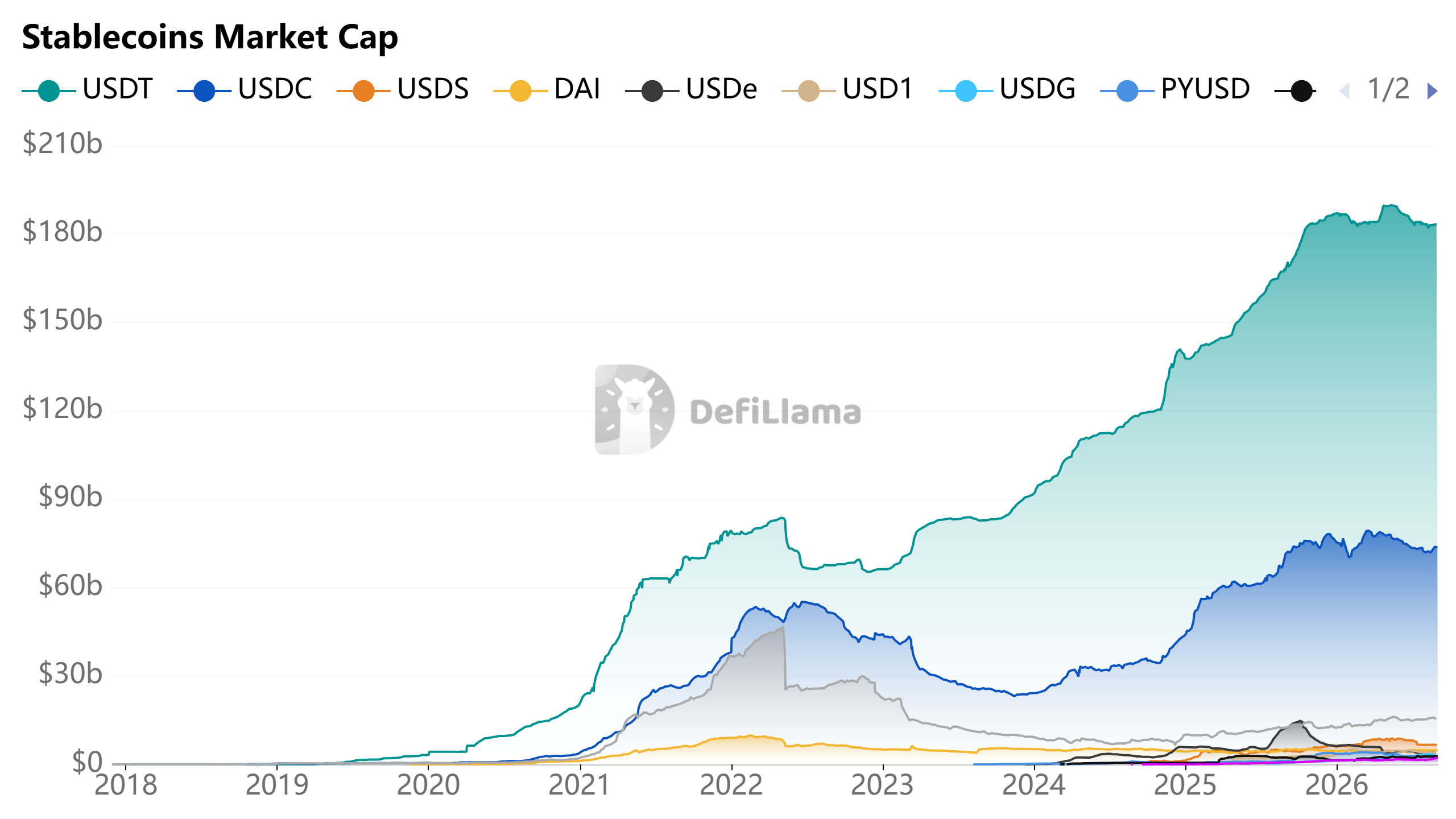 Stablecoins by market capitalization / Source:
DeFi Llama
Stablecoins by market capitalization / Source:
DeFi Llama
Tether additionally earns billions in profit from investing its reserves, among other things in US Treasuries. Indeed, such earnings are an obvious motive for the banks to stop leaving the field to third parties. In its setup, the planned bank token differs little from the established offerings. A first push from the banking sector nevertheless fell flat. Société Générale issued the first dollar-backed stablecoin of a major bank in 2025 through its digital asset subsidiary. Yet only USD 12.5 million are in circulation, according to figures on its own website.
The bank still belongs to neither of the two consortia. A banking brand alone is not enough. The difference from the single push lies in distribution. A group of 21 institutions covers far more client relationships than one bank on its own. Whether demand grows out of that ultimately depends on whether companies prefer a bank token to USDT or USDC. Demand for bank-issued stablecoins has so far stayed limited.
GENIUS Act and MiCA set the timeline
The planned launch falls into a regulatory transition phase. US President Donald Trump signed the GENIUS Act in July 2025. Previously the US lacked a uniform federal framework for stablecoins. The law governs reserve requirements, redemption rights, disclosure duties and custody. Issuers with more than USD 10 billion in issuance volume furthermore fall under federal supervision.
The responsible agencies missed the statutory deadline of 18 July 2026 for the final rules. In February 2026, the OCC first presented a draft regulation. The Treasury Department has opened a comment period until 19 October 2026 on it. Before that process concludes, issuers work with the statutory text but without final implementing rules. Nevertheless, the law takes full effect on 18 January 2027 at the latest. The planned start of the token accordingly falls right into this window.
In the EU the framework already stands. The stablecoin rules of the MiCA regulation have applied there since 30 June 2024. On 1 July 2026 the transition period for crypto service providers without MiCA authorization finally ended. The consortium wants to shape its token under both the GENIUS Act and MiCA, where applicable. Switzerland has its own framework. MiCA does not apply there. Instead, the DLT Act and FINMA supervision govern issuance under the principle of same risk, same rules. On one hand, Swiss institutions have more room on reserve mechanisms. On the other hand, they lack the EU-wide passporting right of a MiCA authorization.