
August Upheaval: Besant Steps In, Policy Bottom Line Quietly Revealed

August was supposed to be the market’s off-season, but instead it turned into a profound period of policy signaling.
U.S. Treasury Secretary Scott Bessent took consecutive actions in the USD/JPY exchange rate and long-term U.S. Treasuries, sending a clear message to the market: authorities would rather tolerate currency depreciation than allow the bond market to collapse. This stance reshaped investors' positioning logic, putting gold, bitcoin, and major metals in the market spotlight, while the AI narrative is quickly shifting from the “build phase” to the “application phase.” Mark Wilson, a Goldman Sachs partner, has characterized this series of events as “the August sequence of serious consequences.”
Wilson believes that Bessent’s intervention is the most important policy node of the month. He first intervened in USD/JPY, then pushed for long-end U.S. Treasury buybacks—so-called “twist operations”—while coordinating measures such as expanding bank balance sheets and shrinking the Fed’s balance sheet, showing that the policy toolbox is far from exhausted. The Goldman Sachs rates team pointed out, these buyback operations may improve long-end supply and demand, but do not touch the fundamental drivers pushing global (not just U.S.) long-end yields higher.
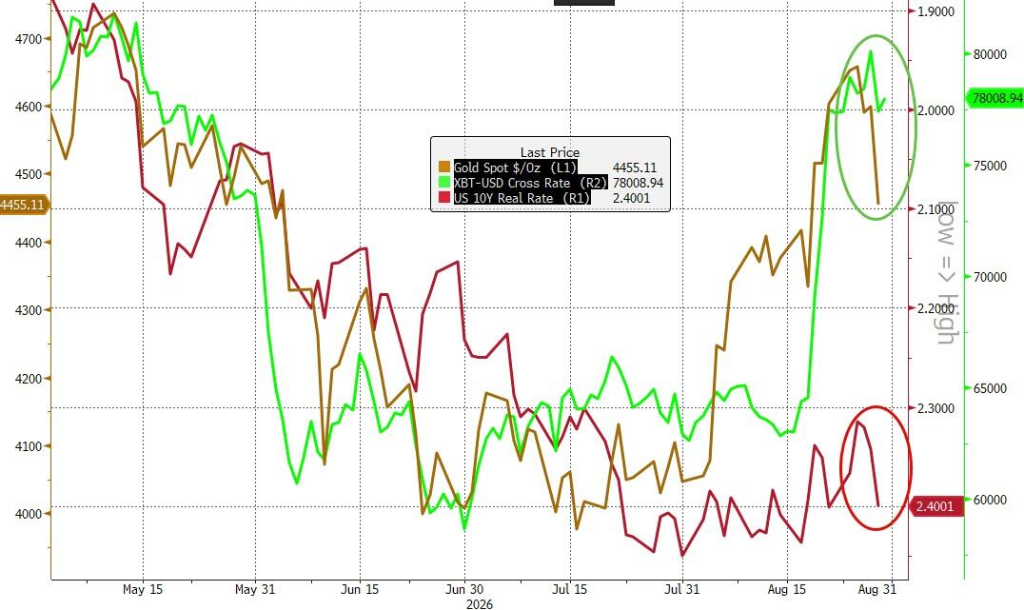
The market’s reaction to this policy signal was swift and direct. Over the past ten days, investors have clearly shown anxiety over insufficient exposure to “store of value” assets, with gold, bitcoin, and metals returning to center stage in every investor conversation.
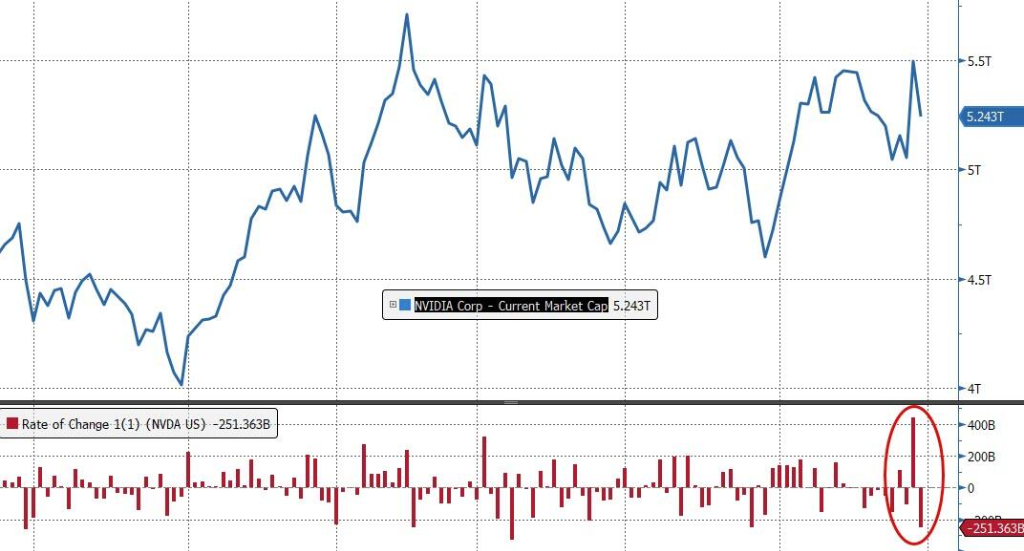
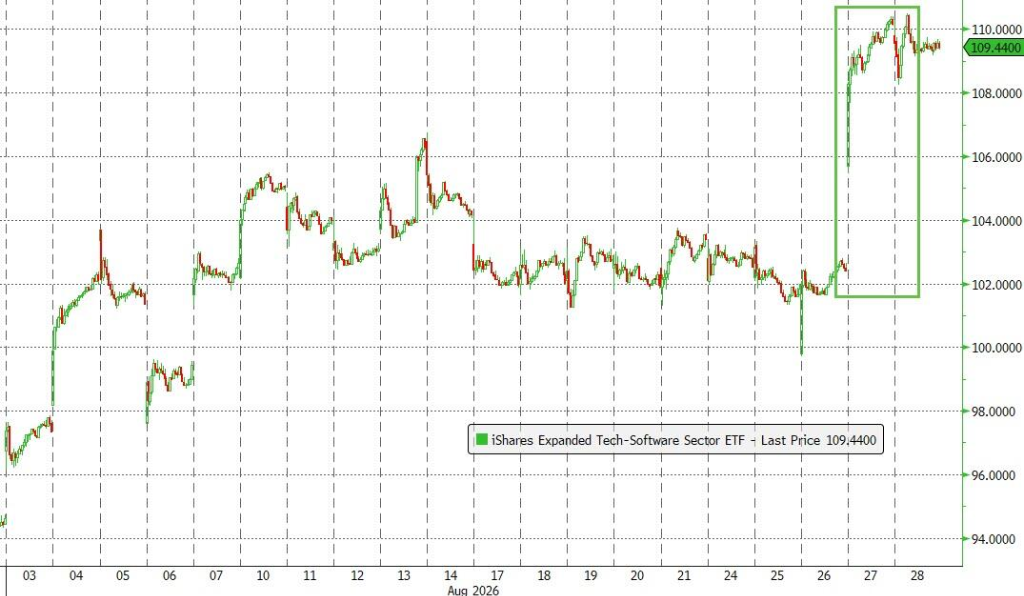
Meanwhile, Nvidia’s market cap soared by nearly $500 billion in a single day, the software ETF IGV recorded its best daily gain in twenty years, yet the S&P 500 fell 0.7% on the day once AI-related stocks were excluded, marking an exceptionally narrow market breadth—two entirely different narratives are running in parallel within the same market.
Policy Cards on the Table: The True Meaning of Bessent’s “Twist Operation”
The persistent rise in long-end yields is an explicit risk facing the now-extended equity bull market, especially as the fiscal positions of developed economies have widely deteriorated. Bessent’s series of interventions marks an important policy turning point.
Mark Wilson points out that Bessent’s “twist operation” and related recent policy measures jointly send a core message: Coordination between the Fed and the Treasury has become much clearer, and authorities will do whatever it takes to backstop nominal growth. This isn’t about a few hundred billion dollars of government bond buybacks solving the debt stock issue, but rather about the policy reaction function becoming more explicit—officials will opt for currency depreciation before allowing the bond market to break.
The Goldman Sachs rates team made it clear that while the buyback operation may marginally improve supply and demand for long-dated bonds, the core driver of global long-end yield increases—namely, the fiscal mathematics of developed economies—remains unchanged. Nonetheless, the positioning significance of this intervention far exceeds its technical effects: it tells investors that nominal growth will have policy support, and those underexposed to “store of value” assets are already behind the curve.
According to Wilson, over the past ten days, the return of gold, bitcoin, and metals to the core of market discussions is a direct reflection of this policy signal.
Nominal Growth: The Macro Narrative of Nvidia and AI Capital Expenditures
The policy goal targeted by Bessent’s intervention is clear: maintain strong U.S. nominal growth. As Wilson notes, on a micro level, nothing exemplifies this narrative better than Nvidia.
After Nvidia released stellar Q2 results, Goldman Sachs raised its 2028 revenue forecast to $955 billion, up $165 billion from previous estimates—the equivalent of conjuring into existence, overnight, a company the size of Mercedes-Benz or BP (by revenue).
Even more striking, Goldman projects Nvidia’s revenue will jump by $543 billion over the next two years (from $412 billion in 2026 to $955 billion in 2028), equivalent to creating, in two years, two companies the size of Volkswagen and Shell—the largest in Europe by revenue—combined.
Meanwhile, investment grade bond issuance hit a historic high in August, driven significantly by hyperscalers. Nvidia announced the formation of a $500 billion financing alliance to underwrite residual GPU value, a move with far-reaching implications: it will drive the standardization of computing power specifications and capacity, eliminate financing bottlenecks as a potential constraint on growth, and effectively lower the capital cost for the builders of the largest AI infrastructure.
AI Narrative Shift: From “Build Phase” to “Application Phase”
Two corporate announcements have powerfully illustrated AI’s entry into a new phase of development.
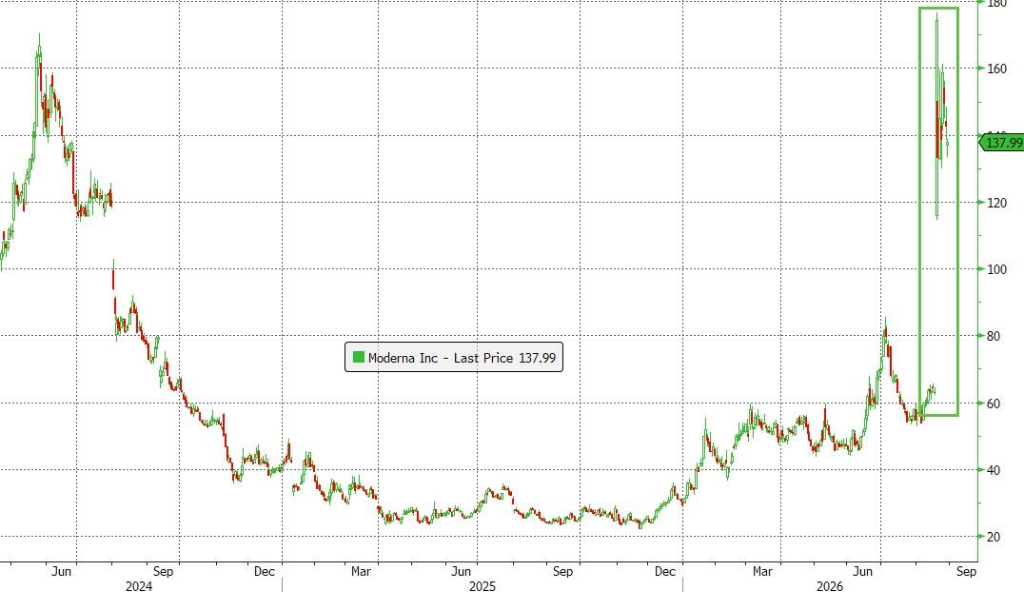
On August 19, Moderna’s stock surged 175% in a single day—the largest one-day gain ever for an S&P 500 constituent—after the company announced research results for a personalized vaccine preventing melanoma recurrence, demonstrating the feasibility of customized, highly efficient personal cancer treatment.
On the same day, Stripe announced the acquisition of OpenRouter and wrote in a letter to shareholders, “We identified January 1 as the beginning of the singularity... we are seeing a major inflection point in long-term trends... AI’s promise and our collective hope is that it will bring about greater material prosperity and abundance.”
Mark Wilson believes these two announcements clearly reveal the innovative possibilities as AI moves from the “build” phase to the “utility” phase. AI is no longer just chatbots—Moderna-like applications and Stripe’s invocation of the “singularity” are no longer science fiction.
The market’s attention is shifting from the beneficiaries of AI’s build phase (memory, semiconductors, hardware) to the ultimate winners of the AI deployment phase—companies whose share prices have yet to reflect this transformation.
Market Fractures: Two Narratives, One Market
Although these developments are generally positive, risk management in August has been far from smooth.
- After Nvidia’s earnings release, its market cap soared by nearly $500 billion in a day, only to give back about $250 billion the next day;
- The IGV software ETF posted its best single-day gain in twenty years;
- However, market breadth was exceptionally poor that day—only once before this century has the S&P 500 risen more than 60 basis points while so few constituents rose.
- The “S&P 500 ex-AI” fell 0.7% on the day, while Goldman’s “AI winners vs AI risk” pair trade fell 3% on the day.
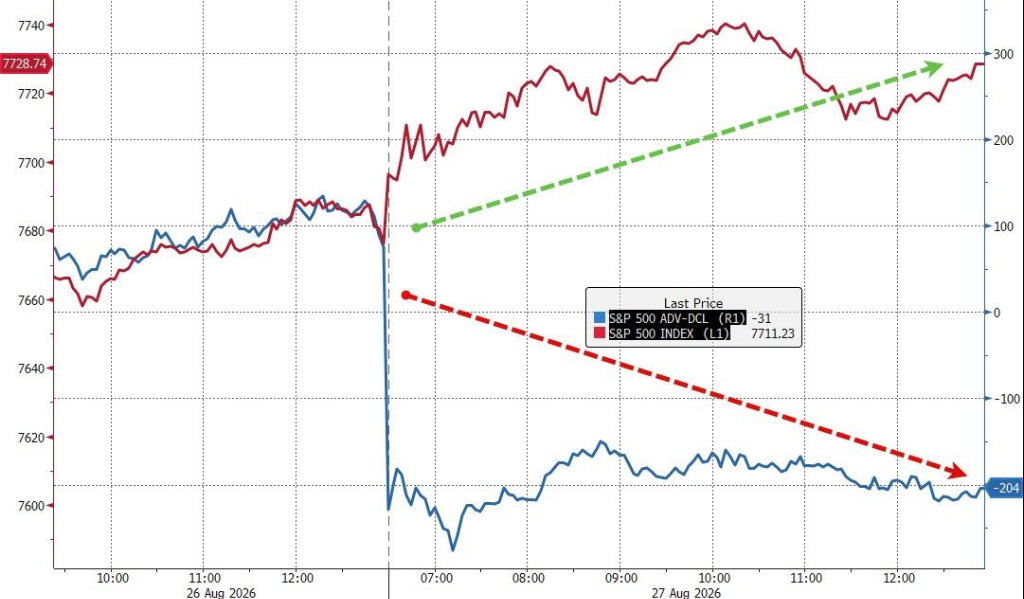
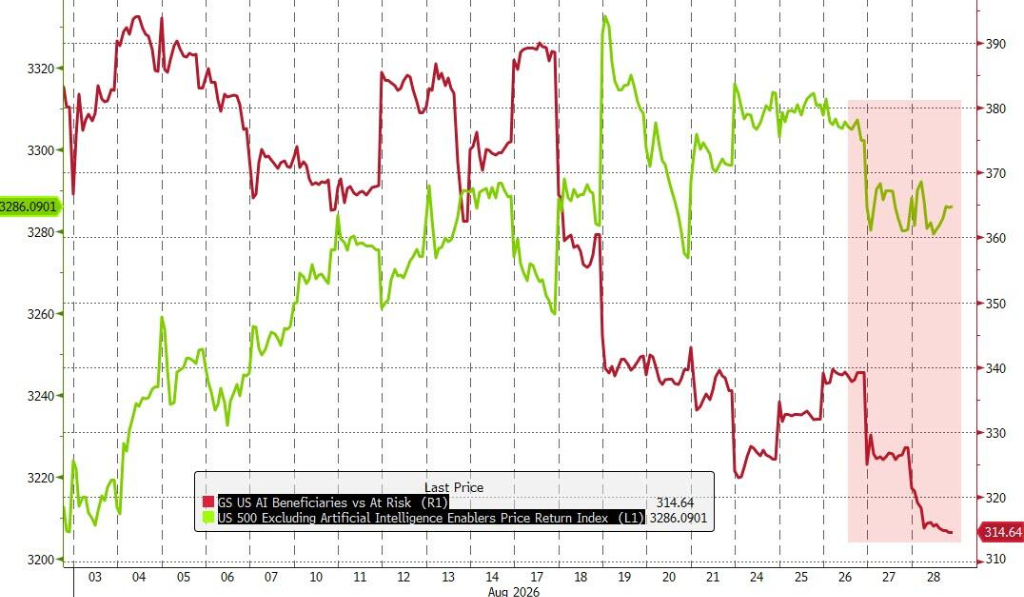
Mark Wilson interprets this as follows: Nvidia’s astonishing revenue growth is likely cannibalizing spending in other areas, mirroring how Salesforce’s performance shows that software itself will in some fields become a key AI beneficiary.
Positioning and forecasting around AI exposure is undoubtedly becoming more complex—software remains heavily represented on the short leg of Goldman’s 12-month momentum factor, but now has equal weight on the long leg of the 3-month momentum factor. The high correlation of AI winners with the momentum factor in June and July indicates that clearing consensus positions may take longer than expected, and overall exposure contraction may follow.
In summary, Wilson believes that, taking August as a whole, the direction is clear: the government will support nominal growth, AI capital expenditures won’t pause, and the “utility” phase is no longer science fiction.
However, the market is not pricing a single story, but two stories—and they do not coexist on the same market regime.
Hyperscalers setting all-time records for investment-grade bond issuance, a $500 billion GPU residual value backstop, the best daily performance for software in two decades—yet, at the same time, the S&P 500 falls when AI is excluded, market breadth among the worst in the century, and AI winner pair trades hammered.
Wilson thinks that this is not a clean bull market. This is a market already confident that the state will not allow the long end or nominal growth to fail, but now debating one by one who can truly benefit from it.
Disclaimer: The content of this article solely reflects the author's opinion and does not represent the platform in any capacity. This article is not intended to serve as a reference for making investment decisions.
You may also like
LINK Faces a Critical Test at $11.22 After Sharp 24-Hour Selloff

August Turmoil: Besant Intervenes, Policymaking Strategies Quietly Revealed
The US Treasury Secretary intervened in the bond and forex markets, making it clear that they would rather see the currency depreciate than allow the bond market to collapse, thus revealing their bottom line for supporting the market. Gold, Bitcoin, and other assets have returned to the spotlight. Meanwhile, the narrative around AI is shifting rapidly from the "construction phase" to the "application phase." The current market is exhibiting rare divergence, with an AI frenzy occurring alongside declines in non-AI assets, as capital fiercely competes to identify the true beneficiaries.
ONDO holds key support as volume surges, targets $0.415 breakout
Bitcoin-Nasdaq ratio falls 62%, matching prior cycle lows as ETFs rebound
Crypto prices
More


