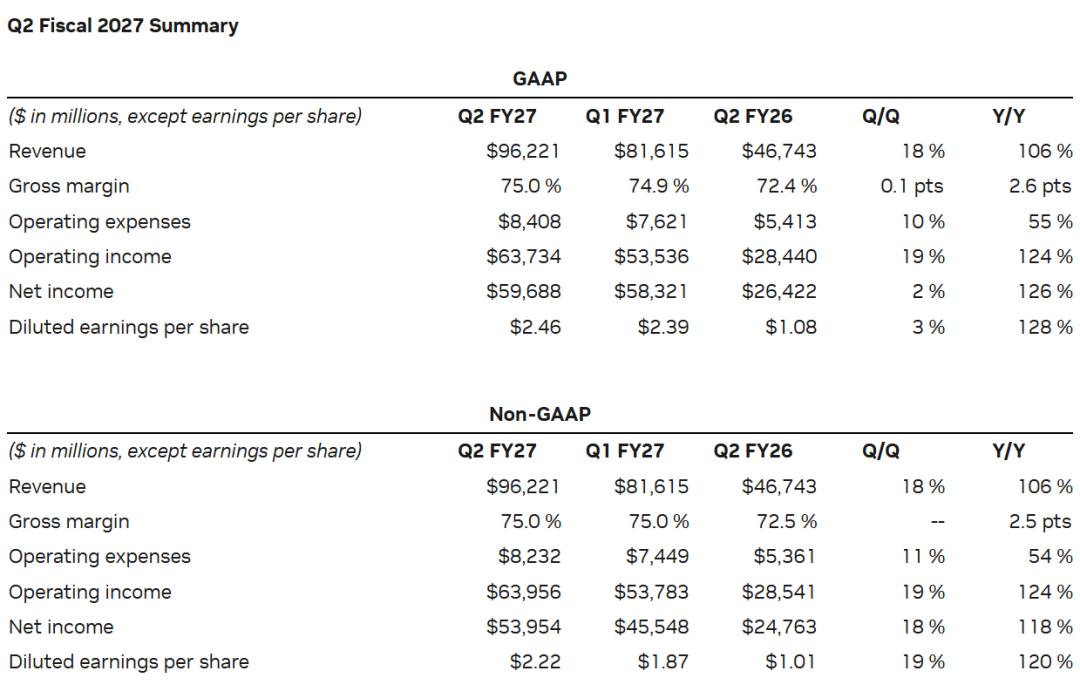
NVIDIA released its financial report for the second quarter of fiscal year 2027 on August 26 local time, with the chip company reporting revenue of $96.2 billion, a year-on-year increase of 106%. Of this, the data center segment contributed $89 billion, up 117% year-on-year.
NVIDIA founder and CEO Jensen Huang stated in the earnings release:
“
AI has reached its inflection point. It is doing useful work. Its tokens are productive and profitable. Now,compute power is revenue, and demand continues to accelerate. ”
A year ago,
the construction of AI infrastructure was mainly driven by a single lab (though not explicitly named, it is most likely OpenAI). Now the landscape is entirely different. New AI labs and startups are emerging rapidly, several cutting-edge AI labs are expanding simultaneously, the open-source model ecosystem is evolving, and physical AI is venturing into deeper areas. Jensen Huang stated that NVIDIA's AI infrastructure construction is progressing at full speed, with the next-generation Vera Rubin platform now in full-scale production, emphasizing that these have been designed for this moment. (Source: NVIDIA)
Driving Force from Data Center Business
The data center business is
the absolute powerhouse in this NVIDIA earnings report, with $89 billion in quarterly revenue accounting for 92.5% of total revenue. This figure is more than double that of the same period in 2025.
There are several key factors behind this growth: some major tech companies'
AI infrastructure spending shows no sign of slowing down; giants such as Microsoft, Google, Amazon, and Meta are continually purchasing NVIDIA GPUs to expand their data centers. Another growth driver comes from emerging AI labs and startups, who are also rapidly scaling their computing power. NVIDIA CFO Colette Kress disclosed a figure in this earnings report,NVIDIA has already made long-term purchase commitments of $27.9 billion for key components, such as memory, over the next few years. Compared to $11.9 billion in Q1 2026, this figure has more than doubled. Coupled with other arrangements, NVIDIA's total future infrastructure commitments have reached $36.6 billion.
Kress also elaborated on a detail about the Ohio data center project; the PORTS-Pike Tech Park, built in partnership with SB Energy, sees each generation of infrastructure deploying around 1.5 million NVIDIA GPUs, equivalent to revenue of about $15-$20 billion. The park is expected to support multiple infrastructure upgrade cycles over the next 20 years.
In terms of gross margin,
NVIDIA maintained a level of 75% in the second quarter, and the company expects third-quarter revenue to reach $108 billion, with a margin of error of 2%. Gross margin is expected to be 74%, with the slight decrease attributed to the cost structure and ramp-up of new generation products.
Deployment Beyond Compute Power
Currently, NVIDIA is transitioning from a chip company to a broader AI infrastructure provider, and this shift is manifested on multiple levels.
On the product line,
the full-scale production of the Vera Rubin platform was a key milestone this quarter. The platform includes the Vera CPU, Rubin GPU, Spectrum-6 switch system, and BlueField-4 DPU, covering the full suite of computing and networking components required for AI factories. Jensen Huang stated that Vera is “
the first CPU designed for
AI agents ”
.
On ecosystem development,
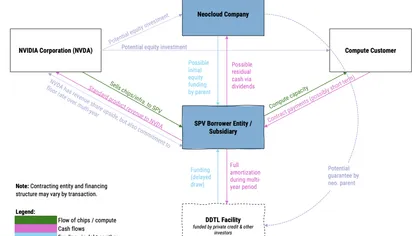
NVIDIA has formed strategic partnerships with several financial institutions such as Apollo, Blackstone, and KKR, aiming to mobilize over $500 billion in third-party capital over time for AI infrastructure development through an independent compute financing platform. This model allows clients to acquire NVIDIA hardware through financing, rather than paying the entire procurement cost upfront.
In fact, this approach has sparked discussions about
“
circular financing
”
, with some questioning whether the returns on AI infrastructure are meeting expectations. However, Kress addressed this in the earnings call, referring to these corporate clients as
“ once-in-a-century companies
”
, believing that their technological leadership and client demand are rapidly growing, and that they are on track to become some of the world’s largest tech companies.
NVIDIA's sales performance in China also received attention. The financial report shows that shipments of the Hopper series data center products to China now account for less than 1% of data center revenue, so NVIDIA did not include data center computing revenue from China in this earnings guidance.
NVIDIA expects third-quarter revenue to be about $108 billion, a year-on-year increase of about 90%. This figure means that NVIDIA is approaching the significant milestone of quarterly revenue surpassing $100 billion. In terms of shareholder returns, NVIDIA returned about $26 billion to shareholders in the second quarter through share buybacks and cash dividends, and had about $99 billion remaining under share repurchase authorization by the end of the quarter.
Regarding the statement by Jensen Huang in the earnings report
“
AI has reached its inflection point ”
, this is reflected more specifically in the financial data. However, whether the demand for compute power can be sustained, and whether clients’ returns on investment can be realized, will continue to be closely watched by the market. At least based on current orders and outlook, there is no sign of growth slowing down yet.