
NVIDIA FY2027 Q2 Earnings Highlights: Revenue Doubles YoY to $96.2 Billion; Data Center Up 117%; Next-Year Guidance Implies ~70% Growth
 Bitget2026/08/27 02:05
Key Takeaways
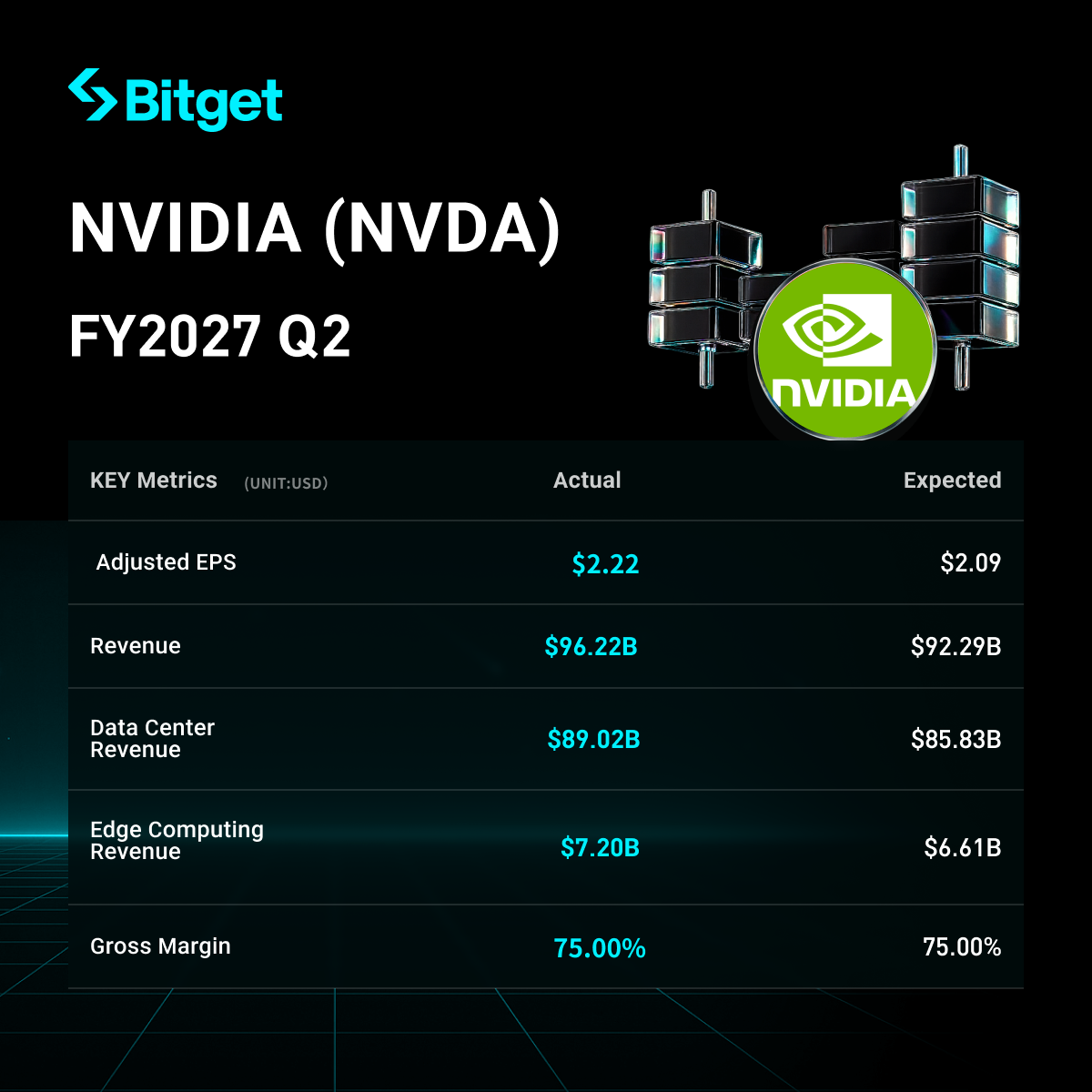
NVIDIA reported FY2027 Q2 revenue (quarter ended July 26, 2026) of $96.221 billion, up 106% year over year and 18% quarter over quarter. That beat analyst estimates by more than 4% and came in about $5.2 billion above the midpoint of the company’s prior Q2 guidance of $91.0 billion.
Non-GAAP adjusted EPS was $2.22, up 120% YoY and above the $2.09 consensus by nearly 6%.
Data center revenue was $89.0 billion (official figure $89.023 billion), up 117% YoY and accounting for about 92.5% of total revenue.
The company guided FY2027 Q3 revenue to a midpoint of $108.0 billion (±2%), implying nearly 90% YoY growth and the first quarter above $100 billion. Gross margin guidance midpoint, however, stepped down to 74.0%. Guidance “does not assume any data center compute revenue from China.”
On the earnings call, management guided FY2028 revenue growth of about 70%, well above the roughly 45% analyst expectation, and said Amazon AWS will deploy an additional 2 million GPUs in 2027–2028. After hours the stock initially dropped about 4%, then turned higher after the call and was up nearly 5% at one point. Shares had already risen more than 10% in the month leading into the report.
Detailed Breakdown
1. Overall revenue and profit
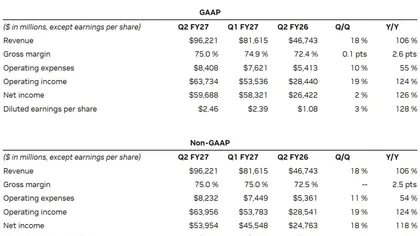
- Revenue: $96.221 billion, +106% YoY, +18% QoQ; highest YoY growth rate since FY2025 Q2.
- Prior Q2 revenue guidance midpoint was $91.0 billion; actual result exceeded that by about $5.2 billion.
- Non-GAAP net income: $53.954 billion, +118% YoY, +18% QoQ.
- Non-GAAP EPS: $2.22 vs. $2.09 expected.
- Non-GAAP operating income: $63.956 billion, +124% YoY, above the $61.19 billion analyst estimate; operating margin about 66%.
- GAAP net income: $59.688 billion, +126% YoY.
- GAAP EPS: $2.46. GAAP exceeded non-GAAP mainly because the quarter included about $7.77 billion of net gains on equity securities (official figure $7.771 billion), which are excluded from non-GAAP profit.
- GAAP and non-GAAP gross margins were both 75.0%, roughly in line with expectations; up about 2.6 and 2.5 percentage points YoY respectively, and essentially flat QoQ.
- Non-GAAP operating expenses: $8.232 billion, below the $8.32 billion estimate.
- GAAP operating expenses: $8.408 billion, +55% YoY, +10% QoQ.
- Operating cash flow for the quarter: $24.077 billion. Working-capital use rose: accounts receivable increased $22.346 billion, inventory $5.784 billion, and prepaid and other assets $5.497 billion.
- About $26 billion was returned to shareholders in the quarter (buybacks and dividends). Next-quarter cash dividend is $0.25 per share; record date September 10, 2026; payment date October 1, 2026.
| Revenue | $96.221B | $81.615B | $46.743B | +18% | +106% |
| GAAP gross margin | 75.0% | 74.9% | 72.4% | +0.1 ppt | +2.6 ppt |
| Non-GAAP gross margin | 75.0% | 75.0% | 72.5% | Flat | +2.5 ppt |
| GAAP operating income | $63.734B | $53.536B | $28.440B | +19% | +124% |
| Non-GAAP operating income | $63.956B | $53.783B | $28.541B | +19% | +124% |
| GAAP net income | $59.688B | $58.321B | $26.422B | +2% | +126% |
| Non-GAAP net income | $53.954B | $45.548B | $24.763B | +18% | +118% |
| GAAP diluted EPS | $2.46 | $2.39 | $1.08 | +3% | +128% |
| Non-GAAP diluted EPS | $2.22 | $1.87 | $1.01 | +19% | +120% |
2. Data center performance
- Data center revenue: $89.0 billion (official $89.023 billion), +117% YoY, +18% QoQ, above analyst estimates of roughly $85.8–85.9 billion by nearly 4%.
- About 92.5% of total company revenue; the business remains tightly tied to the global AI infrastructure buildout.
- Growth was driven mainly by the Blackwell Ultra infrastructure ramp; Blackwell still accounted for the majority of system shipments.
- Hyperscale revenue: $48.71 billion, +102% YoY, +13% QoQ, above the $43.55 billion estimate.
- Compute & Networking: $88.3 billion, above the $84.69 billion estimate.
- ACIE (AI cloud, industrial and enterprise): $40.31 billion, +138% YoY, +25% QoQ, but below the $41.96 billion market estimate. Official explanation: growth came from AI-native customers, enterprises, sovereign customers, and hyperscalers using AI cloud.
- Data center Hopper product shipments to China were less than 1% of data center revenue in the quarter.
- CEO Jensen Huang: “AI has reached an inflection point. It is doing useful work. Tokens are becoming productive and profitable. Compute is now revenue.”
- A year ago, buildout was driven mainly by one AI lab. Today multiple frontier labs are expanding in parallel, the open-source model ecosystem is thriving, and physical AI is starting to go live.
- The Vera Rubin platform has entered full-scale production. Racks are already running at partners including CoreWeave, Google Cloud, Microsoft Azure, Oracle Cloud Infrastructure, and Nebius. Management expects Rubin to account for about 20% of Q3 data center revenue.
3. Other segments
- Edge Computing revenue: $7.2 billion (official $7.198 billion), +27% YoY, +13% QoQ, above the $6.61 billion estimate. Covers RTX, Windows on-device AI, robotics, autonomous driving, and is core to the “physical AI” narrative, but remains far smaller than data center.
- By reported segment: Compute & Networking $88.299 billion; Graphics $7.922 billion.
- Structurally, NVIDIA remains highly dependent on data center in the near term. Edge/graphics is growing but is not yet large enough to change the revenue mix.
| Data Center | $89.023B | $75.246B | $41.096B | +18% | +117% |
| of which: Hyperscale | $48.710B | $43.050B | $24.168B | +13% | +102% |
| of which: ACIE | $40.313B | $32.196B | $16.928B | +25% | +138% |
| Edge Computing | $7.198B | $6.369B | $5.647B | +13% | +27% |
| Total | $96.221B | $81.615B | $46.743B | +18% | +106% |
Note: The company changed market-platform reporting in FY2027 Q1 and restated comparative periods. In Q2 it also reclassified one customer from ACIE to Hyperscale and restated prior periods.
4. Supply, purchase commitments, and “AI factory” expansion
- Management stressed that demand is still accelerating, but supply is the bottleneck. CFO Colette Kress said demand continues to accelerate at current scale and customer forecasts point to a doubling of growth next year, but the company is “supply constrained.” Huang said true demand is well above 70%; if supply were unconstrained, growth would be higher. The broader supply chain is tight, with shortages in memory and other critical components.
- Purchase commitments to suppliers rose to $279 billion from $119 billion last quarter, driven mainly by memory purchases.
- 10-Q disclosure: supply and capacity commitments of about $279 billion; total future commitments across supply, cloud, data centers, equity investments, and capex of about $366 billion, plus about $36 billion of AI-cloud-related commitments.
- On the call: the top five hyperscalers’ capex is expected to approach $800 billion in 2026 and about $1.3 trillion in 2027; cloud-industry backlog already exceeds $2 trillion.
- NVIDIA is shifting from selling individual GPUs to system-level delivery of full racks, networking, CPUs, software, and deployment solutions. Rubin is not a single chip; it is an “AI factory” architecture that includes Vera CPU, Rubin GPU, Spectrum-6 networking, BlueField, security, storage, software toolchain, and the DSX platform.
- The company is trying to address bottlenecks in power, land, data-center shells, networking, cooling, and long-term financing at the same time. It has formed strategic partnerships with Apollo, BlackRock, Blackstone, Brookfield, Goldman Sachs, and KKR, aiming to mobilize more than $500 billion of third-party capital for AI infrastructure. It has also locked land, power, and building-shell capacity with SB Energy at the Ohio PORTS-Pike campus.
- Responding to “circular financing” questions, Kress said frontier labs such as OpenAI “will become the largest technology companies in history,” face a compute-access bottleneck, and that NVIDIA is providing capital support. “We understand the scale of this support… the capital we put in will generate excellent equity returns.”
| Supplier commitments | $279B | Sharp rise from $119B last quarter, mainly memory purchases |
| Total future commitments (supply / cloud / data center / equity / capex, etc.) | ~$366B | 10-Q basis |
| Separately listed AI-cloud-related commitments | ~$36B | 10-Q basis |
| Targeted third-party AI infrastructure capital | >$500B | Call / media basis; not company on-balance-sheet capex guidance |
The original material did not include an item-by-item capex comparison versus AMD, Broadcom, or other chip peers, so no such peer figures are invented here.
5. Next-quarter guidance and FY2028 outlook
FY2027 Q3 guidance:
- Revenue $108.0 billion ±2%, or about $105.8–110.2 billion; YoY growth about 85.6%–93.3%, midpoint about 89.5%.
- Above Street consensus (Futu source cited ~$105.15 billion; other compilations roughly $104–105 billion). Even the low end of the range would put the company in the $100 billion-per-quarter club.
- Guidance explicitly “does not assume any data center compute revenue from China.”
- GAAP and non-GAAP gross margin midpoint both 74.0% ±50 bps, below the ~75% analyst expectation.
- GAAP opex about $9.2 billion; non-GAAP about $9.0 billion.
- Full-year FY2027 GAAP and non-GAAP tax rate expected at 16.0%–18.0% (excluding discrete items and major tax-law changes).
- Sequentially, the $108.0 billion midpoint is up about 12% from Q2’s $96.2 billion, slower than Q2’s 18% sequential growth.
- Management said Q3 sequential growth will be driven mainly by ACIE within data center; hyperscale growth is expected to re-accelerate in Q4 and FY2028 as Vera Rubin supply ramps.
Longer-term profit and growth path:
- Gross margin is expected to bottom around 71%–72% in Q4 and stabilize around 72%–73% in FY2028. The company plans to implement price increases starting in the first quarter of the next fiscal year.
- FY2028 revenue is expected to grow about 70%, well above the roughly 45% analyst expectation. This is a supply-constrained outlook; the supply bottleneck is expected to last at least through the end of FY2028.
- Expanded AWS partnership: on top of the existing plan for about 1 million GPUs, an additional 2 million GPUs will be deployed in 2027–2028 (covering Blackwell Ultra, Rubin, and Rubin Ultra), along with Vera CPUs (some integrated with Rubin, some standalone).
| Q3 revenue | $108.0B ±2% | ~$104.0–105.15B | About 3%–4% above consensus, but short of the most optimistic ~$112B |
| Q3 gross margin | 74.0% ±50 bps | ~75% | Slightly below expectations |
| Q3 non-GAAP opex | ~$9.0B | — | Continues to rise from Q2’s $8.232B |
| China data center compute revenue | Not included in guidance | — | Potential upside, but not a certainty |
| FY2028 revenue growth | ~70% | ~45% | The key point that flipped sentiment after the call |
6. Market context and investor concerns
- The core issue was not whether the quarter beat sell-side consensus, but whether it cleared the higher bar already priced in by buyers. Shares had already risen more than 10% in the month before the report; the market was trading the size of the beat.
- The initial after-hours drop of about 4% was triggered by Q3 gross-margin guidance coming in slightly light; revenue guidance beating consensus but not the most bullish range; and China data center compute being excluded from guidance, so any recovery could not be treated as a locked-in upward revision.
- The stock turned up nearly 5% after the call, driven by the ~70% FY2028 growth guide, the additional 2 million GPUs for AWS, and management’s emphasis that demand is still accelerating and AI has reached a “compute is revenue” inflection.
- Structural concern: the beat this quarter was driven mainly by hyperscale customers. ACIE came in below expectations, suggesting enterprise, industrial, and some AI-cloud expansion is slower than previously hoped.
- Margin pressure comes from early Rubin production costs and yields, rising supply-chain costs for HBM / advanced packaging / substrates, and a richer mix of full-rack system deliveries.
- The balance sheet is expanding quickly: total assets rose from $206.8 billion on January 25, 2026 to $320.3 billion on July 26, 2026. Accounts receivable stood at $63.059 billion and inventory at $31.575 billion; higher working-capital use is already showing up in free cash flow.
- Ecosystem investments versus the core business remain in focus: nearly $7.8 billion of net equity-securities gains boosted GAAP profit this quarter, while capital support for labs and the ecosystem has been labeled “circular financing” by some in the market. Management denied that characterization and stressed equity returns.
- China remains uncertain: China Hopper shipments were under 1% of data center revenue this quarter, and forward guidance fully excludes China data center compute revenue.
- Capital return did not include a more aggressive commitment beyond existing authorizations. The company said it will increase return of excess free cash flow after strategic uses.
Stock Limited-time Offer:August new user gift: Buy U.S. stocks and get free NVIDIA stock.Trade Now for Better Deals
New to stock spot trading? These videos will get you up to speed:
"Understanding Bitget Spot Stock Trading"
"Spot Stock vs. Stock Perps vs. Traditional U.S. Stocks: Pros, Cons, Ownership & Leverage"
"How to Pick the Right Stock Tokens & ETFs on UEX? 2 Key Metrics to Help You Avoid Costly Mistakes"
Disclaimer
This article is for reference only and does not constitute investment advice. All figures are compiled from the source material provided and from contemporaneous official earnings / earnings-call disclosures. It does not constitute a forecast of future results or share price.
Disclaimer: The content of this article solely reflects the author's opinion and does not represent the platform in any capacity. This article is not intended to serve as a reference for making investment decisions.
You may also like
Trump signs executive order banning foreign power grid equipment, boosting policy support for domestic U.S. electric equipment manufacturers
Trump signs executive order banning certain foreign energy devices from connecting to the U.S. power grid.

Crypto prices
More


