
Breaking Yield Constraints: The Market Truth Behind Gold's Independent Trend

Fxstreet News, August 24—— Despite the US dollar remaining strong and real yields staying elevated, gold continues to attract buying interest, showing that traditional correlations have failed. Silver’s underperformance relative to gold sends a warning: this rally is driven by safe-haven demand, not a reflation trade.
At the opening of the spot gold market this week, a familiar set of contradictions emerged: spot gold traded at $4,643.26 per ounce, up 0.85%; but the US Dollar Index did not weaken, and US real yields remained high. In most of the past two years, such a combination would have been a sell signal; now, it is only a secondary factor. The market is no longer relying on the traditional logic for gold trading, but is instead operating under a new regime—gold buying has decoupled from traditional macro drivers.
Let’s clarify the current market environment. USD/JPY sits at 159.195, a level which, historically, prompts Japanese investors to reduce their yen-hedged gold exposure, thus dragging down gold prices. EUR/USD has fallen to 1.1663, while USD/CHF has strengthened to 0.8025. The dollar has not collapsed, yet gold continues to rise. The current rally is driven by physical gold demand and ETF inflows, not mere speculative trading.
The classic trading model holds that gold is negatively correlated to the yield of US 10-year Treasury Inflation-Protected Securities (TIPS). Since Q2 this year, this model has gradually broken down. Even as real yields linger at multi-decade highs, gold prices have not experienced significant declines. The core reason is that the internal composition of real yields matters much more than their absolute value.
If rising real yields are caused by stronger expectations of nominal economic growth, gold usually comes under pressure; but if rising real yields are the result of a sharp decline in inflation breakeven expectations, gold can hold steady or even rise—because the market is then pricing in a deflationary shock, and central banks are likely to launch large-scale easing measures.
The current market falls into the latter scenario. Recent oil price action illustrates this point: West Texas Intermediate (WTI) crude is down 1.88% at $85.42/barrel, while Brent crude is at $93.23/barrel. The inflationary pressures from the energy sector are dissipating, inflation breakeven expectations are falling, but this also increases the likelihood of central banks turning dovish. Gold is positioning ahead of a policy pivot, rather than fighting against the current high real yield environment.
Dollar Divergence: Seemingly Strong, but Structurally Uneven
The resilience of the dollar is the key detail most likely to be overlooked in this rally. Asian currencies have not collectively collapsed, which means that dollar strength is concentrated against the euro and yen, not the entire market. This is critical: if the dollar were universally strong, gold would inevitably be pressured; but this localized strength, stemming from weak European and Japanese economies, does not stifle gold’s upside.
Silver is an unavoidable factor in the current market. Silver is quoted at $68.831 per ounce, down 0.20%, significantly underperforming gold; the gold-silver ratio has climbed above 67, entering a historically high range.
In a healthy bull market for precious metals, silver should outperform gold—but that is not happening now. The divergence between the two indicates that current gold buying is defensive, driven by safe-haven demand rather than an inflation-fueled reflation trade. In a broad-based metals bull market, silver would lead the rally. The movement of funds from silver into gold now constitutes a risk-off signal within the precious metals sector.
The current gold rally is not being driven by short-covering, but by structural capital inflows. This means the upward trend in gold prices is more persistent, but until silver catches up, gold’s upside will be limited.
Three Scenario Analysis
Scenario 1 (Bullish Baseline): Gold consolidates above $4,600 for 48 hours, with weaker-than-expected US economic data subsequently pushing gold through $4,640, targeting $4,680; stop-loss is set at a daily close below $4,570.
Scenario 2 (Bearish Case): USD/JPY surges through 160, triggering Japanese investors to sell gold; gold falls back to $4,570, and if silver also drops below $68, gold may further test $4,520.
Scenario 3 (Neutral Baseline): Over the next week, gold fluctuates within the $4,570–$4,640 range, gradually rising as the dollar’s structural strength fades.
Prices of physical gold and tokenized gold remain aligned, with no obvious premium distortions, confirming genuine buy-side support for gold. This is a steady accumulation phase, not a speculative, bubble-driven rally.
The rise of USD/CAD to 1.3842 is noteworthy. Usually, a weaker Canadian dollar indicates general pressure on commodities, but gold is unaffected. This further shows that the current rally in gold is not a commodities trade, but a currency hedging play. Investors are buying gold out of distrust in central bank policy responses amid a global economic slowdown, not because of bullishness on raw materials.
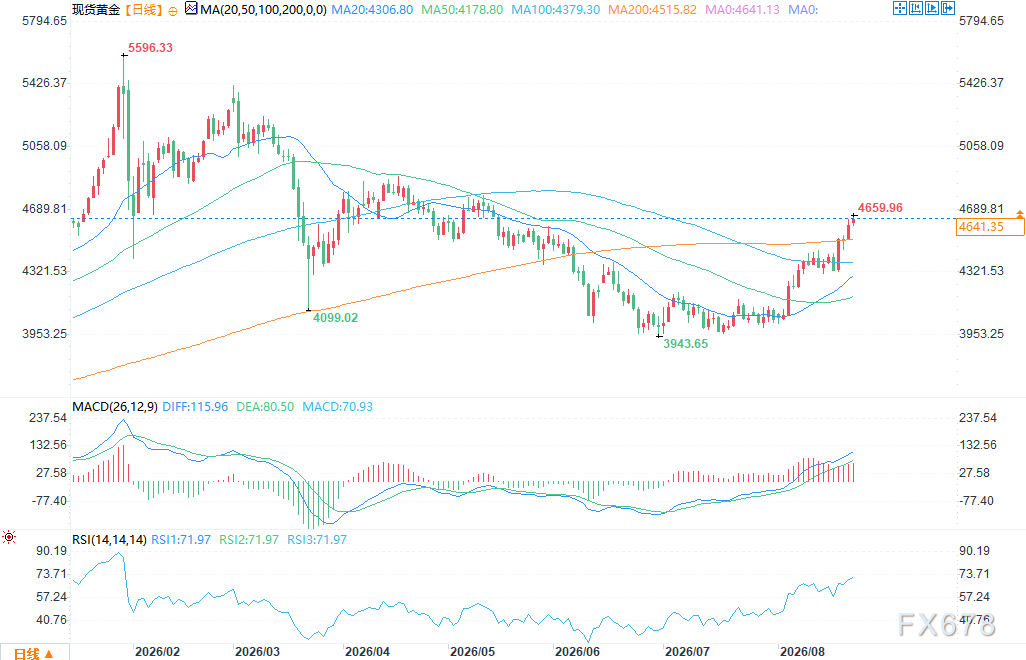
(Spot Gold Daily Chart Source: Fxstreet)
Gold is carving out an independent trend. The traditional correlation between real yields and gold prices has been broken; the dollar’s strength is localized and structural; silver is lagging. All these suggest that buying in gold is mainly defensive and safe-haven oriented. This pattern will continue until the Federal Reserve signals a clear pivot or the dollar undergoes a broad-based decline.
The main tail risk at this stage is if USD/JPY suddenly breaks above 160, which would trigger a concentrated sell-off of yen-denominated gold holdings. Excluding this risk, gold faces less resistance to further upside.
Disclaimer: The content of this article solely reflects the author's opinion and does not represent the platform in any capacity. This article is not intended to serve as a reference for making investment decisions.
You may also like
When will the long-term bond turmoil end, and how much is AI really worth?
Another mining company prepares to transform into an AI computing power factory! BTC Digital (BTCT.US) surges about 60% pre-market as the 10 MW computing power project approaches countdown to realization.
BTC Digital, a digital computing power infrastructure company, announced in a pre-market statement on Monday that its cryptocurrency computing power infrastructure project in Georgia has been completed and is now approaching a "deployment-ready" status. This news drove the company's stock price to soar nearly 60% during Monday's pre-market trading.

Ripple Price Today: XRP Stalls at $1.48 as RSI Hits Overbought 80.48

Can Cardano price hold its rally as whales dump 100M ADA?

Crypto prices
More


