
Anthropic's billion-dollar entry ticket


👆Click the blue text to follow us
Anthropic
According to Bloomberg, Anthropic has set its credit line at around $10 billion, but the total commitments submitted by banks may exceed this amount. Negotiations are still ongoing, and Anthropic has declined to comment.
A revolving credit facility can be understood as a corporate credit card: the bank first commits funds for lending, the company can draw on the funds when needed, and repayment is due by a specified deadline. It does not require collateral and is entirely based on the company’s credit, short-term debt repayment ability, and cash flow levels.
However, for a mega-unicorn company preparing to go public, the situation could be more complex. For the banks, whether the company can repay on time is just one factor—perhaps more importantly, can the bank participate in future capital operations?
In syndicated loans, the higher the committed amount, the higher the fees banks typically earn, and the more involved they become in future capital operations, including IPOs, refinancing, and M&A activities, each bringing considerable returns. This explains why banks are eager to put up funds; the higher the credit extended, the more likely the bank secures a key future role.
Bloomberg further noted that SpaceX provided a reference point. In May of this year, SpaceX raised its revolving credit line from $1.5 billion to $5 billion, and just a month later completed a record-breaking IPO. The roster of banks for the loan and IPO underwriting were largely the same. This case naturally fuels competition among banks for the Anthropic project.
Of course, aside from IPO competition, Anthropic itself is showing high-quality growth. Bloomberg said the company's annualized revenue (ARR) surpassed $6.5 billion as of the end of July. Preliminary revenue for the most recent full quarter was over $1.15 billion, up from only $787 million in the same period last year—a nearly 14-fold year-over-year growth rate, with adjusted operating profit turning positive during the same quarter.
Bloomberg believes that with Anthropic’s accelerating revenue and improving profit metrics—and as it actively engages with investors—these factors together have boosted the banks’ credit commitments and implied an accelerated IPO timeline for Anthropic.
Jason believes this wave of tactics from major banks is normal, and it’s something top asset managers and private equity firms cannot do, as they’re unable to provide all-in-one services to clients. Following SpaceX’s path, if Anthropic goes public in September or October, Goldman Sachs and Morgan Stanley may once again be in high demand.
However, I’m more interested in Anthropic’s financials. I’ve listed its ARR, the corresponding dates, and sequential growth rates. Some of these are from official statements, some from media leaks, but overall they’re fairly reliable.
From the chart, you can see that from the beginning of the year to mid-May, the ARR growth rate was very strong, exceeding 50% at almost every data point. But at the latest data point—$6.5 billion by end-July, as reported by Bloomberg today—the ARR growth slowed to 38%. Note that the time intervals differ at each data point; if normalized to a 30-day compound growth rate, the compounded ARR growth by the end of July was only 13%, the lowest this year. This is far below the explosive boom seen in February for AI agents, or the frenzy in semiconductor storage in April and May. It seems AI demand persists, but growth is slowing.
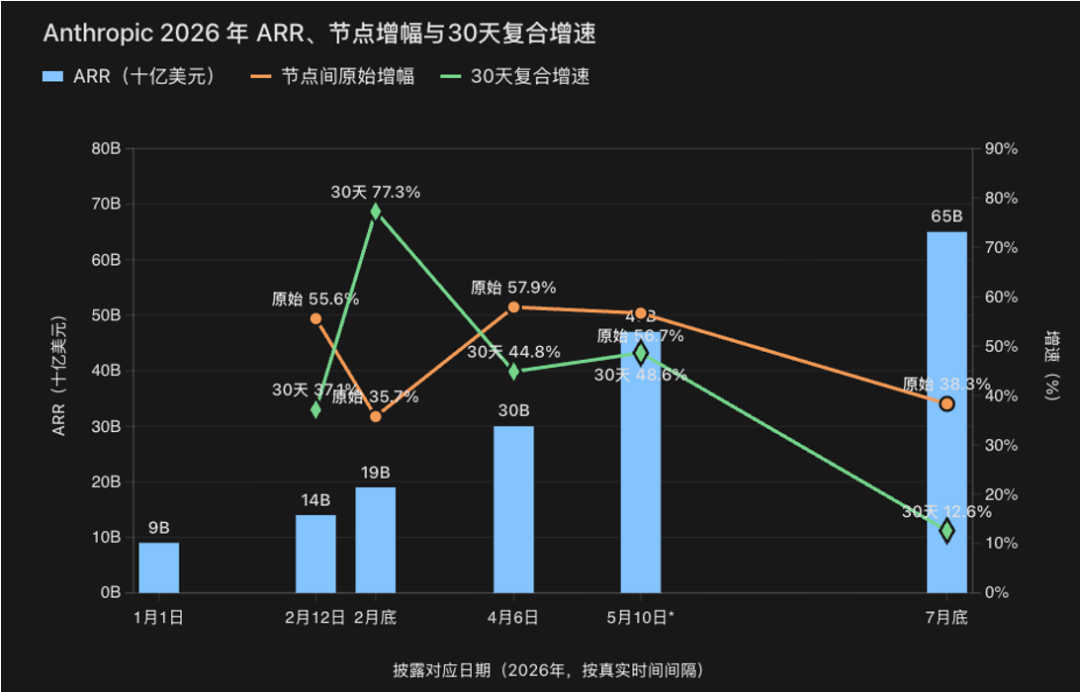
However, from my past professional experience, this slowdown may be intentional. Companies do a lot of preparation ahead of an IPO, one of which is performance management within the regulatory framework. This means slowing performance growth as much as possible before the IPO and then ramping up performance right before the IPO prospectus goes public, updating and supplementing the prospectus, so that high growth from a low base captures the favor of the primary and secondary markets, conveying the impression that growth is just beginning with no end in sight.
In addition, this time Anthropic also reported turning adjusted operating profit positive. I don't know what specific items were adjusted or if R&D expenses were cut too aggressively, but as long as it’s not due to any special changes, at least it shows Anthropic has transitioned from AI monetization to AI profitability. I believe this shift is very positive for the long-term sustainability of AI investments. Furthermore, the banks extending billion-dollar credit lines also testify to Anthropic’s positive operating profit and short-term debt repayment ability.



Disclaimer: The content of this article solely reflects the author's opinion and does not represent the platform in any capacity. This article is not intended to serve as a reference for making investment decisions.
You may also like
Soros’ eldest son aggressively bought memory chips and AI computing power in Q2! Korean stock market ETF immediately became top holding; TSMC position surged
Soros Capital Management has significantly increased its exposure to AI computing power allocation, particularly by boosting its holdings in TSMC by more than 1,000% to 78,430 shares, valued at approximately $37.46 million.

The Xiaomi AI Overlooked by the Market
Barclays' latest report points out that the market has "severely underestimated" Xiaomi's AI strategy—a differentiated AI matrix is quietly being built across its hardware ecosystem, spanning smartphones, home appliances, and automobiles, yet this strategic value is almost entirely unreflected in the current share price. Although Q2 revenue came under pressure, electric vehicle deliveries exceeded expectations and the average selling price of smartphones hit a historic high. The "Overweight" rating is maintained, with a target price of $30, implying an 82% upside from the current level.
GoPlus Security crypto holds bullish daily trend despite oversold RSI dip
Crypto prices
More


