
Nvidia CPO switches enter full-scale production, AI data centers usher in the "silicon photonics era"!

Nvidia has announced that its Spectrum-X Ethernet photonic switch has officially entered full-scale mass production, marking a critical turning point for AI data center network architecture.
The core product of this mass production deeply integrates co-packaged optics (CPO) technology with switch chips, fundamentally changing the signal conversion method of traditional pluggable optical modules. According to Nvidia, compared to traditional pluggable optical networks, the new architecture delivers a 5x improvement in network power efficiency, 5x longer uninterrupted runtime for AI applications, and a 10x increase in mean time between failures. This leap in performance provides direct cost and reliability benefits to cloud computing vendors and AI infrastructure operators who are rapidly expanding their GPU clusters.
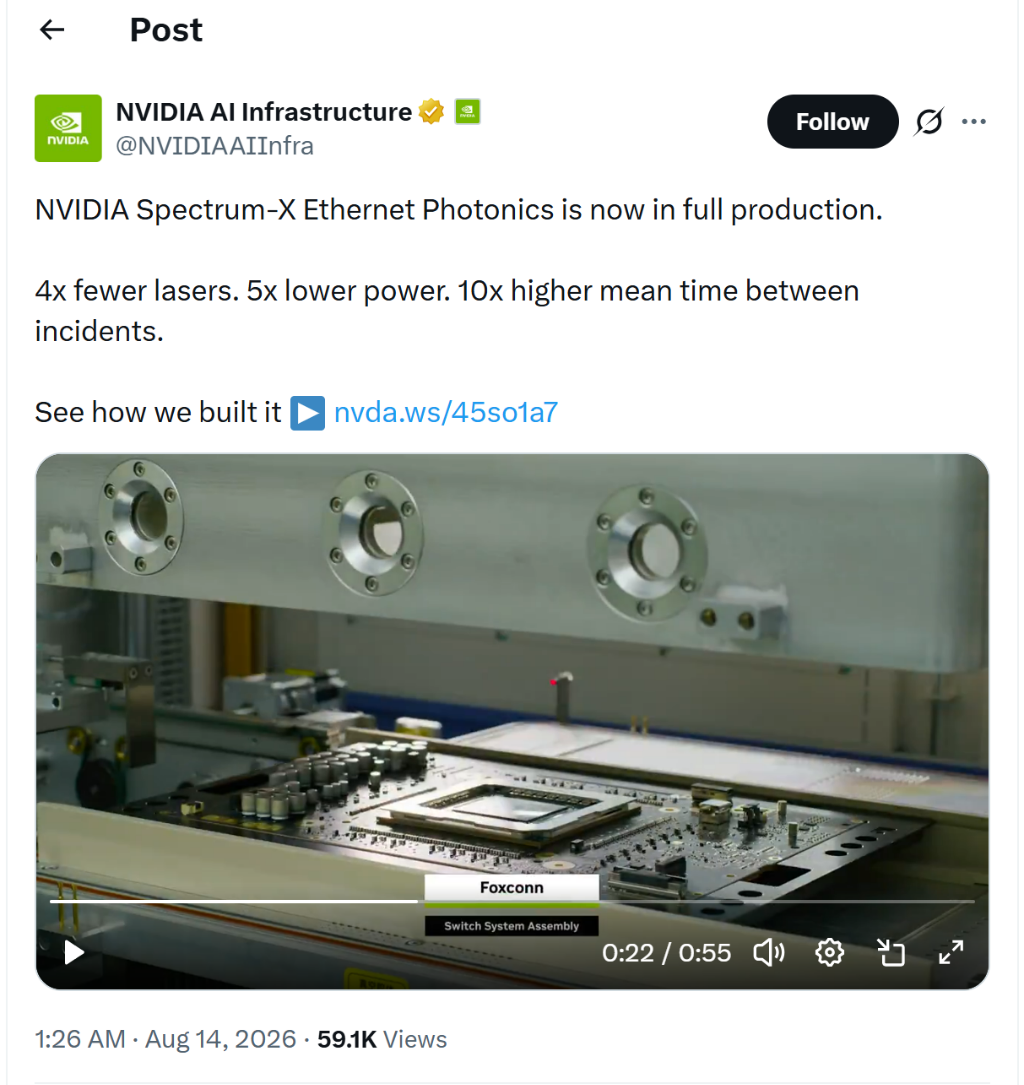
The mass production involves a supply chain spanning multiple top-tier vendors: TSMC is responsible for silicon photonic chip manufacturing, SPIL handles chip-level packaging and testing, Lumentum and TFC supply laser components, while Foxconn is responsible for the R&D and assembly of the overall switch system. Nvidia conducts the final testing of the finished switches before shipment. This supply chain structure indicates that photonic integration technology is permeating the core of AI hardware, and relevant supply chain enterprises are likely to benefit from expanding demand.
CPO Architecture Reconstructs Network Energy Efficiency Logic
Traditional data center networks rely on installing independent optical modules on each switch panel to complete the conversion between electrical and optical signals. Although mature, this method has inherent drawbacks such as high power consumption, significant heat dissipation pressure, and multiple points of failure—problems that are exponentially magnified in AI training clusters with thousands of GPUs communicating concurrently.
The Nvidia Spectrum-X Ethernet photonic solution packages the optical engine and the switch chip within the same multi-chip module, with signal conversion occurring adjacent to the switching ASIC, significantly shortening the electrical path and thus reducing signal attenuation and energy loss. The external laser module adopts a centralized light delivery design, supplying optical signals to all optical engines; this reduces the number of lasers required by 75% compared to traditional solutions, further lowering power consumption and heat output.
This system achieves extremely high port density within liquid-cooled chassis. The 2U SN6810 chassis can accommodate 128 800 Gb/s ports, for a total bandwidth of 102.4 Tb/s; the 5U SN6800 version integrates four switching ASICs, providing 512 800 Gb/s ports or over two thousand 200 Gb/s ports, with an aggregate bandwidth of 409.6 Tb/s. Larger chassis have built-in optical interconnect modules, supporting horizontal scaling without adding extra switching layers, effectively controlling network latency.
Manufacturing Process Breakthroughs Support Scalable Implementation
CPO technology has long faced bottlenecks in mass production due to complex manufacturing processes and low yield rates. Nvidia's achievement of full-scale mass production relies on systematic reengineering of assembly procedures.
The optical engine is soldered directly onto the module substrate, a process compatible with existing standardized production lines and capable of reducing manufacturing complexity. The top-mounted fiber optic connector design further enhances assembly precision and yield. The supply chain pattern of multi-vendor collaboration integrates the expertise of each segment—silicon photonics manufacturing, packaging and testing, laser supply, and system integration—providing an engineering foundation for large-scale shipment.
The Spectrum-X Platform Builds Global AI Networks
The CPO switch is just one hardware component of the Spectrum-X platform, which also features systematic software and architectural designs tailored for AI workloads.
The platform incorporates adaptive routing, congestion control, and end-to-end telemetry capabilities to maintain stable traffic in workloads with thousands of GPUs communicating simultaneously. The multi-plane network architecture distributes connectivity across multiple independent planes, preventing single points of failure from interrupting the entire operation. Nvidia has further launched Spectrum-XGS, extending the same network architecture to entire buildings or campuses, supporting integration of multiple data centers into a single collaborative system.
According to Nvidia, compared to traditional Ethernet, the Spectrum-X platform can boost AI network speeds by 1.6 times while maintaining compatibility with mainstream open tools like SONiC, thus reducing user migration and maintenance costs.
Disclaimer: The content of this article solely reflects the author's opinion and does not represent the platform in any capacity. This article is not intended to serve as a reference for making investment decisions.
You may also like
3 Altcoins With Major Catalysts and Risks to Watch in 2026

Pump.fun ranks third in 7-day revenue among all protocols, trailing only Tether and Circle
Walmart Inc. stock stalls at $116 resistance ahead of Aug. 20 earnings
Overseas "Seeing the Light," DiDi Finally Welcomes Its "Day of Emergence"
Crypto prices
More


