
Overseas "Seeing the Light," DiDi Finally Welcomes Its "Day of Emergence"


Leading ride-hailing company $Didi Chuxing (DIDIY.US) released its Q2 2026 financial report on the evening of August 13. Overall, the results were strong, with both GTV and adjusted profits exceeding Bloomberg's expectations.
In terms of trends, domestic business grew steadily, though slightly slower, with overall margins remaining stable;the highlight is that overseas business continues to accelerate in growth while its absolute loss has peaked. The company has even shared a timeline for reaching profitability in overseas markets in private discussions.
In other words, after some time of “floor price friction”, Didi’s re-rating is finally coming!
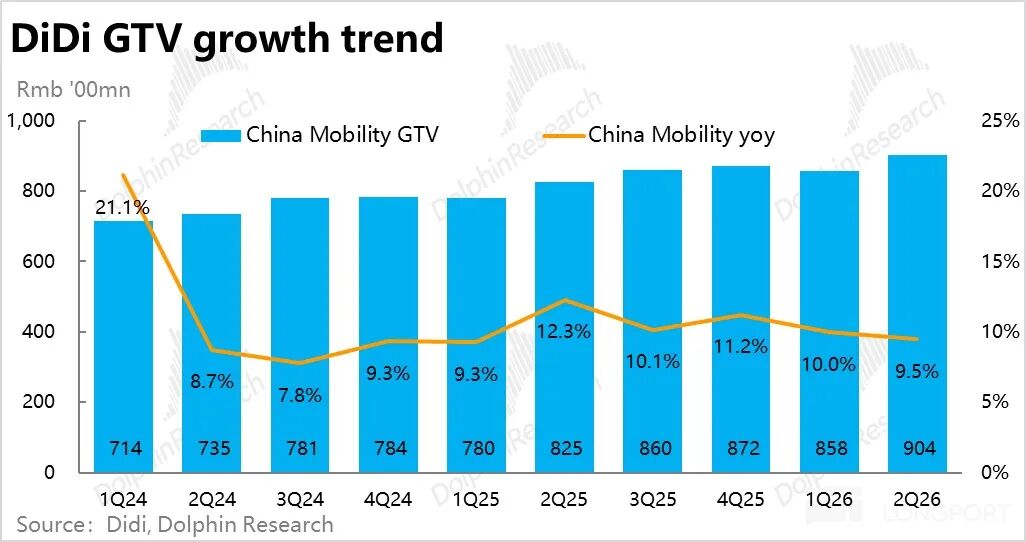
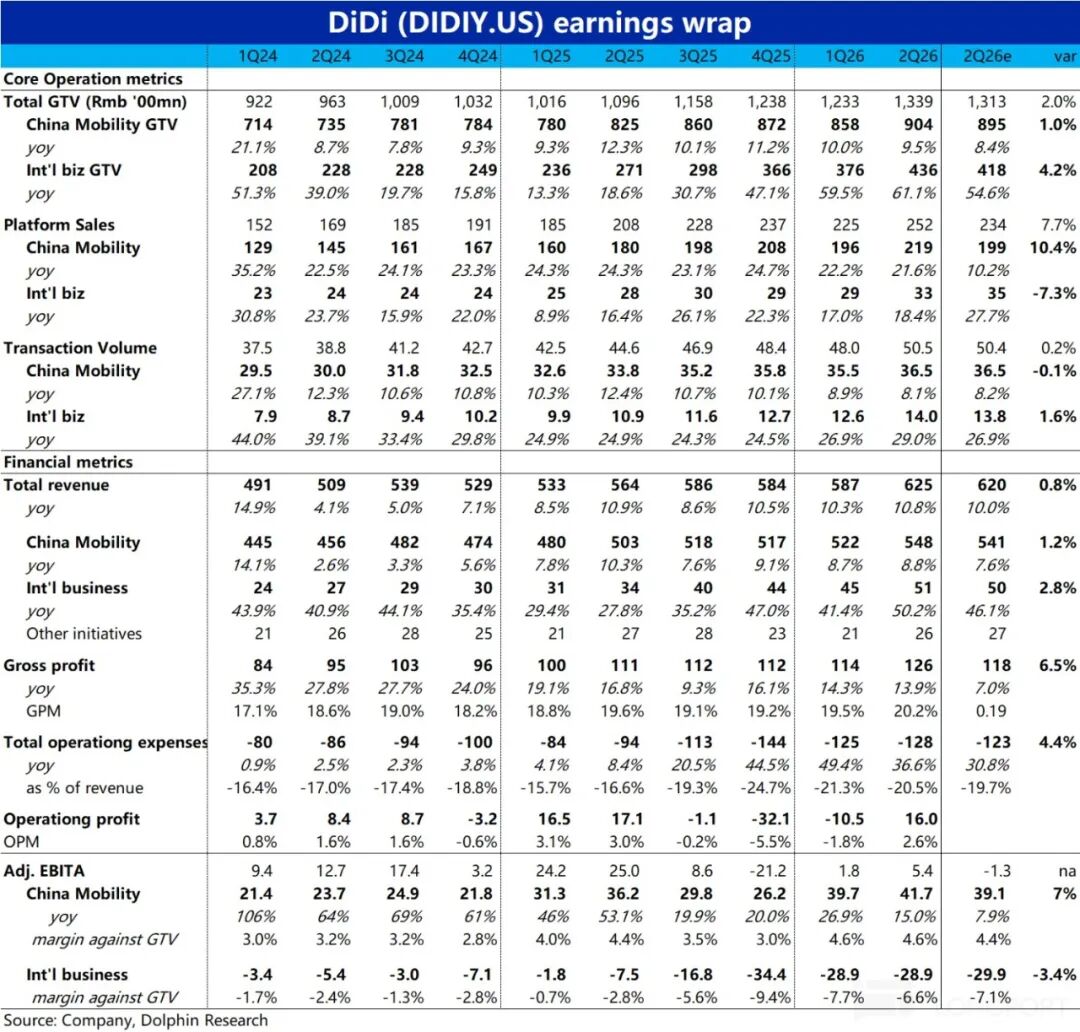
1. Domestic market is mature: This quarter,Didi’s domestic GTV was RMB 90.4 billion, an increase of 9.5% year-on-year. Compared to last quarter, growth was largely stable, with only a slight deceleration, and came in slightly above Bloomberg’s expected 8.4%.
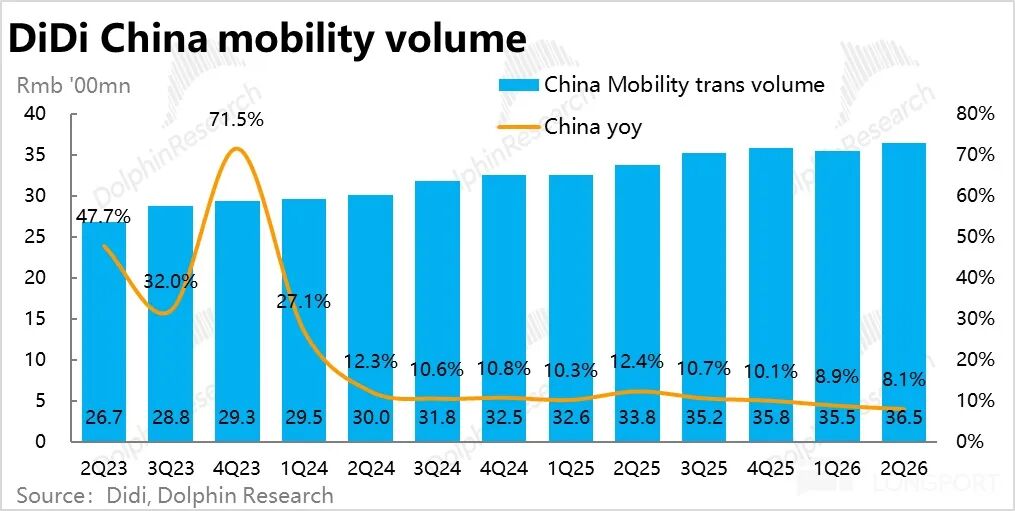
Breaking it down between price and volume,domestic trip orders rose by 8.1% year-on-year,again a small slowdown quarter-on-quarter, which means the remaining ~1.4% growth was driven by increases in average order price.
Overall,the domestic business is stable and at the “mature late stage” where a high base means growth is slowing but holding steady.
2. Domestic net monetization rate is stable: This quarter,domestic ride-hailing revenue (GTV minus taxes and passenger subsidies)was about RMB 54.8 billion, up 8.8% year-on-year, a 0.1pct increase quarter-on-quarter. The gap with GTV growth narrowed, too.
As for thedomestic platform sales (GTV minus driver commissions and taxes, etc.)year-on-year increase was 21.6%,which is in line with GTV trends. Growth slowed slightly (-0.6pct), but the absolute pace remains notably higher than GTV.
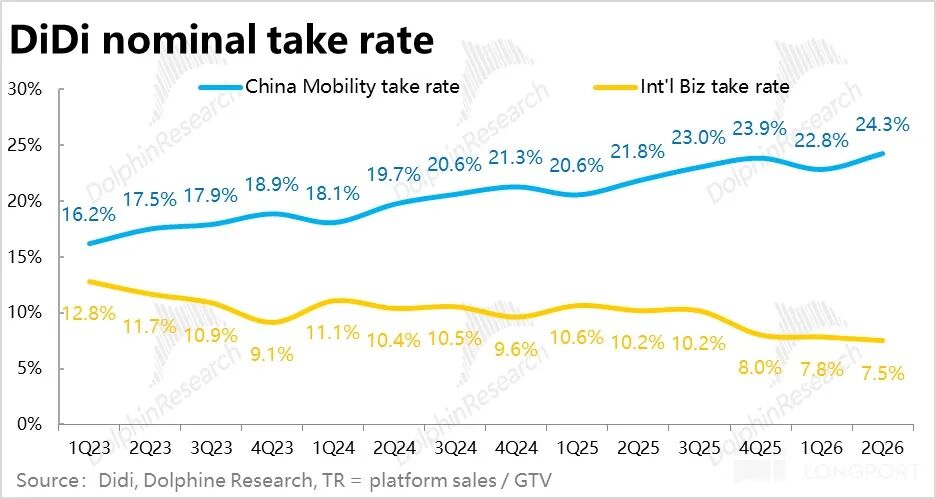
Based ondomestic platform sales/GTV, the monetization ratewas 24.3%,up by 2.4pct year-on-year, with the improvement largely stable,
This suggests thatDidi’s average driver commission rate has recently stabilized, with no significant decline from last quarter, while subsidies for consumers may have contracted slightly.
All in all,the platform’s final net monetization rate should be generally stable, which also explains why the quarter-over-quarter adj. EBITA margin is largely flat.
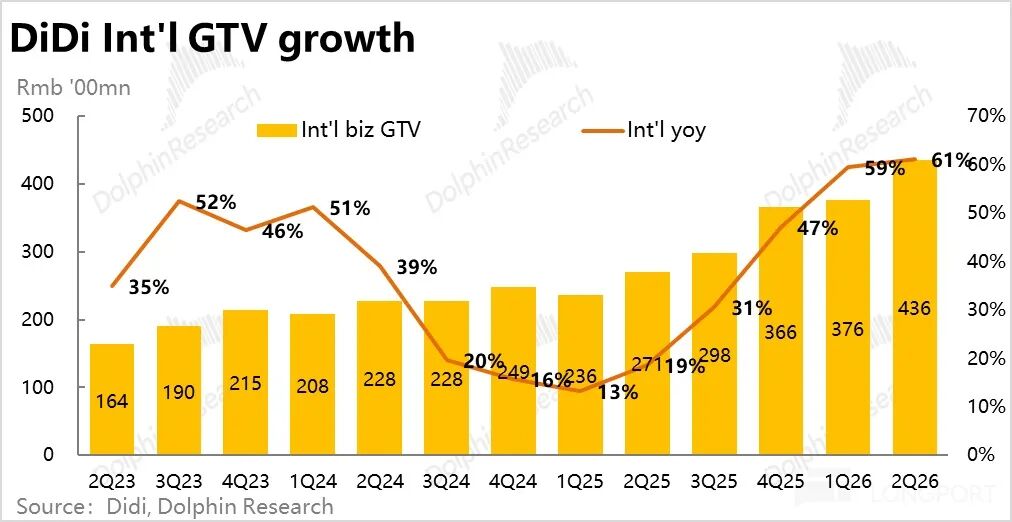
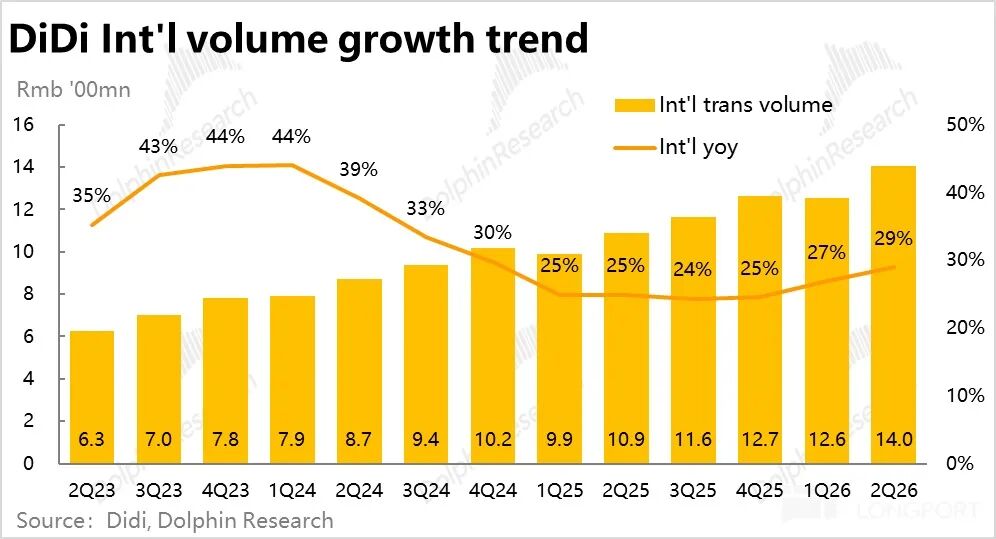
3. Overseas continues surging, scaling up volume but not yet profits: This quarter,Didi’s overseas GTVwas up 61% year-on-year,far outpacing Bloomberg’s expected 55%.
Even excluding FX gains, growth reached 53%, still 4pct faster than last quarter. Though momentum has slowed compared to the previous 11pct acceleration, overseas business remains robust given the ever-rising base.
Similarly,overseas ride order volumes rose 29% YoY, up 2pct QoQ.Average order price reached RMB 31.1, up 1.2 RMB from last quarter. Taken together, these metrics suggest Didi’s food delivery in Brazil and other markets performed very well this quarter.
However, as before, due to revenue-sharing and subsidies for partners and consumers,overseas platform retained revenue (“Platform sales”) grew just 18% year-on-year, accelerating only 1pct over last quarter, still well below GTV growth. In other words, delivery is still in the “burn money for market share” stage.
Calculated by platform sales/GTV,comprehensive overseas monetization rate is about 7.5%,and hasdeclined for three consecutive quarters.
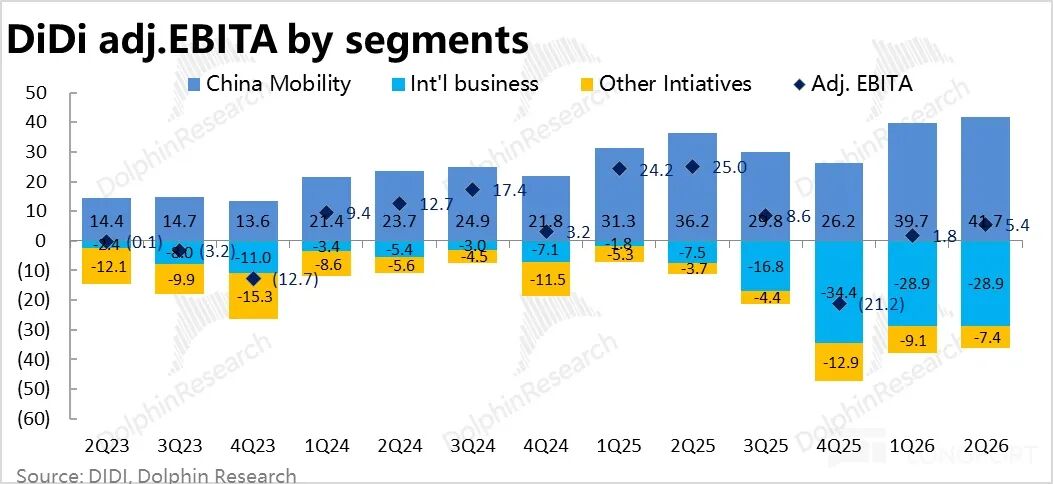
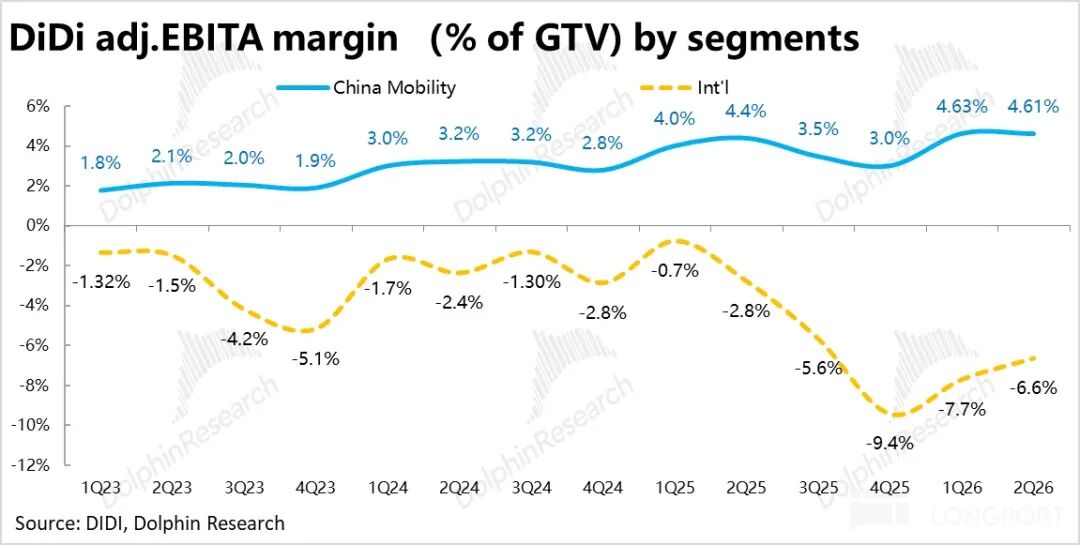
4. “Significant” profit improvement, beating expectations: On profitability, since domestic monetization was stable this quarter, as a ratio of adj. EBITA to GMV,the profit margin was 4.6%, basically flat with last quarter. Year-on-year, it’s up by about 0.2pct, profit reaching RMB 4.17 billion, up 15% YoY and beating Bloomberg’s expected RMB 3.9 billion.
Overseas business loss was RMB 2.89 billion—almost unchanged from last quarter.Business scale here still grows fast, but loss isn’t expanding. That is,loss margin is declining—down from 7.7% last quarter to 6.6%.This maysignal the peak of overseas losses has passed—a minor positive surprise.
In addition, losses from other businesses narrowed a bit this quarter—from RMB 910 million to RMB 740 million. With each segment performing better than expected, the company’s overall adj. EBITA hit RMB 540 million this quarter. While that figure is still “tiny”, compared with market expectations and last quarter’s losses, it’s a big improvement.
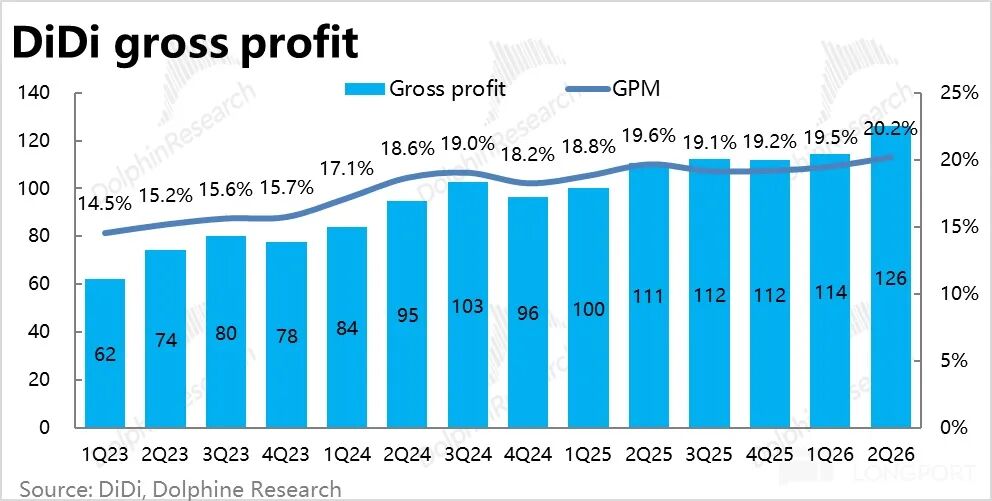
5. Gross profit under pressure, cost growth peaks: In terms of costs and expenses, Didi’s gross margin this quarter was 20.2%, up 0.5pct year-on-year, but the pace of improvement is narrowing compared with the prior two quarters (0.9pct and 0.7pct increases).This reflects the impact of overseas investment on gross margin.
However, seasonality (Q2 usually sees peak gross margins) means that quarter-on-quarter margins improved notably.
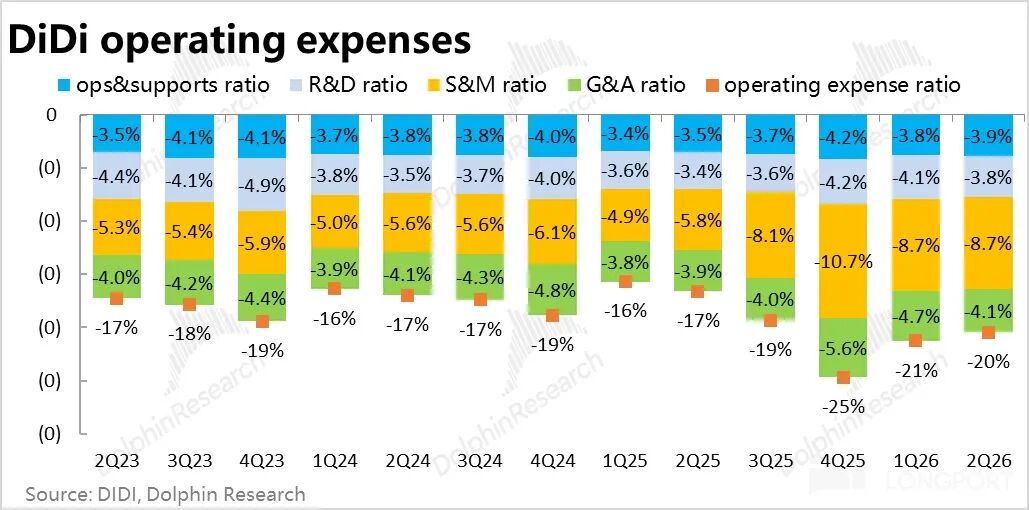
Regarding expenses, this quarter,the sum of four operating expenses rose 37% year-on-year—still high, but down from last quarter’s 49%,with growth decelerating.
Marketing was the main driver:YoY growth in marketing spend dropped from 96% to 67%, with absolute spending rising just over RMB 300 million quarter-on-quarter.Dolphin Research believes this matches the peaking overseas losses, that is,absolute overseas investment should have peaked too.
Growth of other expense items hovered around 20% YoY, just slightly slower than last quarter.
6. Shareholder returns are not impressive: According to company disclosures, from end-May to end-July this year (2 months),the company repurchased shares worth nearly $86 million, plus about $195 million bought back during the quarter, annualized at about 4% of current market cap. However,in light of the recent weak share price, shareholder returns remain low.
Of course,overseas investments require capital, and the company’s net cash inflows have been negative for several quarters, as expected.
7. Key highlights of the financial report at a glance
Dolphin Research View
To summarize, Didi’s performance this time is solid in terms of marginal changes and positive surprises. The main highlight is that while overseas and other segments are still loss-making, the “blood-generating” core—domestic business profit—remains strong. As overseas revenue continues to scale and operational/profit leverage releases more, the drag on overall group profits could shrink substantially.
The market narrative toward Didi may shift from “overseas burning through domestic profits” and valuation pressure to a segment valuation logic:
a. Domestic business—mature and a steady profit engine;
b. Even if overseas cannot succeed, its drag on profit is decreasing, and according to company profit guidance, could even fetch a valuation uplift.
Therefore, after a nearly 40% drawdown and some time at bottom,this set of results likely ushers in a period of sustained recovery.
On valuation, with overseas losses potentially peaking, the market is likely to revert from valuing Didi as a consolidated profit pool toward a SOTP approach. Specifically,
a. China's business is stable, so our forecast for 2026 full-year profit (adj. EBITA) remains at RMB 15.5 billion.
If you assign RMB 15.5 billion adj. EBITA for domestic in 2026, subtract ~RMB 2.5 billion in share-based compensation (with non-core income far above tax, so no further tax is deducted).
b. International business losses in 2026 remain stable, with the loss margin shrinking quarter by quarter as revenue grows; the target is for international mobility & finance to achieve $100 million profit in 2027 and $300 million in 2028.
Even though there’s no current profit, thus not warranting a valuation; should overseas gradually turn profitable as guided and achieve $300 million profit in 2028, a PE above 20X is reasonable. Discounting 15% back to 2026 roughly equals RMB 30 billion. In other words, there’s still a considerable certainty premium if Didi’s overseas business eventually pays off.
- END -

Article writing is not easy. Click “Share” to give me some support~
Disclaimer: The content of this article solely reflects the author's opinion and does not represent the platform in any capacity. This article is not intended to serve as a reference for making investment decisions.
You may also like
Institutional XRP Exposure Gains Ground

Crypto Investment Fundamentals Split Market: Tokens Fall 36% as Stocks Jump 23%
Bloomberg’s Mike McGlone warns Bitcoin could fall to $10,000 as tech stocks rally
3 Altcoins Set to Shine in 2026: Top Picks, Catalysts, and Market Trends

Crypto prices
More


