
Ignoring the stronger dollar, gold holds strong above $4,100—has a reversal signal appeared?

HSBC believes that the market has already priced in tightening expectations, and gold prices may rise gradually. However, geopolitical factors resulting in a surge in oil prices pose the biggest downside risk. JPMorgan points out that the resistance between $4,197 and $4,264 remains unbroken, and the medium-term bearish trend is unchanged; this round of gains appears to be a technical correction rather than a trend reversal. Medium-term resistance is near $4,500. If gold prices accelerate downward again, further support may be found around the $3,600 region.
Gold has demonstrated rare resilience, rising strongly even amid the triple headwinds of a strengthening US dollar, rising yields, and elevated oil prices. However, the latest research reports from HSBC and JP Morgan point to the same conclusion: This rally appears more like a technical correction after an oversold phase, rather than a trend reversal, and the upside remains limited.
This round of gold's price surge began during Tuesday's Asian and London trading sessions, continued into the US market, and on Wednesday in Asia, broke above the $4,100 mark, reaching as high as $4,141.11 intraday—all without any clear fundamental catalyst.

According to analysis by James Steel, HSBC's Chief Precious Metals Analyst, in a research note dated July 21, the Shanghai Gold Exchange premium has risen to $6-$8/oz, indicating a revival of domestic physical demand. A large concentrated buy order may have been the direct trigger for this rally. Meanwhile, US private sector employment data (ADP) fell for the fourth consecutive week to a net gain of 16,500 jobs, but the impact of this weak signal on gold prices is equally difficult to quantify.
HSBC also believes that the market has largely priced in expectations of monetary tightening, meaning gold prices may continue rising gradually, but geopolitical risks—especially an escalation in the Middle East and further increases in oil prices—remain the biggest threats.
JP Morgan technical strategist Jason Hunter, however, poured cold water on the rally from a chartist perspective. He pointed out that, at present, gold is merely seeking support around $4,074 (the 38.2% Fibonacci retracement from August 2022), and clusters of momentum divergence buy signals suggest the market may enter a prolonged consolidation period. Nevertheless, until the cluster of trend-line resistance between $4,197 and $4,264 is convincingly broken, the medium-term bearish pattern in gold prices remains unchanged.

An Unusual Rally Amid Triple Headwinds
The reason this gold price rally has attracted market attention is because it has occurred within an extremely unfavorable macro context. The strengthening US dollar index, rising US Treasury yields, and elevated oil prices—these three factors have historically been core variables suppressing gold, yet gold prices have risen against all three simultaneous pressures.
HSBC's James Steel interprets this phenomenon as a signal of potential endogenous strength. In his report, he writes, After consolidating around $4,000 for a long period, investors judged that the timing for an upside breakout was ripe. This move may not simply be a technical rebound, as the market has to a large extent priced in expectations of tighter monetary policy, and other risk factors are providing ongoing support for gold prices.
However, James Steel also emphasizes that this does not mean the upside channel is now unobstructed. He thinks, if geopolitical tensions escalate further—leading to a sharp rise in oil prices that in turn pushes both the dollar and yields higher simultaneously—gold prices will face correction pressure, which currently represents the biggest downside risk.
The Middle East situation is the biggest variable affecting the direction of gold prices at present, but its impact is not unidirectional.
The HSBC report notes that Middle East conflicts continue to escalate, while the International Energy Agency (IEA) has also warned, "There is no room for complacency on oil security," pointing out that an escalation in hostilities could further deplete global oil inventories.
According to HSBC, for gold, geopolitical tensions usually have a safe-haven effect, but the current situation is more complex. If oil shipments through the Strait of Hormuz are disrupted, a sharp spike in oil prices will push inflation expectations higher, which could force the Federal Reserve to maintain a tighter stance for longer, strengthening both the dollar and yields—and this in turn could suppress gold prices. HSBC sees this transmission chain as the greatest tail risk facing gold prices at the moment.
It is also worth noting that the Federal Reserve is currently in a "blackout" period, resulting in a lack of new monetary policy guidance for the market, which to some extent increases the uncertainty of gold price movements.
Technical Analysis: Medium-Term Bearish Pattern Intact
JP Morgan's technical analysis offers a more cautious interpretative framework for this rally.
Jason Hunter notes in his report that spot gold prices are currently seeking support near $4,074 (the 38.2% Fibonacci retracement from August 2022) and $3,886 (October 2025 low). The recent cluster of momentum divergence buy signals suggests the market may undergo further consolidation, but these do not suffice to trigger a trend reversal.
He lists three structural factors constraining gold's upside:
First, there is a lack of medium-term accumulation pattern on the charts; second, the dollar index is trading above the annual breakout range and its technical posture is bullish; and third, the 2-year US Treasury yield has broken below multi-quarter range support and remains bearish.
Against this backdrop, JP Morgan believes that unless gold breaks through the trend-line resistance cluster between $4,197 and $4,264, the medium-term bearish bias remains intact. Medium-term resistance lies near $4,500. If gold prices accelerate lower again, the next support would be at $3,605 (the 50% retracement from August 2022) and then the $3,400-$3,500 breakout area from Q4 2025.
Limited Upside, but Downside Risks Also Curbed
Combining the views of HSBC and JP Morgan, gold prices currently find themselves within a delicate equilibrium zone—supported on the downside, but capped on the upside.
HSBC's James Steel leans toward the view that gold prices will "rise slowly," as the market has largely priced in monetary tightening expectations, and other risk factors overall support gold. He also points out that previous pessimism around the demand for semiconductors and electronic products may have been overestimated, and ETF demand is recovering, all of which together provide bottom support for gold prices.
JP Morgan, meanwhile, is more cautious, believing the upside will be significantly constrained during the summer, and views $4,197 to $4,264 as the key short-term resistance zone. Only by convincingly breaking through this area can the current medium-term bearish view be changed.
Disclaimer: The content of this article solely reflects the author's opinion and does not represent the platform in any capacity. This article is not intended to serve as a reference for making investment decisions.
You may also like
Sui integrates Tether’s Hadron, SUI price targets $0.72 after defending support
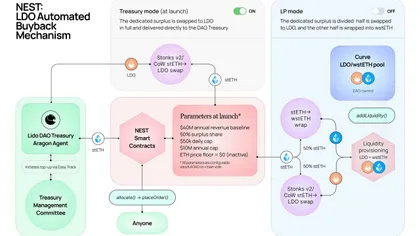
Lido launches $10M LDO buyback – But NEST may remain idle until…
From Struggle to Luxury: 5 Crypto Coins to Watch Before the Next Massive Bull Run

Crypto prices
More


