
领涨海外银行股,高盛才是特朗普交易大赢家?

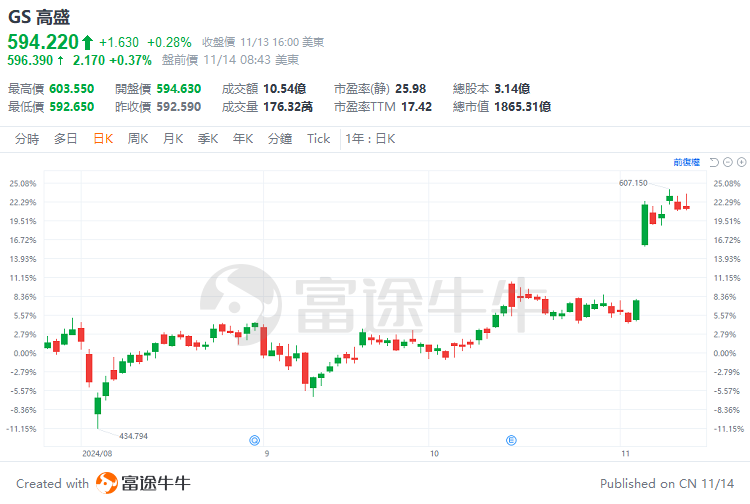
 据《华尔街日报》报道,高盛的这一表现可能并非偶然。与其他华尔街银行一样,高盛将从并购和IPO活动的增加以及监管放宽中受益。而且,通常在华尔街繁荣时期,高盛也会表现出色:在2021年(交易)活动激增期间,其全年股本回报率达到23%,而标普500银行指数的整体回报率仅为12%。
 Analysis suggests that due to the significant growth of private crediting and alternative assets, goldman sachs may become a potential big winner among banks. On one hand, there will be no restrictions on private crediting during Trump's presidency, allowing it to continue growing for the next four years; on the other hand, the rise in government bond yields may also benefit private crediting.
Since Trump's election, the market's expectations for trade activities, regulatory relaxation, and private crediting have risen, with bullish factors continuing to accumulate, driving. $Goldman Sachs (GS.US)$ the arrival of the "harvest season."
In November, Goldman Sachs topped the global banks in the S&P 500 index, with a nearly 15% increase, far exceeding the approximately 9% increase in the S&P 500 bank index, and on par with the increase of private equity giant Apollo this month.
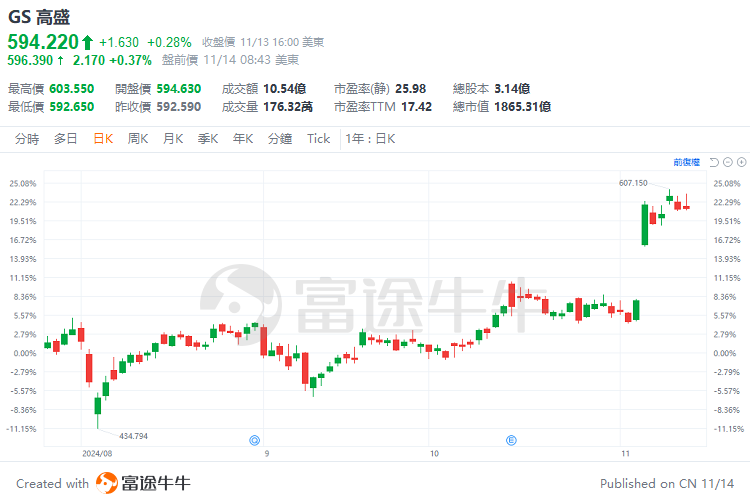
 According to The Wall Street Journal, Goldman Sachs' performance is likely not accidental. Like other Wall Street banks, Goldman Sachs will benefit from increased M&A and IPO activities, as well as relaxed regulations. Moreover, during prosperous times on Wall Street, Goldman Sachs tends to perform exceptionally well: in 2021, during the surge in trading activities, its annual return on equity reached 23%, while the overall return on equity of the S&P 500 bank index was only 12%.
However, due to the significant growth in private crediting and alternative assets, Goldman Sachs may become a potential big winner among these banks.
Analysts believe that under the Trump administration, new securities regulatory agencies or systemic risk regulatory agencies may be less inclined to restrict the availability of private crediting investments with relatively poor liquidity to everyday investors, or see them as a source of financial risk. TD Cowen Washington Research Group analyst Jaret Seiberg said:
"We expect no restrictions on private crediting during the Trump administration, which is why we believe private crediting will continue to grow over the next four years."
Another reason is that the rise in government bond yields may benefit private credit, especially in rapidly growing areas such as Asset Backed Financing (ABF). Moody's Executive Vice President of Private Credit Mark Wasden said, "The increase in government bond yields will impact long-term asset rates (follow the increase)."
Although other major Wall Street banks are also involved in private credit business, analysts believe that Goldman Sachs' ongoing strategic shift may allow it to gain more significant benefits.
In its recent strategy, Goldman Sachs has shifted its asset management department from betting on the company's own funds to investing more through funds for clients. The latter has lower capital intensity and can generate stable management fee income. As of the third quarter, Goldman Sachs manages approximately $140 billion of private credit assets and continues to enter rapidly growing markets such as Asset Backed Securities (ABS).
This also means that Goldman Sachs can further expand the pre-tax profits of its asset and wealth management division by charging higher fees.
However, analysts also warn that if the tariffs implemented by Trump put pressure on large multinational companies, it may widen credit spreads or slow down client activities. Policy uncertainties or excessive market volatility caused by unexpected presidential statements, combined with rapidly rising rates, may make financing more challenging. In addition, regulatory changes sometimes do not necessarily meet people's expectations.
Editor/ping
Disclaimer: The content of this article solely reflects the author's opinion and does not represent the platform in any capacity. This article is not intended to serve as a reference for making investment decisions.
You may also like
WTI posts modest gains above $88.50 on unexpected EIA draw, Middle East conflicts in focus

Betting on 'U.S. Treasury yields plunging', bullish options trading volume for long-term U.S. Treasury and utility sector U.S. stock ETFs surges
The increasing activity in long-term U.S. Treasury options “very directly” reflects traders’ expectations for a decline in long-term interest rates. Utility stocks have added a new logic due to rising power demand from AI data centers. Historically, whenever U.S. Treasury yields retreat, these two sectors are often the first to benefit and see sharp rebounds. Analysts believe that the battle between high interest rates and the AI frenzy has become the core narrative in the current market.
Impact of Surging US Treasury Yields: US Stock PE Ratio Shrinks Significantly, Mag 7 Dominates Small Caps
The 10-year US Treasury yield has reached a 24-year high, quietly reshaping the landscape of the US stock market. The S&P 500 forward price-to-earnings ratio has compressed from 22.2 times at the beginning of the year to 19.3 times, marking a “three-tier decline in valuation.” Meanwhile, the Russell 2000 Index is approaching technical correction territory, while Mag 7 stocks like Microsoft and Nvidia continue to support the broader market with the AI narrative and strong earnings. Market concentration is nearing historic extremes.
Has the "only buyer" of Korean stocks left early?
Over the past two months, Samsung and SK Hynix have alone absorbed over $25 billion in sell pressure. Now, Samsung Electronics has completed its buybacks ahead of schedule, and SK Hynix is left with only about $500 million to finish up. On their "exit" day, the KOSPI instantly dropped by 2%. More dangerously, Samsung's Q3 results missed expectations for both revenue and profit. Coupled with ETF rebalancing and options expiry, a "liquidity vacuum" has become a reality, leaving the question of who will step in as the biggest mystery.
Crypto prices
More


