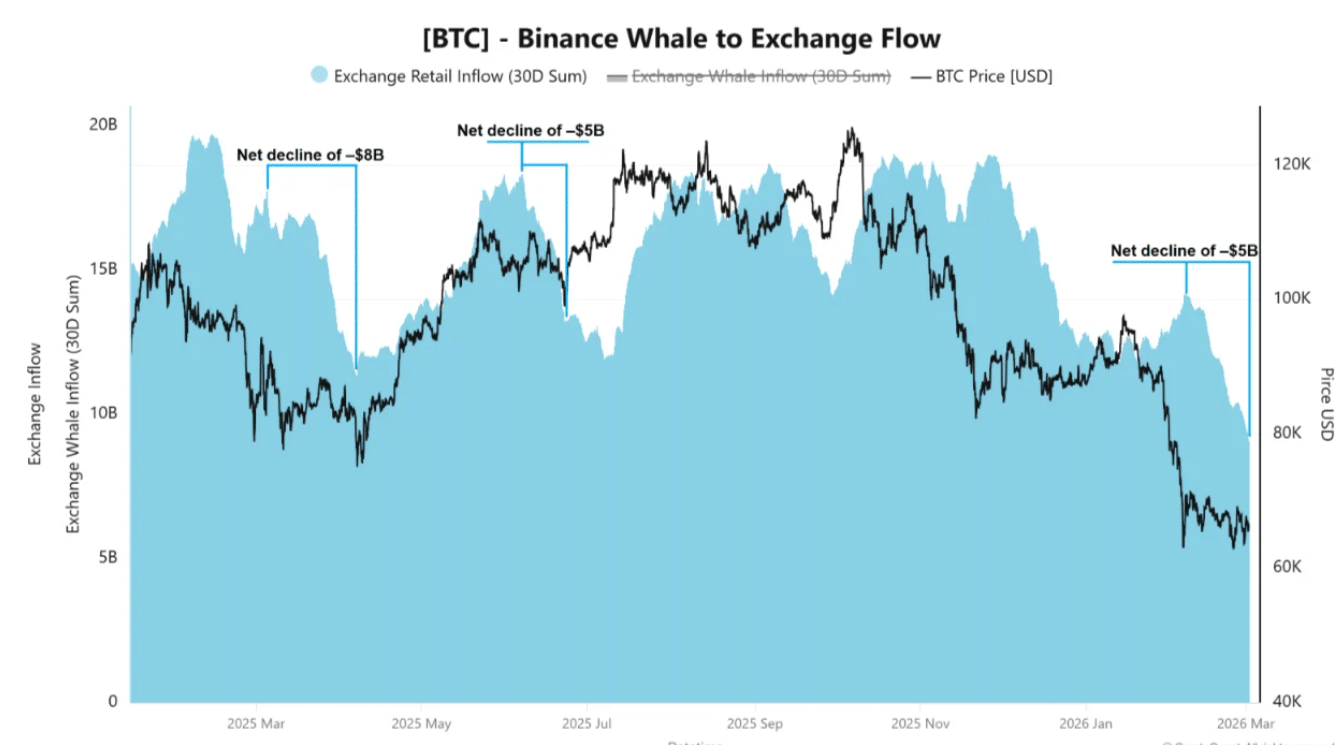
Bitcoin’s market structure reveals a notable shift in capital flows during early 2026. Retail exchange inflows on Binance declined steadily from about $14.1 billion to roughly $9.05 billion between the 6th of February and the 2nd of March.
This $5 billion contraction closely mirrors earlier periods in March–April 2025 and June 2025. During those episodes, falling retail deposits coincided with phases of market cooling rather than aggressive distribution.
Source: CryptoQuant
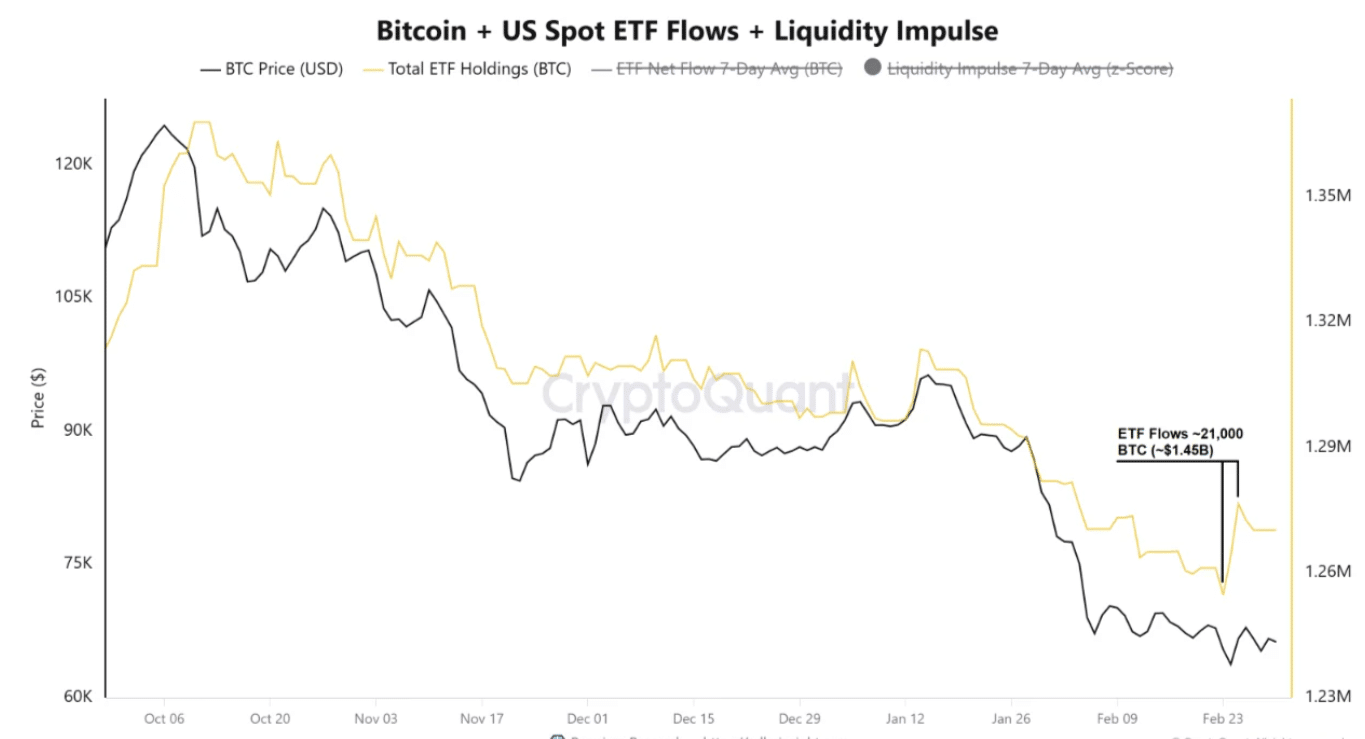
Meanwhile, Bitcoin’s [BTC] price weakened from near $100,000 toward the $60,000–$70,000 range, reflecting broader risk-off pressure across crypto markets. As prices stabilized in this lower range, another signal began to emerge.
On the 25th of February, U.S. Spot Bitcoin ETFs recorded inflows of about 21,000 BTC, equivalent to roughly $1.45 billion.
Source: CryptoQuant
As retail participation softened, institutional demand began reappearing. This overlap between declining exchange inflows and rising ETF holdings suggests capital may be rotating away from short-term trading venues toward longer-term institutional custody.
$1.8B sell volume hits Bitcoin derivatives
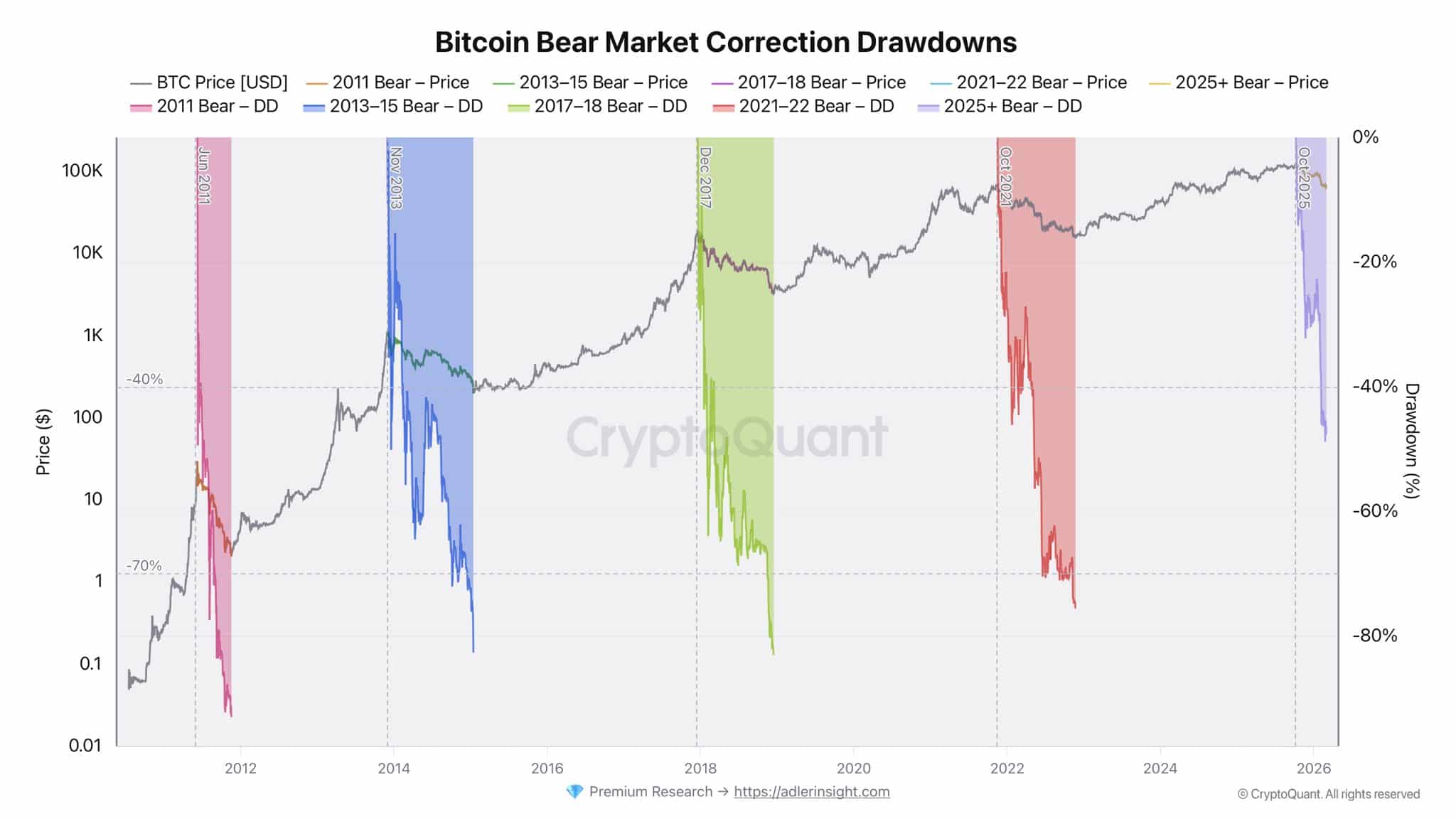
Bitcoin’s current correction remains moderate compared with previous bear market cycles.
The drawdown stood near 47% at press time, well below earlier historical extremes. In contrast, the 2011–2012 bear market wiped out more than 90% of Bitcoin’s value.
Later cycles moderated slightly, although the 2013–2015 and 2017–2018 phases still exceeded 80% declines. Meanwhile, the 2021–2022 downturn reached roughly the 75% region.
Source: CryptoQuant
This gradual moderation suggests structural maturation as the asset class expands.
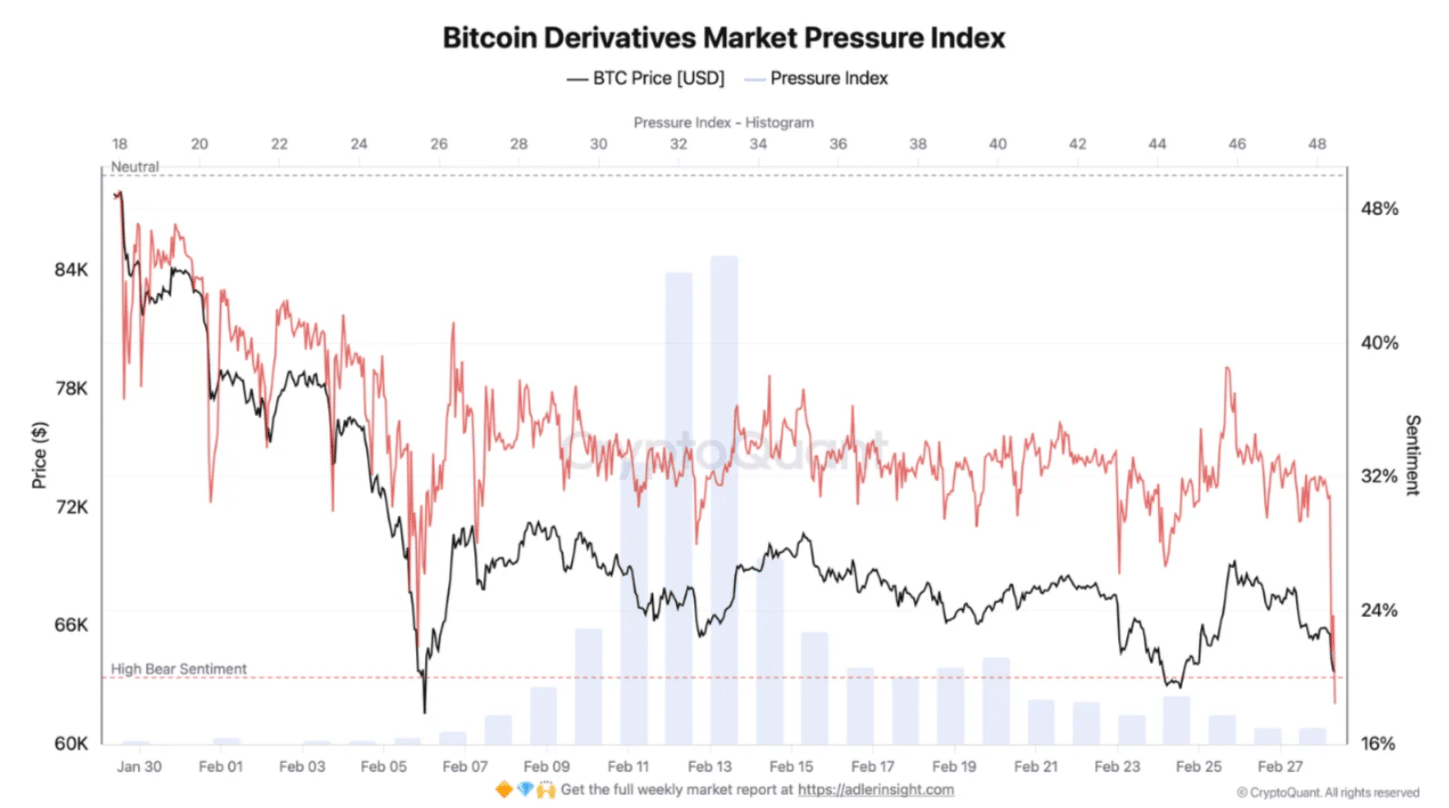
Even so, short-term sentiment has deteriorated sharply. Derivative markets reacted immediately as geopolitical tensions between the United States and Iran escalated.
Within one hour, aggressive sell orders pushed roughly $1.8 billion in volume through the market.
Source: CryptoQuant
At the same time, the Derivatives Pressure Index plunged from around 30% to near 18%. This shift reflects strong seller dominance and rising risk aversion.
Yet such extreme positioning often signals emotional trading phases that sometimes precede short-term technical rebounds.
Bitcoin derivatives face stop-loss cascade risk
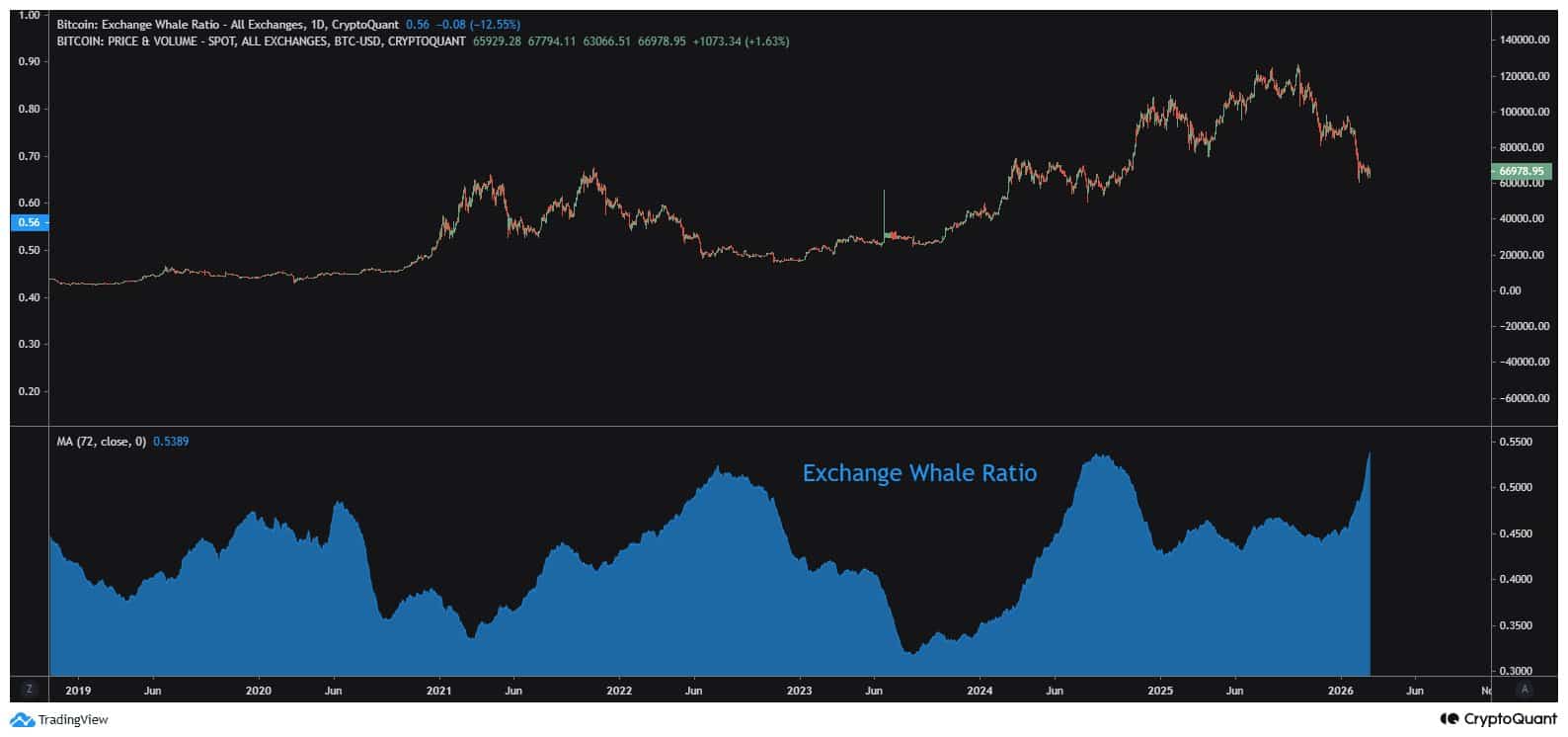
Bitcoin stabilized near $66,150 after briefly dipping toward the $60,000 region in early February. Meanwhile, exchange flows began showing strong whale dominance.
The Exchange Whale Ratio climbed to 0.64, its highest level since 2015, then retraced to 0.56. This means the top ten addresses now generate roughly over 50% of all BTC inflows to exchanges.
As large holders deposit coins, potential spot selling pressure gradually increases.
Source: X
At the same time, derivatives positioning remains restrained.
Bitcoin futures Open Interest stood near 649,880 BTC, equivalent to roughly $43.03 billion. However, OI declined 2.55% in 24 hours, signaling moderate deleveraging.
Meanwhile, the Long-to-Short Ratio remained balanced at 50.33% long and 49.67% short.
This structure implies mild bearish sentiment across perpetual markets. When combined with concentrated whale inflows, the market becomes structurally fragile. Under such conditions, a downward move could sweep clustered long stops and trigger a volatility-driven liquidation cascade.
Final Summary
- BTC shows declining retail inflows and rising ETF demand, signaling a shift toward institutional accumulation.
- Bitcoin derivatives remain fragile as whale inflows and negative funding raise liquidation risk.