
After the bombings against Iran, Kalshi makes a decision that divides the community

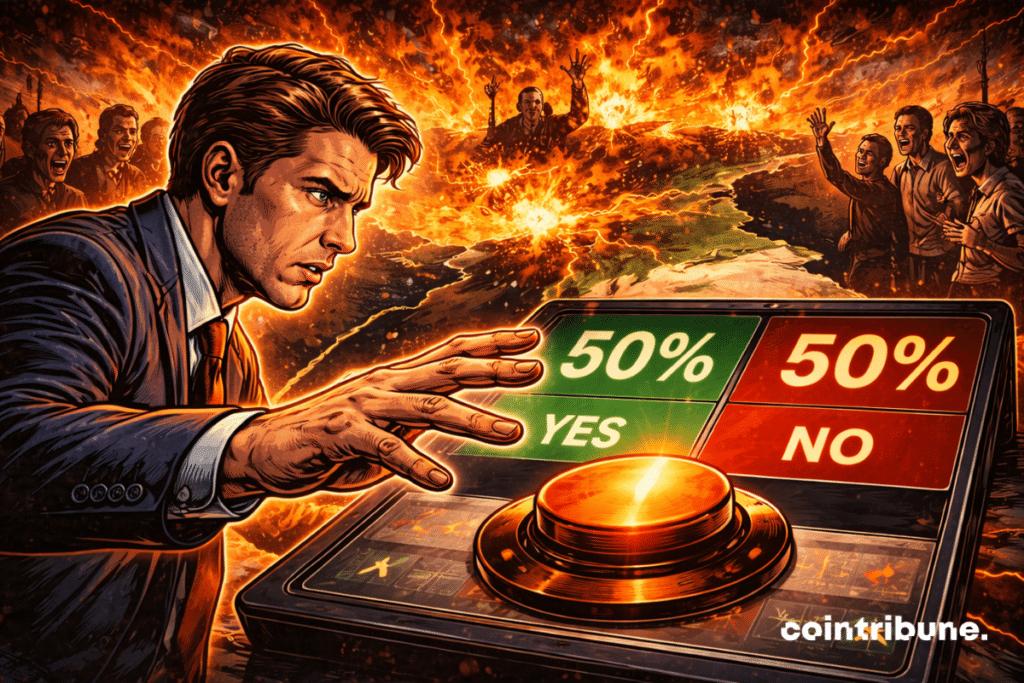
Missiles are raining down on Isfahan. Tehran is burning, Tel Aviv holds its breath, Dubai looks on sideways. While the real world is shaking, another world stirs. That of crypto bettors. On Kalshi, on Polymarket, people speculate on death, on war, on the edge of chaos. The opportunity is too good to inflate accounts. But the American platform just clipped the wings of its traders. And anger is rumbling fiercely across the networks.
In Brief
- Kalshi resolved its market on Khamenei’s departure at the last price before the announcement of his death, in accordance with its policy.
- The platform refunded all fees and compensated open positions after the Iranian leader’s death.
- Six traders on Polymarket are suspected of insider trading after cashing in 1 million dollars before the strikes.
- The suspicious accounts were created in February and funded a few hours before the explosions in Tehran.
Kalshi faced with the poisoned jackpot: what if crypto had to choose its side?
The announcement drops on a Sunday, brutal: Ayatollah Khamenei has joined his ancestors. The day before, Israeli-American strikes shook Tehran. On Kalshi, a market was booming: “Ali Khamenei out as Supreme Leader.” Probabilities just rose to 68%.
Big problem: the platform, regulated in the United States, strictly forbids “death markets.” No betting on a man’s death, even a supreme leader. Its rules are concrete: in the event of death, the contract is settled at the last price before the announcement. Period.
Tarek Mansour, the founder, takes to X:
We do not list markets directly related to death. When potential outcomes involve death, we design rules to prevent people from profiting from death.
The intention is noble, almost puritanical. But in practice, it really backfires. Bettors had opened positions after the death announcement, betting on a quick rise. They end up with flat losses. The crypto community is rumbling, accusing, insulting.
On social media, Kalshi is called a thief, a killjoy, a dream breaker. The platform does not budge on the principle, but the fire threatens to consume everything.
Deaths, suspicions, and millions: the betting platform war turns into a nightmare
Kalshi does not fold but opens the checkbook. The founder details forced generosity: full refund of all market fees, generous compensation for open positions after the death, payment of pre-death positions at the last price. A desperate attempt to buy social peace.
We refund all fees of this market. If you had a position before Khamenei’s death, you will be paid at the last price before his death. If you had a position after, we fully refund your stake.
Tarek Mansour
Yet this generosity falls in a poisoned climate. A few weeks earlier, six traders on Polymarket quietly pocketed 1 million dollars betting on strikes against Iran. Their accounts, created in February, were funded a few hours before the explosions in Tehran.
Suspicions of insider trading, talk of leaks from American intelligence circles. Kalshi is not targeted, but the shadow of “too precise predictions” hangs over the whole profession. By trying to play the shocked virgins, the New York platform attracts the wrath of traders. Doubt remains. And so does the smell of sulfur.
Kalshi-Polymarket: the war of numbers
- 68%: the probability displayed by Kalshi just before Khamenei’s death;
- 1 million dollars: the suspicious gains of six traders on Polymarket;
- 100%: the refund rate of fees and losing positions at Kalshi;
- A few hours: the time gap between suspicious bets and explosions in Tehran;
- 66,570 dollars: bitcoin price at the time of writing.
Between Kalshi and Polymarket, it’s not just a quarrel of ethics. It’s a merciless commercial war. At the end of December 2025, Kalshi crushed its competitor with a record weekly volume of 2.3 billion dollars. The two crypto betting giants are engaged in a fierce battle. Against a backdrop of missiles, death, and green bills. The next round promises to be bloody.
Maximize your Cointribune experience with our "Read to Earn" program! For every article you read, earn points and access exclusive rewards. Sign up now and start earning benefits.
Disclaimer: The content of this article solely reflects the author's opinion and does not represent the platform in any capacity. This article is not intended to serve as a reference for making investment decisions.
You may also like
Borrow another 40 billion USD, SpaceX plans to buy Nvidia chips
After completing a $25 billion investment-grade bond issuance in June, SpaceX now plans to raise $40 billion, with $30 billion to be issued as investment-grade bonds and $10 billion coming from bank loans. The funds will be used for large-scale procurement of NVIDIA chips. Elon Musk has confirmed the adoption of NVIDIA’s Vera Rubin architecture. Apollo will lead this round of financing, as demand for massive funding of AI infrastructure continues to rise.
Quantum-proof network Quantus debuts its QTC token on Near – Details
S&P 500 Hits a New High, but Gains Are Mostly Driven by AI Trading
Although US stocks have reached historic highs, the market is severely polarized, with gains heavily reliant on AI-driven tech giants. Under macro pressures such as Federal Reserve rate hikes, high US Treasury yields, and elevated oil prices, funds view cash-rich tech giants as safe havens, resulting in broad pressure on small-cap stocks and traditional sectors. Despite technical risks, this narrow-range rally continues to temporarily support the broader market.

Crypto prices
More


