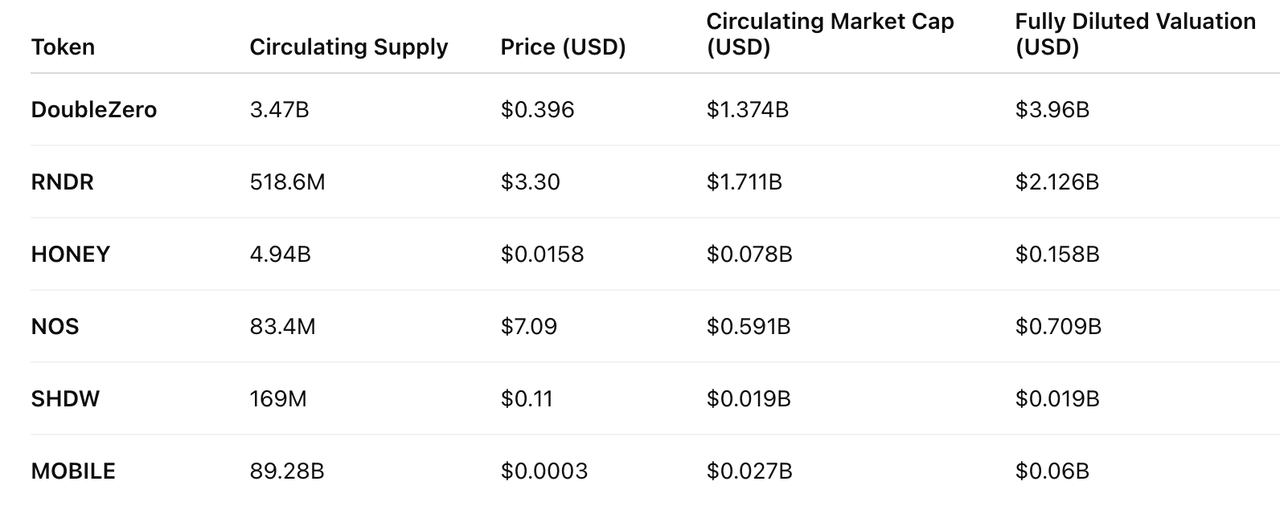
1. Project Overview
DoubleZero (2Z) is a decentralized protocol dedicated to creating and managing high-performance, permissionless networks to optimize communication for blockchains and other distributed systems. By mobilizing underutilized private fiber resources to build dynamic networking, DoubleZero aims to eliminate existing communication bottlenecks and push performance closer to physical limits.
The project positions itself as an
“N1 Layer” (Network Layer One) — distinct from traditional blockchain L1 or L2 layers — focusing on building dedicated fiber-optic infrastructure to significantly
reduce latency (up to 50%) and
increase bandwidth.
This solution is particularly suited for high-throughput, low-latency blockchains such as
Solana, providing validators with low-jitter direct connections and traffic filtering. The
2Z token adopts a
Proof of Utility (PoU) mechanism, used for network incentives, staking, and governance.
Regarding token allocation,
28% goes to
Jump Crypto,
14% to
Malbec Labs, and
12% to other institutional investors, though some community concerns exist about transparency and internal token control.
The project’s
mainnet-beta launched in 2025, now serving
300+ blockchain validators, with
$28 million raised at a
$
400
million valuation, supported by an
SEC no-action letter for compliance. By innovating at the physical layer, DoubleZero is reshaping blockchain infrastructure, with a current focus on the
Solana ecosystem.
2. Key Highlights
Revolutionary “N1 Layer” Infrastructure
DoubleZero is pioneering a decentralized global physical network that forms the
“foundation of blockchain foundations.” Its goal is to overcome latency, bandwidth, and centralization bottlenecks in public internet communication, enhancing blockchain performance, resilience, and decentralization at scale.
Hardware Acceleration & Physical-Layer Optimization
The project deploys
dedicated hardware (e.g., FPGA accelerators) at network edges, leveraging idle fiber globally. It performs
traffic filtering, rapid data validation, and dedicated routing, effectively
decoupling data verification from block production and transaction execution. This design reduces validator workload, supports
multicast transmission, and strengthens DDoS resistance.
Proof of Utility (PoU) Token Model
DoubleZero introduces a
Proof of Utility (PoU) model, where the native
2Z token powers incentives and network security.
Nodes contributing fiber or hardware earn 2Z.
Validators and users pay 2Z for optimized transmission services.
Smart contracts and SLA frameworks ensure fair and transparent incentives. Through network effects, each node becomes part of a globally resilient, scalable communication fabric.
Cross-Industry Integration Potential
Beyond blockchain, DoubleZero’s network architecture supports
RPC nodes, MEV systems, L2 rollups, and can extend to
CDNs, online gaming, AI model training, and enterprise systems, offering high-bandwidth, low-latency connectivity across industries.
3. Market Outlook
As one of the leading protocols optimizing blockchain communication, DoubleZero has deployed its
Beta mainnet with
300+ validators globally. With a
$
400
million valuation and strong backing in the rising
DePIN narrative, DoubleZero is positioned to become a
core “N1 Layer” infrastructure in Web3.
4. Tokenomics
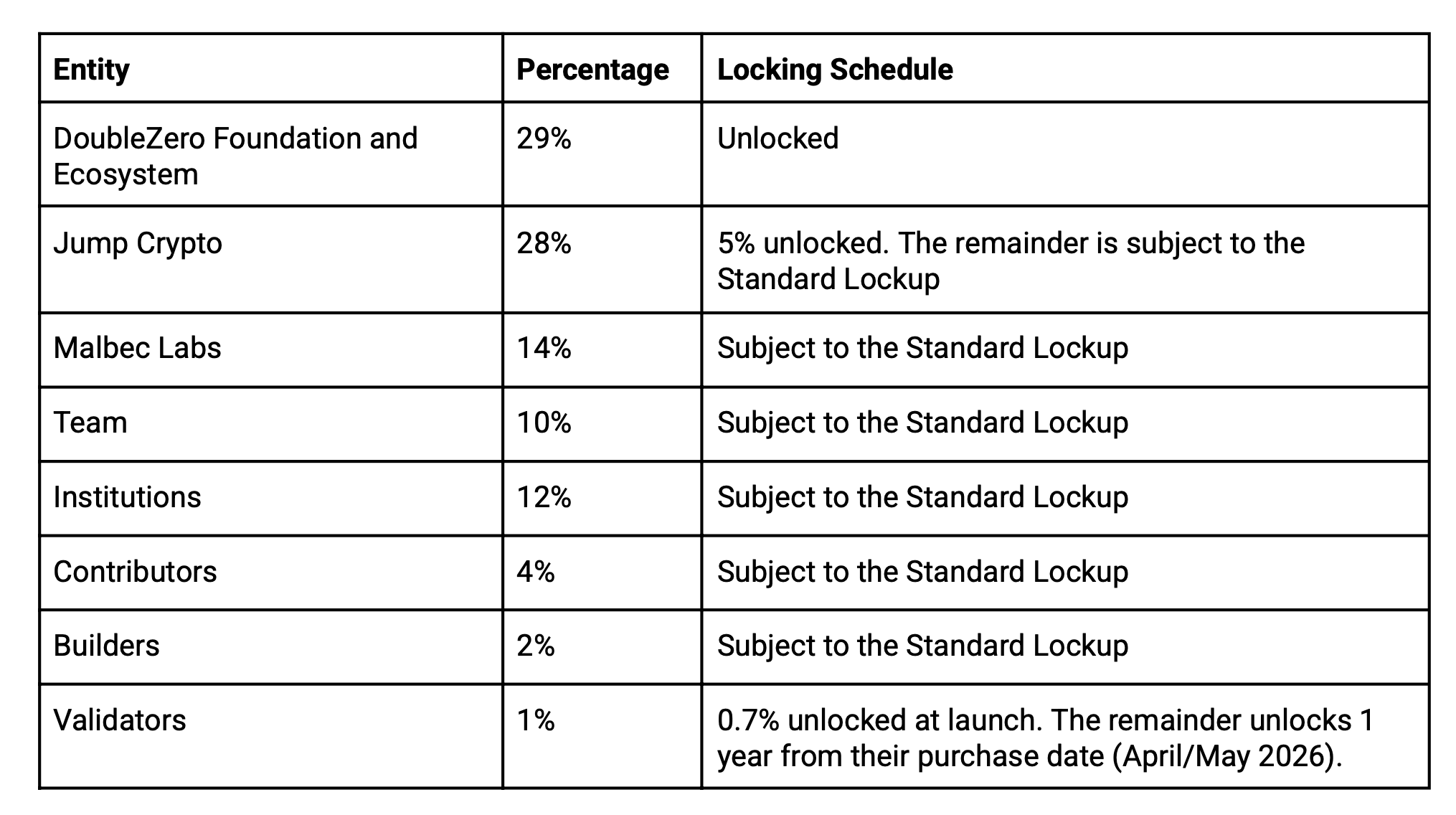
Total Supply: 10 billion $2Z
Allocation Breakdown:
Foundation & Ecosystem: 29% (unlocked)
Jump Crypto: 28% (5% unlocked, remainder standard lockup)
Malbec Labs: 14% (standard lockup)
Institutional Investors: 12% (standard lockup)
Team: 10% (standard lockup)
Contributors: 4% (standard lockup)
Builders: 2% (standard lockup)
Validators: 1% (0.7% unlocked at launch; remainder unlocks ~Apr–May 2026)
Token
Utility:
Network fees: Pay for data transmission and transaction bandwidth.
Incentives: Earned by contributors based on throughput and uptime.
Staking & Governance: Secure the network and participate in decisions.
Cross-chain utility: Supports DeFi, interoperability, and distributed applications.
5. Team & Funding
Core Team:
Austin Federa (CEO) — Former Head of Strategy & Communications at
Solana Foundation, responsible for strategic direction and ecosystem development.
Andrew Reed (CTO) — HFT network expert with deep experience in distributed systems and low-latency infrastructure; leads protocol and hardware design.
Mateo (Matteo) Ward — Specialist in fiber infrastructure and network engineering; responsible for physical links, security, and validator integration.
Nihar Shah — Former Head of Data Science at
Mysten Labs; oversees economic modeling, data analytics, and tokenomics.
Funding:
Total Raised: $28 million
Valuation: $400 million
Lead Investors:
Multicoin Capital and
Dragonfly Capital
Other Participants: Foundation Capital, Reciprocal Ventures, Borderless Capital, Superscrypt, Frictionless, and angels including
Anatoly Yakovenko and
Raj Gokal (co-founders of Solana).
6. Token Unlock & Sell Pressure Analysis
Initial Circulating Supply: ~34% (Foundation 29% + Jump 5%) This is relatively
high for infrastructure projects, suggesting
notable early sell pressure potential.
Short Term (0–3 months)
Risk from
Foundation (29%) and
Jump Crypto’s 5% unlocked tokens.If used for ecosystem incentives or partnerships, tokens may enter circulation quickly.
Risk Level: High
Mid Term (3–12 months)
Standard lockups for
Malbec Labs, Team, and Institutions begin unlocking.If revenue generation or demand remains limited, selling pressure could emerge.
Risk Level: Medium
Long Term (12–24 months)
Validator allocations (unlocking around Q2 2026) are small but ongoing.Combined with staking rewards, could contribute to gradual sell pressure.
Risk Level: Medium-Low
7. Official Links
Disclaimer: This report was generated by AI and human-verified for accuracy. It is not intended as investment advice.