
Pi Network Is Adding Major DeFi Features – But Is It Enough To Reverse The Price Slump?

Pi Network continues advancing its ecosystem with new DeFi tools and testnet features aimed at long-term utility.
Pi Coin remains under intense selling pressure despite a broader market recovery that has pushed Bitcoin to fresh all-time highs.
The altcoin has been unable to follow the market’s bullish momentum, continuing its slide even as new developments roll out across the Pi Network ecosystem.
Pi Coin Sinks 24% as Bitcoin Hits New Highs
As of press time, Pi Coin trades around $0.26, reflecting a 24% drop over the past month, according to data from BeInCrypto.
The decline underscores a widening gap between Pi’s performance and that of major digital assets.
While most altcoins have rallied alongside Bitcoin, Pi has moved in the opposite direction. This suggests that network-specific factors, rather than overall market sentiment, are driving the digital asset’s current market downturn.
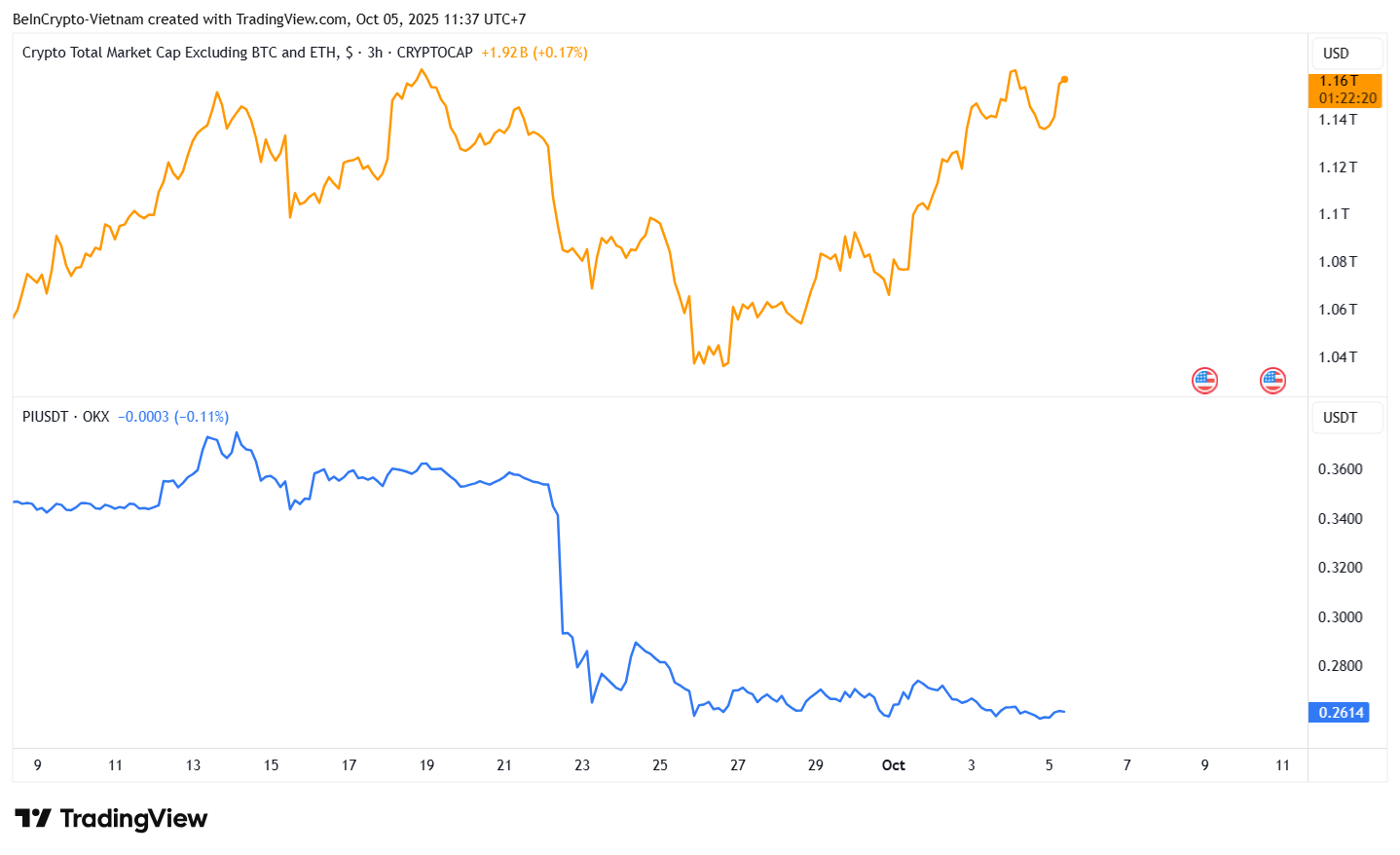 Pi Price Performance vs. Altcoins Market Cap. Source:
Tradingview
Pi Price Performance vs. Altcoins Market Cap. Source:
Tradingview
A key contributor is the surge in Pi tokens held on centralized exchanges (CEXs). Data from Piscan shows exchange reserves recently exceeded 445 million PI, up from 420 million in early September.
This sharp rise indicates that more holders are transferring tokens to trading platforms, often a precursor to increased selling activity.
Adding to the strain, more than 110 million PI tokens are due for release in October as part of the network’s unlock schedule.
The upcoming supply expansion, combined with elevated exchange reserves, increases potential downward pressure, limiting any near-term rebound.
New DeFi Tools
While short-term sentiment remains bearish, Pi Network is making visible progress on its technology roadmap.
The team recently launched several new testnet features, including a decentralized exchange (DEX) and an automated market maker (AMM) integrated directly into the Pi Wallet.
🤖 We just announced a game-changing update for the #PiNetwork ecosystem:🙌 Pi DEX (Decentralized Exchange)❤️ AMM Liquidity Pools🤑 Token Creation Tools🛡 Now LIVE on Pi Testnet ⚙️Here’s what Pioneers & Developers can do right NOW:🛠 Swap tokens & explore DeFi mechanics… pic.twitter.com/jSv3oXUtue
— Pi Core Team ᵖⁱ ⁿᵉᵗʷᵒʳᵏ (@PiCoreGroup) October 2, 2025
These tools let users experiment with token swaps, liquidity pools, and DeFi mechanisms in a controlled test environment without exposing mainnet assets to risk.
According to the development team, the goal is to prepare users for the eventual mainnet transition. The new tools allow direct peer-to-peer trades within the wallet, giving users more control over their assets.
By doing so, Pi aims to reduce reliance on centralized exchanges, which have often proved to be points of failure in the crypto industry.
Beyond the DEX, Pi has introduced token creation capabilities on its testnet.
This update allows developers to issue tokens, build applications, and launch marketplaces directly within the Pi ecosystem. It mirrors how Ethereum’s ERC-20 framework spurred that blockchain network’s early growth.
Pioneers are optimistic that such products could mark a turning point for Pi Network’s ecosystem strategy. They argue that the project’s focus on infrastructure, decentralization, and developer participation reflects an attempt to establish lasting value beyond speculative trading.
Pi Network is focused longterm and it will bring real world assets onchain and new productions onchain. You are on the right path of shaping the future of Crypto "Cycles and narratives come to an end"Keep mining ⚡ and find ways to earn extra pi. Opportunities are available… pic.twitter.com/uuIphaN250
— PiNewsZone (@PiNewsZone) October 5, 2025
So, in the long run, PI’s success will not depend on short-term price action but on whether these innovations translate into sustainable utility.
Disclaimer: The content of this article solely reflects the author's opinion and does not represent the platform in any capacity. This article is not intended to serve as a reference for making investment decisions.
You may also like
Highlights of the U.S. Stock Market This Week: Intensive Speeches from Federal Reserve Officials, Middle East Situation and China-U.S. Summit Influence the Market
This week, U.S. stock market investors will focus on the trajectory of interest rates, tensions in the Middle East, the U.S.-China summit and technology-related topics, as well as calls to slow down the development of artificial intelligence (AI), while weighing whether major stock indexes can reach new historical highs.
Korean media reports that "Besant Mentor" Druckenmiller will visit Korea for the first time and will discuss investment with SK Hynix, Samsung Electronics, and Doosan.
This is Druckenmiller's first public visit to South Korea, focusing on the two main themes of AI and energy. He will be inspecting Samsung and SK Hynix, which hold key positions in AI supply chain bottlenecks such as HBM and semiconductor materials, as well as Doosan Enerbility, which is involved in nuclear power and gas turbines. It is worth noting that he has reduced his AI holdings to 20% of what they were six months ago; this visit is interpreted as a strategic shift from broad investments to the precise selection of core targets.
Applovin CEO: The "Darkest Hour" of a 92% Stock Price Crash and "Self-Salvation"
AppLovin's CEO reviewed the company's history: when its stock price plummeted by 92% in 2022 and its market value shrank to $3.8 billion, he stopped roadshows, initiated a $6 billion buyback, and quietly completed a technological upgrade from regression models to deep learning. Afterwards, the stock price rose from $9 to $750, and the market value peaked at $250 billion. He also revealed that the company expects to generate about $6 billion in cash this year, with an EBITDA profit margin of 84%.
Trump Security Agreement Ignites Greenland Concept Stocks! Resource Stocks Soar, Greenland Energy (GLND.US) Surges 119% After Hours
In after-hours trading on Friday, the stock prices of three companies with mining and energy projects in Greenland surged sharply. This came after U.S. President Trump announced a security agreement with Denmark and the Arctic territory.
Crypto prices
More


