Gold Trading Reminder: Market Weighs US Treasury's "Bailout" Effect, Gold Prices Fluctuate at High Levels—Can the Uptrend Continue?
汇通网 August 21st news—— Gold prices are experiencing sharp swings between Treasury buyback interventions and inflationary geopolitical risks, maintaining high volatility in the short term. The market is digesting expectations for "devaluation trades" and the uncertainty of Fed policy, while soaring oil prices and debt concerns are laying the foundation for a long-term bull market. Investment banks are already bullish towards the $5,000 mark.
Due to the US Treasury’s sudden announcement to increase the scale of long-term bond buybacks, gold soared over 4% on Wednesday. In the early session on Thursday (August 20th), it faced profit-taking and multiple negative factors, causing spot gold to dip to as low as $4,450.08 per ounce. Later, as Treasury Secretary Bessent once again signaled that the buyback size “could exceed $4 billion,” the price gradually regained ground, finally closing at $4,516.19, a slight drop of 0.1%. The intraday high reached $4,540.63, the highest since June 2nd. US gold futures closed up 0.6% at $4,571.40. Behind the seemingly calm closing prices is the fierce tug-of-war between inflation concerns and expectations of falling real rates, as well as the deep game among fiscal intervention, monetary policy independence, and geopolitical tensions.
This reflects a profound shift in global asset pricing logic: as US public debt surpasses $40 trillion for the first time, long-term yields approach 20-year highs, and ongoing Middle East tensions push up oil prices, gold not only serves as the traditional refuge and inflation hedge, but also becomes the focal tool for the market’s dual doubts about "fiscal sustainability" and "currency devaluation."
Treasury Buybacks: Short-term Stimulus or Long-term Credit Overdraw?
On Wednesday, the US Treasury announced that it will double the scale of repurchases for 10- to 30-year government bonds with each round at least $4 billion, injecting a dose of "stimulant" into the tense bond market. Long-term yields dropped sharply, the dollar sold off rapidly, and gold and other “devaluation trade” assets soared in tandem. On Thursday, Bessent ramped up the rhetoric in an interview, stating the buyback size "could even exceed $4 billion" and stressing that "yields do not reflect fundamentals." This is intended to ease bond market turmoil sparked by rising fiscal deficits and exploding debt, while also injecting liquidity—especially critical during the quiet late-summer period with heightened competition for corporate bond issuance (including AI infrastructure financing).
However, the market’s reaction was far from one-sided. Yields quickly recovered half the previous day’s losses on Thursday; the 10-year yield rose to 4.698%, and the 30-year to 5.238%, showing investors’ skepticism regarding the sustainability and credibility of Treasury intervention. CIBC strategists noted this was more like Bessent "testing the market," and the market is pushing back. Scotiabank FX strategists bluntly stated that if the Treasury is unwilling to let the government bond market bear the pressure of fiscal sustainability and the Fed's credibility, then the pressure must fall on the dollar. This "devaluation trade" logic boosts gold in the short term, but if the buyback fails to genuinely reverse the fundamentals, gold’s rally may lose its footing.
At a deeper level, the Treasury's frequent actions are blurring the boundaries between fiscal and monetary policy. St. Louis Fed President Musalem stated clearly that the Fed is focused on the labor market and inflation, independently setting policy and not being influenced by debt management. San Francisco Fed President Daly commented that current long-term yields have not provided much signal for policy adjustment and emphasized, "It’s still early days." The Treasury's move to ease financial conditions may conflict with the Fed’s stance, which still needs to curb inflation through rate hikes. Such inter-agency tension itself is a latent catalyst for gold price volatility.
Inflation & Rate Expectations: Oil Prices Add Fuel to the Fire, Gold Trapped Between Forces
Meanwhile, ongoing geopolitical tensions continue to fan inflation. As Iran negotiations stall and concerns over Middle East supply disruptions fester, oil prices surged over 2% on Thursday. Brent crude settled at $93.78/barrel and US crude at $88.15/barrel—both hitting their highest level in nearly a month. Trump threatened an “economic war” against countries supporting Iran, further heightening expectations for rising energy prices and overall inflation. The 5-year and 10-year TIPS breakeven inflation rates rose to 2.338% and 2.345%, respectively, indicating that the market has noticeably repriced future inflation.
The release of the July Fed minutes added to the hawkish tone. “Several” policymakers were prepared to raise rates, and “many” officials said if inflation does not fall toward the 2% target, it will be necessary to further increase borrowing costs. St. Louis Fed President Musalem even indicated he may support a rate hike at the September meeting, noting that financial conditions remain "fairly accommodative." CME FedWatch shows a 67.4% chance of holding rates steady in September, but a 67% chance of hiking by December. This expectation of "short-term pause, medium-term hawkish" supports real rates, exerting pressure on gold.
Gold is thus caught in a classic bull-bear standoff: on one side, the Treasury buyback drives expectations of falling long-term real rates and a weaker dollar; on the other, oil-induced inflation risks and potential Fed tightening. Morgan Stanley analysts presented an optimistic outlook—they expect that if the Fed holds rates steady, gold prices could break $5,000/oz by 2027 or even earlier, but stressed that volatility remains high. The core of this view is whether real rates can keep trending down, and whether the “devaluation trade” can evolve from short-term sentiment into a medium- to long-term trend.
Debt Flood & Safe Haven Logic: The Gold Role After $40 Trillion
The crossing of the symbolic $40 trillion US public debt threshold adds a new dimension to gold’s long-term narrative. Bessent tried to downplay the "magic" of this number, stating that they will look for “hundreds of billions” in savings through economic growth and reducing waste, fraud, and abuse. He noted that this year’s deficit increase is partly due to returns of tariffs invalidated by the Supreme Court, which won’t recur next year; immediate deductions from factory and data center construction booms also temporarily suppressed corporate tax receipts. However, rigid expenditures on Social Security, Medicare, and soaring interest payments (already approaching $1.2 trillion in the first ten months of the fiscal year) continue to expand. High long-term yields are raising financing costs not only for the government but also for corporations and households—since Trump and Israel took military action against Iran, 30-year fixed mortgage rates have risen by over 0.5 percentage points.
Against this backdrop, gold’s role as a traditional store of value and fiat alternative is being revived. Gold's surge after Wednesday's buyback announcement was a direct market reaction to "fiscal dominance" and potential currency devaluation. But, as the bond market's Thursday rebound showed, investors have not entirely abandoned Treasuries, and the situation has yet to escalate into an "urgent crisis." Gold's rally thus represents a repricing of uncertainty, not a bet on systemic collapse.
Outlook: Seeking New Balance Amid Volatility
Overall, the current high volatility of gold prices is the result of multiple forces offsetting each other. Treasury buybacks are providing short-term liquidity and signaling support, but doubts over their sustainability and underlying fiscal issues are capping upside; oil prices and geopolitical tensions are lifting inflation expectations and reinforcing the Fed’s hawkish stance, adding support to real rates; meanwhile, the breach of the $40 trillion debt threshold is reinforcing the long-term safe-haven narrative for gold. The $5,000 target set by Morgan Stanley is predicated on the Fed holding rates steady; any higher-than-expected inflation persistence or failed fiscal intervention would quickly amplify volatility and correction risk.
In the coming weeks, the market will closely watch Fed Chair Walsh’s remarks at the Jackson Hole Symposium—investors are hoping for more substantial content than in the July press conference, rather than high-level, obscure repetition. Meanwhile, the actual scale and frequency of subsequent Treasury buybacks, oil price trends, and any developments in the Middle East will all be key variables for short-term gold price direction. In an era where the boundaries between fiscal and monetary policy are increasingly blurred, and debt and inflation pressures coexist, gold is no longer just a simple safe-haven tool, but also an important window for observing global macro order and policy credibility. With prices locked in high-range confrontation, a true breakout may require clearer policy signals and fundamental validation—until then, volatility and oscillation remain the main theme.
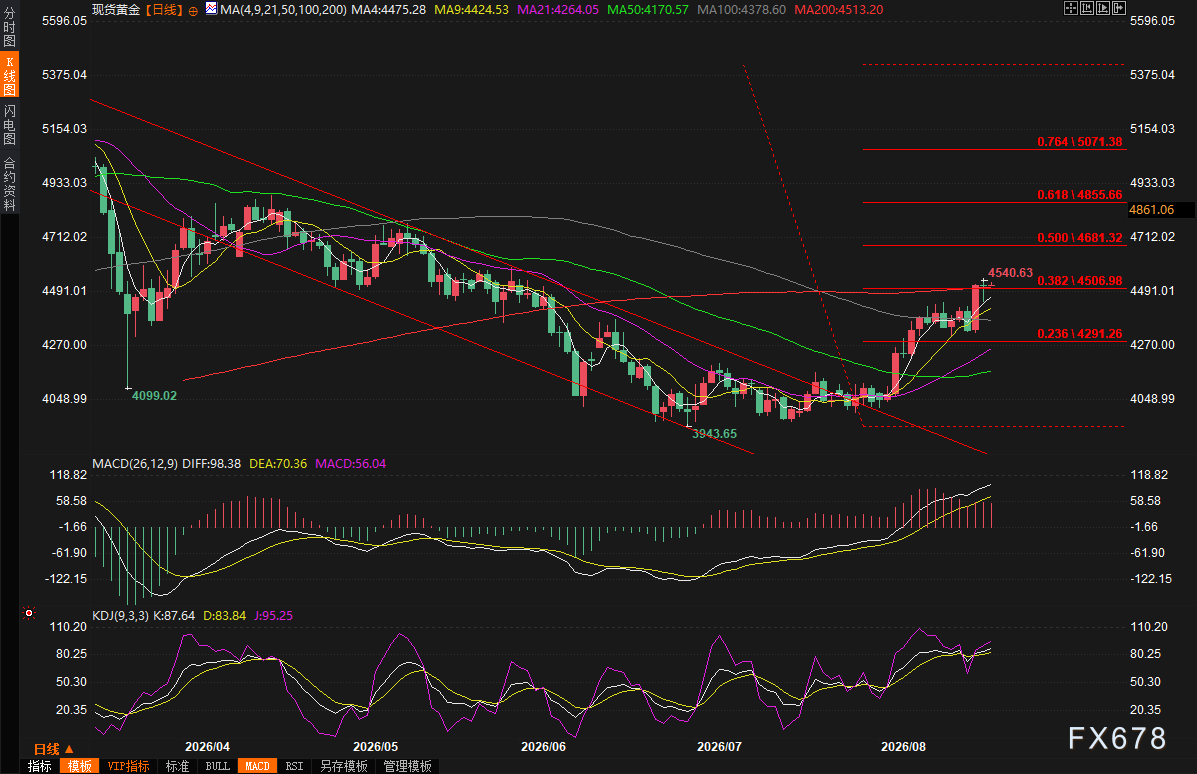
(Spot Gold Daily Chart, source: EasyMarkets)
GMT+8 07:40. Spot gold is now quoted at $4,524.43/oz.






