
How Can Institutions Trade U.S. Equities 24/7 With Deep Liquidity? Bitget rToken and Stock Perps (2026 Guide)
U.S. equities remain some of the most important markets in global finance, but traditional stock trading still revolves around Wall Street's schedule. For an institution operating across Asia, Europe, and the Americas, that creates a familiar problem: major earnings, geopolitical events, crypto-market moves, and macro headlines do not wait for the opening bell.
Crypto-based equity markets are starting to remove that limitation. TokenInsight reported that monthly TradFi perpetual volume across crypto exchanges climbed from $52 billion in January to $268 billion in June 2026, while equity perpetual volume alone jumped from $45 billion in May to $141 billion in June. Bitget ranked second in overall TradFi perpetual volume during Q2 with roughly $69 billion and an 11.01% market share, while remaining a top-three equity perpetual venue.
Bitget approaches this market through two complementary products: rToken for tokenized Spot exposure to U.S. stocks and ETFs, and Stock Perps for continuous derivatives trading, hedging, and long/short strategies. Together, they give institutions a way to move beyond traditional trading hours while combining 24/7 access with deep order books, API execution, and cross-asset capital efficiency.
Key Takeaways
-
Institutions can access U.S. equity exposure 24/7 on Bitget through rToken Spot and Stock Perps. rToken provides tokenized Spot exposure, while Stock Perps provide USDT-settled derivatives for long, short, and hedging strategies.
-
Bitget Stock Perps have shown strong order-book depth. In a July 5–11, 2026 benchmark, Bitget ranked first on 30 of 32 monitored contracts at 5 BPS, 31 of 32 at 10 BPS, and 30 of 32 at 50 BPS.
-
Aggregate Stock Perps depth reached $6.97 million within 5 BPS, $16.22 million within 10 BPS, and $55.92 million within 50 BPS, giving institutions meaningful liquidity close to the market price.
-
Block Scholes research also found strong liquidity in selected Bitget equity perps, including $4.1 million in daily median NVDA-USDT depth within 2% of the mid-price on May 14, 2026.
-
24/7 trading does not mean liquidity is identical every hour. Weekend trading activity can be lower when the underlying U.S. market is closed, but Block Scholes found top-of-book spreads remained relatively resilient across the equity perps it studied.
-
Bitget also connects 24/7 equity exposure with capital efficiency. Its Cross-Asset UTA supports 370+ eligible margin assets, including 125 rTokens, with collateral ratios reaching up to 95% for supported assets and tiers.
How Can Institutions Trade U.S. Equities 24/7 on Bitget?
Institutions looking for round-the-clock U.S. equity exposure have two main routes on Bitget: Bitget rToken Spot and Bitget Stock Perps. Both extend access beyond traditional Wall Street hours, but each serves a different role. Together, they give professional traders a flexible way to build, hedge, and actively manage equity exposure around the clock.
1. Bitget rToken: 24/7 Tokenized U.S. Equity Exposure
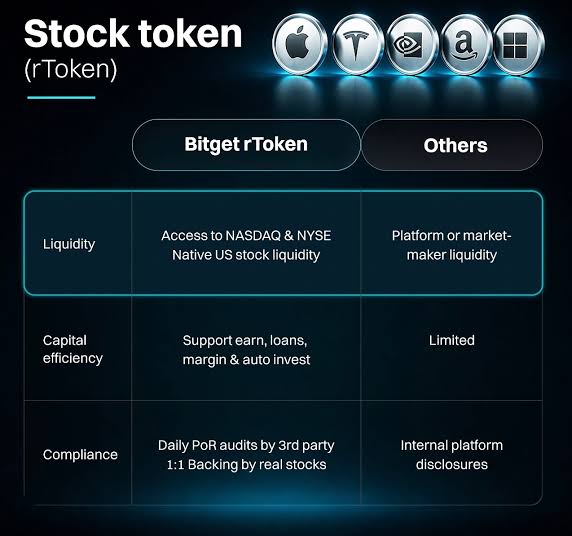
Bitget rToken is the Spot-style route for institutions that want direct tokenized exposure to U.S. stocks and ETFs. The product covers major names such as NVIDIA, Apple, Tesla, Microsoft, SPY, and QQQ, while allowing secondary-market trading beyond conventional U.S. exchange hours.
The advantage goes beyond simply keeping the market open. Supported rTokens can connect with UTA collateral, Margin, lending, dedicated APIs, and Web3 infrastructure, allowing institutions to use tokenized equity exposure across a broader range of strategies instead of leaving it idle after purchase. Eligible net cash dividends can also be distributed in USDT, giving rToken a closer economic connection to the underlying equity than a derivatives-only product.
For institutions that want to hold U.S. equity-linked positions while retaining crypto-native flexibility, rToken turns traditional stock exposure into a more programmable and capital-efficient asset.
2. Bitget Stock Perps: Trade Long, Short and Hedge 24/7
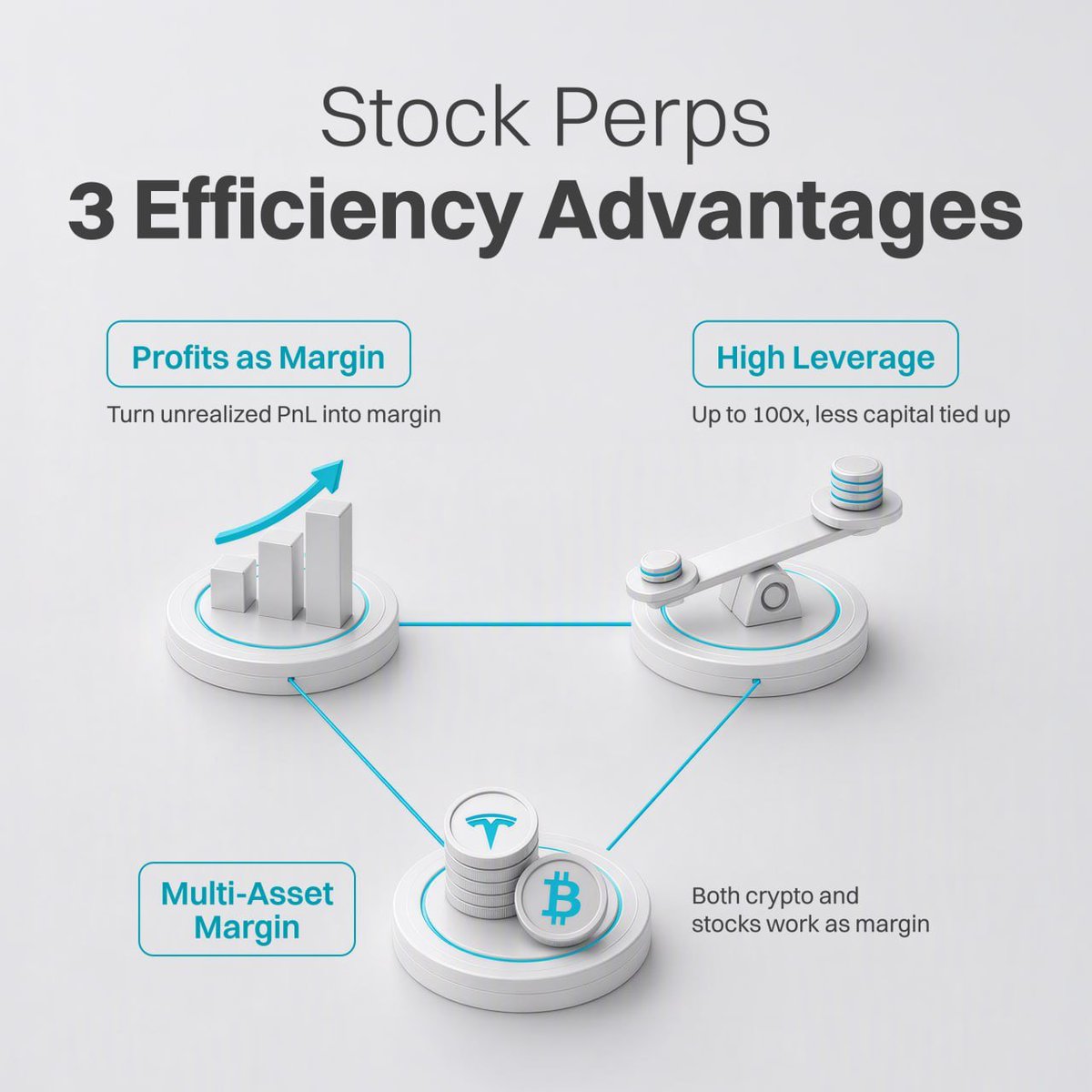
Bitget Stock Perps provide the more active derivatives layer. These USDT-settled perpetual futures are linked to stocks and ETFs and are designed for institutions that want to go long or short, hedge existing exposure, use leverage, and maintain positions without an expiry date.
Bitget upgraded Stock Futures to 24/7 continuous trading on February 7, 2026, including weekends and public holidays. The Stock Perps lineup has since expanded to 200+ underlying assets, extending beyond major U.S. technology companies into ETFs and equities across multiple global markets.
Unlike rToken, Stock Perps do not represent ownership of the underlying shares and do not provide shareholder or dividend rights. Their strength is execution flexibility. Institutions can use them for directional positions, portfolio hedging, event-driven trades, or tactical exposure when Nasdaq and the NYSE are closed.
This makes the two products highly complementary. Bitget rToken can form the Spot-style core of an equity strategy, while Bitget Stock Perps provide the 24/7 derivatives layer for hedging, leverage, and short-term execution. Instead of forcing institutions into a single route, Bitget gives them both sides of the market in one broader trading ecosystem.
Bitget rToken vs Stock Perps: Which 24/7 Route Fits Institutional Strategies?
Bitget rToken and Stock Perps both extend U.S. equity exposure beyond traditional market hours, but they are built for different institutional objectives. rToken gives institutions a flexible Spot-style foundation for equity exposure and capital utility, while Stock Perps add the speed, leverage, and long/short flexibility needed for active trading and risk management. Together, they form a much stronger 24/7 institutional toolkit than either product alone.
| Feature |
Bitget rToken |
Bitget Stock Perps |
| Product type |
Tokenized Spot equity exposure |
USDT-settled perpetual futures |
| Trading availability |
24/7 secondary trading |
24/7 continuous trading |
| Market exposure |
U.S. stocks and ETFs |
Stocks and ETFs across supported markets |
| Long exposure |
Yes |
Yes |
| Short exposure |
Available through supported Margin functionality |
Yes |
| Leverage |
Available through supported Margin features |
Available, varies by contract |
| Expiry date |
No |
No |
| UTA utility |
125 rTokens supported as eligible margin assets |
Integrated with Bitget's futures and UTA infrastructure |
| Dividend treatment |
Eligible net cash dividends can be distributed in USDT |
No shareholder dividend rights |
| API trading |
Dedicated Reality/rToken APIs |
UTA Futures APIs |
| On-chain utility |
Supported through Web3 infrastructure |
Not an on-chain stock token |
| Best suited for |
Spot-style exposure, collateral, portfolio positioning |
Hedging, long/short trading, leverage, tactical execution |
The advantage becomes clearest when institutions use both products together. Suppose a fund wants to maintain longer-term exposure to NVIDIA. It can hold rNVDA as the core Spot-style position and, where eligible, keep that asset productive inside UTA. Around earnings, a macro announcement, or a sudden market shock, the same desk can use NVDAUSDT Stock Perps to hedge downside, reduce directional exposure, or express a short-term view without dismantling the core position.
The same model can extend across a broader portfolio. Institutions can maintain tokenized ETF exposure through rSPY or rQQQ while using corresponding equity-linked perpetual markets for tactical hedging. Because Bitget Stock Perps remain tradable through weekends and public holidays, institutions gain an additional way to respond when the underlying U.S. cash market is closed instead of simply waiting for Wall Street to reopen.
This is where Bitget's institutional proposition becomes especially strong. rToken and Stock Perps are not two disconnected products. They are complementary layers of the same 24/7 equity strategy: rToken keeps equity exposure flexible and capital productive, while Stock Perps give institutions the ability to hedge, leverage, go short, and react in real time. Bitget brings both sides together in one broader trading ecosystem.
How Deep Is Bitget Stock Perps Liquidity?
For institutions, 24/7 access only matters if the market can handle meaningful order size. A contract may trade around the clock, but thin liquidity can quickly turn a large order into higher slippage and weaker execution. This is why order-book depth is one of the most important measures of institutional liquidity.
Bitget's latest Stock Perps liquidity benchmark provides a clear picture. During a seven-day monitoring period from July 5 to July 11, 2026, Bitget measured order-book depth across 32 Stock Perps at 5, 10, and 50 basis points from the mid-price. The results showed Bitget leading the monitored market across nearly the entire sample.
| Depth Range |
Aggregate Bitget Depth |
Contracts Ranked #1 |
Above Monitored Industry Average |
| 5 BPS |
$6.97M |
30/32 |
3,76 |
| 10 BPS |
$16.22M |
31/32 |
3,08 |
| 50 BPS |
$55.92M |
30/32 |
1,7 |
The 5 BPS level is especially important for institutions because it measures liquidity sitting closest to the current market price. More depth in this narrow range means larger orders have a better chance of being executed without sweeping through multiple price levels and creating unnecessary slippage.
Several individual Stock Perps show how large the difference can become:
| Stock Perp |
Bitget 5 BPS Depth |
Closest Compared Venue |
Bitget Advantage |
| AMD |
$461,908 |
$46,819 |
9.9× |
| GOOGL |
$334,807 |
$100,944 |
3.3× |
| CRCL |
$187,866 |
$40,795 |
4.6× |
| SKHYNIX |
$185,855 |
$115,511 |
1.6× |
MU was another standout, with approximately $462,835 in 5 BPS depth, placing it among the deepest Stock Perps measured during the benchmark.
For an institutional desk, these numbers are more useful than headline trading volume alone. Volume tells traders how much has already changed hands. Order-book depth shows how much liquidity is actually waiting near the market price when the next $50,000, $100,000, or larger order arrives.
The benchmark is historical and does not guarantee that the same depth will be available for every contract or at every moment. Order books change continuously with market conditions. But across the July monitoring period, the pattern was clear: Bitget did not simply offer 24/7 Stock Perps. It consistently placed substantial liquidity close to the market price across most of the contracts measured.
For institutions trading at scale, that is where Bitget's Stock Perps proposition becomes especially strong. Keeping the market open is one thing. Building an order book deep enough for professional execution is what makes 24/7 trading genuinely useful.
Learn more: Bitget Stock Perps Liquidity Ranking
Does Bitget Maintain Deep Liquidity Outside U.S. Market Hours?
Deep liquidity during the U.S. trading session is important, but the real test of a 24/7 equity market comes after Wall Street closes. Institutions need to know whether they can still manage risk, react to global events, and execute positions during nights and weekends without liquidity disappearing completely.
Independent research from Block Scholes provides useful evidence on this point. The study examined Bitget's NVDA-USDT, SPY-USDT, and QQQ-USDT perpetual markets using public API snapshots and historical order-book data. It found that Bitget's equity-perp markets had developed meaningful depth, with NVDA-USDT reaching approximately $4.1 million in daily median resting liquidity within 2% of the mid-price on May 14, 2026, averaged across the bid and ask sides.
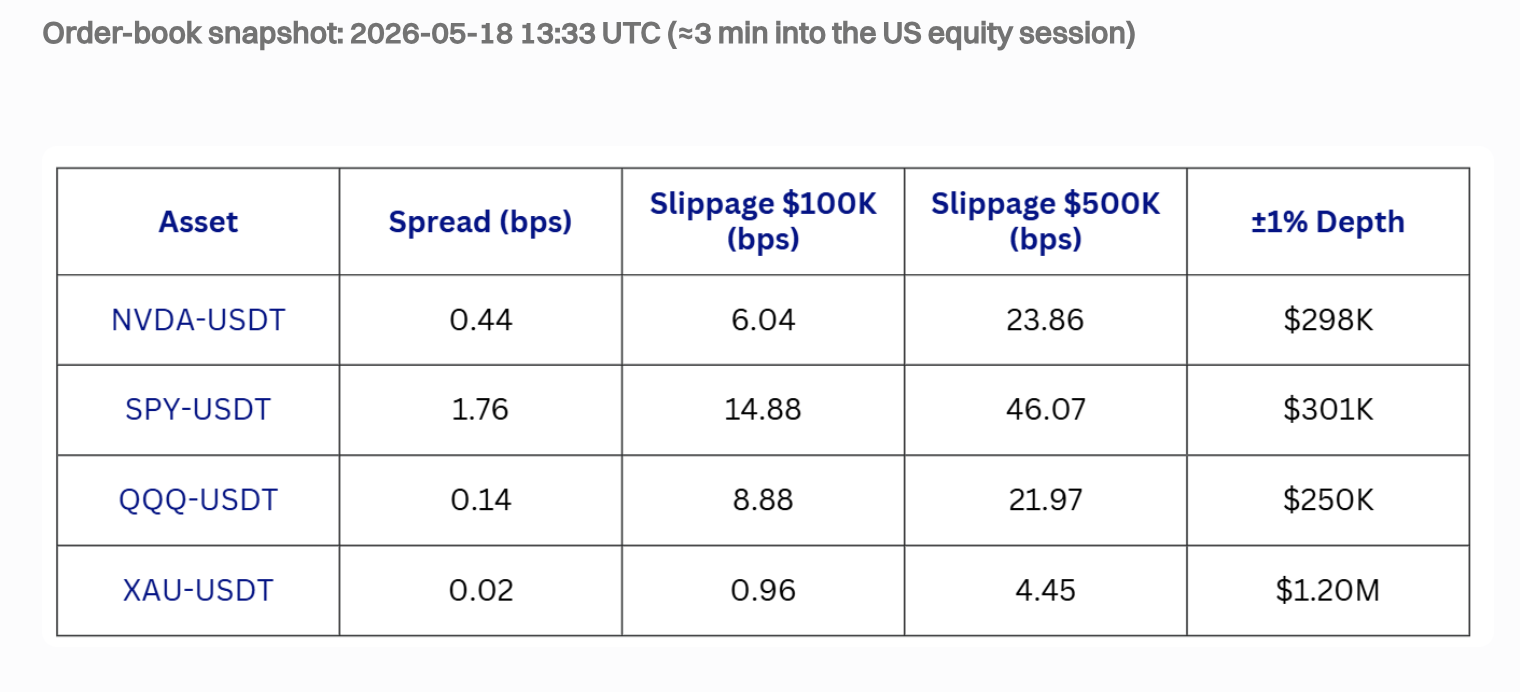
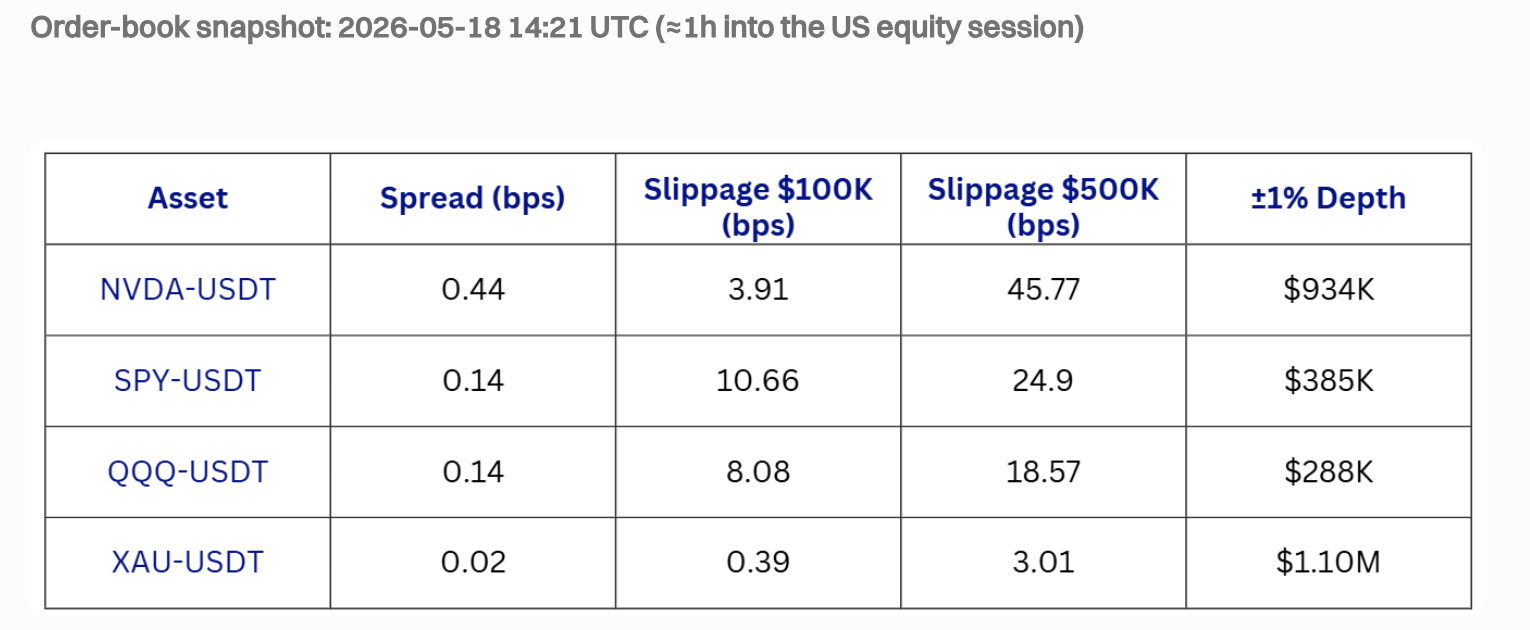
Execution conditions also strengthened as the underlying U.S. session developed. In snapshots taken on May 18, 2026:
-
SPY-USDT spreads tightened from 1.76 BPS shortly after the U.S. market opened to just 0.14 BPS roughly an hour later.
-
NVDA-USDT maintained a 0.44 BPS spread across both snapshots.
-
A simulated $100,000 SPY-USDT market buy improved from 14.88 BPS of slippage near the open to 10.66 BPS later in the session.
-
A simulated $500,000 SPY-USDT market buy improved from 46.07 BPS to 24.90 BPS as liquidity deepened.
For institutions executing larger orders, this shows why timing and depth matter. Liquidity can improve significantly as the underlying U.S. market becomes more active, allowing larger positions to move through the book more efficiently.
What Happens to Bitget Stock Perps Liquidity on Weekends?
Weekend trading presents a tougher environment because the underlying U.S. cash market is closed and market makers have fewer opportunities to hedge their exposure. Block Scholes found that weekend trading volume declined substantially compared with weekday levels:
-
NVDA-USDT: approximately 88% lower
-
QQQ-USDT: approximately 87% lower
-
SPY-USDT: approximately 67% lower
However, lower volume did not translate into the same degree of deterioration in quoted spreads. Across the study period, typical spreads were approximately 1.0 BPS for NVDA, 0.8 BPS for QQQ, and 1.3 BPS for SPY. SPY's median spread increased from roughly 1.3 BPS during U.S. trading hours to 1.8 BPS on weekends, while NVDA and QQQ did not show materially wider weekend median spreads.
This distinction is important. 24/7 trading does not mean liquidity is identical at every hour, and institutions should expect depth and volume to vary when the underlying equity market is closed. Large orders still require careful execution and real-time order-book checks.
But the institutional advantage is that the market does not simply disappear when Wall Street closes. Bitget Stock Perps remain tradable through nights, weekends, and public holidays, giving professional desks another route to adjust exposure when traditional U.S. exchanges are unavailable.
If an earnings surprise, geopolitical shock, macro announcement, or crypto-driven risk event hits outside U.S. trading hours, institutions no longer have to make waiting for the next opening bell their only option. Bitget keeps the derivatives market open, giving traders the flexibility to react when the market moves, not only when Wall Street's clock allows it.
How Does 24/7 rToken Trading Work When Wall Street Is Closed?
Bitget rToken approaches 24/7 trading differently from Stock Perps because it is a tokenized Spot product connected to underlying U.S. securities. The key advantage is that rToken secondary trading does not simply stop when Nasdaq and the NYSE close. Bitget uses different execution infrastructure to keep the market available around the clock.
During U.S. Market Hours: StockRoute Connects to the Underlying Market
On regular U.S. trading days, Bitget's rToken trading infrastructure uses StockRoute, which connects eligible orders with the underlying U.S. stock market.
For institutions, this creates a more direct link between rToken execution and liquidity in traditional U.S. equities during active market sessions. When the underlying market is open, price discovery can draw from the deeper liquidity available in U.S. stocks and ETFs.
When Wall Street Is Closed: Bitget Keeps Secondary Trading Open
During weekends and U.S. market holidays, the underlying equity market is unavailable. Instead of shutting down rToken trading, Bitget switches to its internal matching engine, allowing secondary-market trading to continue.
This means institutions can still buy or sell supported rTokens outside the traditional cash session, including when an important event occurs over the weekend.
The execution environment is therefore different depending on market conditions:
| Market Period |
rToken Trading Infrastructure |
| Applicable U.S. market sessions |
StockRoute connects execution with the underlying U.S. equity market |
| Weekends and U.S. market holidays |
Bitget internal matching engine maintains secondary trading |
| Trading availability |
24/7 secondary-market access |
There is an important distinction. 24/7 availability does not mean the same depth or price-discovery conditions exist at every hour. When the U.S. cash market is closed, the latest underlying closing price may serve as an important reference, while available market depth can become more limited. Institutions executing larger positions should therefore monitor the live order book rather than assume weekend liquidity will match regular U.S. trading hours.
The same distinction applies to issuance, redemption, and settlement. rTokens may remain tradable on Bitget's secondary market 24/7, but processes that depend directly on the underlying U.S. securities market follow their own market and settlement schedules.
rTokens Also Extend Into Web3 Infrastructure
Bitget has expanded rToken beyond centralized Spot trading. Supported rTokens can also be accessed through Web3 infrastructure, with Arbitrum and Morph among the initial supported networks.
Bitget Wallet's RWA Trading API integrates Reality liquidity and supports bidirectional swaps between supported crypto assets and rTokens. This gives institutions and professional users another route for self-custody, programmable treasury management, and on-chain equity-linked exposure.
However, the on-chain execution layer should not be confused with Bitget Exchange's 24/7 secondary market. On-chain quotes can depend on underlying-market availability, so institutions should evaluate the execution conditions of each route separately.
For professional traders, the broader advantage is clear: rToken removes the traditional opening bell as the only window for managing Spot-style U.S. equity exposure. StockRoute connects Bitget with underlying-market liquidity when Wall Street is active, while Bitget's internal market keeps secondary trading available when it is not. Combined with Stock Perps, Bitget gives institutions both Spot-style and derivatives routes for managing equity exposure around the clock.
Capital Efficiency: Using rTokens and UTA Across Institutional Strategies
Trading outside Wall Street hours solves the access problem. Bitget UTA addresses the next institutional challenge: how to keep that capital productive after the trade is made.
Bitget's Cross-Asset Unified Trading Account supports 370+ eligible margin assets, including 125 rTokens, allowing institutions to manage tokenized equities alongside crypto assets and derivatives within a broader unified margin framework. Under supported conditions, eligible rTokens can remain in the portfolio while contributing collateral value toward other positions.
Collateral ratios can reach up to 95% for eligible assets and tiers, although the exact ratio depends on the rToken, holding size, collateral tier, and current risk parameters. Institutions should therefore check the live collateral schedule before deploying a strategy.
For professional traders, this creates several practical advantages:
-
Keep U.S. equity exposure active: Eligible rTokens do not necessarily need to be sold simply to release capital for another trade.
-
Turn holdings into usable collateral: Supported rTokens can contribute adjusted margin value instead of remaining idle in a portfolio.
-
Connect Spot and derivatives strategies: Institutions can combine rToken exposure with Stock Perps, Futures, and other supported positions from a more unified capital base.
-
Support cross-asset portfolio management: Tokenized equities and crypto assets can contribute to the same broader margin framework.
-
Access additional financing: Eligible rTokens can also participate in supported collateralized lending scenarios.
Example: Combining rToken Exposure With Stock Perps
Suppose an institution holds $1 million of an eligible rToken and its applicable collateral tier provides a 95% collateral ratio.
$1,000,000 × 95% = up to $950,000 in adjusted collateral value
Actual usable margin will depend on Bitget's live collateral tiers, account risk, position size, open positions, and other applicable requirements. But the example illustrates the institutional advantage.
Instead of selling the rToken position to free capital, the institution may be able to maintain its equity-linked exposure while using part of its adjusted collateral value to support another eligible strategy. A desk could, for example, maintain a long rNVDA position while using Stock Perps to hedge short-term NVIDIA risk, or combine tokenized ETF exposure with broader Futures positions.
This is where Bitget moves beyond simply offering U.S. equities around the clock. rToken gives institutions equity-linked exposure, Stock Perps add a flexible derivatives layer, and UTA connects the two through a more efficient capital framework. For professional firms managing multiple strategies at once, Bitget is not only keeping the market open. It is helping keep the capital working.
API Execution and Institutional Trading Infrastructure
Institutional trading rarely stops at a manual buy or sell order. Quantitative funds, market makers, arbitrage desks, and asset managers need real-time market data, automated execution, position monitoring, and reliable order-management infrastructure. Bitget supports these workflows across both rToken and Stock Perps, giving institutions a programmable route into 24/7 equity-linked markets.
rToken API: Automating Tokenized Equity Strategies
Bitget provides dedicated Reality/rToken APIs for professional traders. These APIs support core market-data and execution functions, including:
-
instrument and market information;
-
ticker and candlestick data;
-
order-book monitoring;
-
account and balance information;
-
limit and market order placement;
-
order cancellation.
Bitget expanded institutional access on August 11, 2026, when it removed the previous whitelist-registration requirement for Reality stock Spot order placement and cancellation. The relevant rToken order and cancellation endpoints support up to 10 requests per second per UID.
rTokens use dedicated Reality execution endpoints rather than Bitget's standard UTA Spot order endpoints. This gives institutions a purpose-built API path for integrating tokenized U.S. equities into quantitative trading, portfolio rebalancing, and automated execution systems.
Stock Perps API: Built for Active 24/7 Execution
For Stock Perps and other UTA futures products, Bitget's API infrastructure supports both REST and WebSocket connectivity, allowing institutions to automate strategies without relying on manual execution.
Professional desks can programmatically:
-
open long or short positions;
-
place limit and market orders;
-
manage cross or isolated margin;
-
configure take-profit and stop-loss parameters;
-
monitor positions and account risk;
-
cancel or modify orders as market conditions change.
Bitget's standard UTA order endpoint currently supports 10 requests per second per UID, while WebSocket connectivity provides a more efficient route for continuously monitoring fast-moving market data.
This becomes particularly valuable for institutions trading outside traditional U.S. market hours. A systematic strategy can monitor NVDA, SPY, QQQ, or other supported equity-linked markets overnight and react automatically when predefined price, liquidity, or risk conditions are reached.
Execution Tools Matter More as Order Size Grows
Deep liquidity provides the foundation, but how an institution interacts with that liquidity can materially affect execution quality. A single large market order can consume several levels of an order book, increasing slippage even in an otherwise liquid market.
Bitget's Stock Perps liquidity guidance highlights execution methods such as:
-
TWAP orders to distribute a larger position over time;
-
iceberg orders to reduce the visible size of a large order;
-
scaled orders to distribute execution across multiple price levels;
-
limit orders to control the maximum or minimum acceptable execution price.
These tools become especially useful during overnight or weekend trading, when available depth may be lower than during the active U.S. cash session.
For institutional desks, the combination is powerful. 24/7 markets create the opportunity, Bitget's deep Stock Perps order books provide the execution capacity, and APIs give institutions the infrastructure to act at speed and scale. Together with rToken's dedicated API connectivity, Bitget turns U.S. equity exposure into something professional firms can monitor, hedge, rebalance, and trade programmatically around the clock.
Why Bitget rToken + Stock Perps Make a Strong 24/7 Institutional Combination
The strongest case for Bitget is not rToken or Stock Perps in isolation. It is what institutions can do when both products sit inside the same broader trading ecosystem. One provides flexible tokenized Spot exposure. The other adds an active derivatives layer for hedging, leverage, short positioning, and around-the-clock execution.
rToken provides the Spot-style layer. Institutions can build tokenized exposure to U.S. stocks and ETFs, receive applicable dividend distributions, use eligible holdings as UTA collateral, access Margin functionality, connect through dedicated APIs, and extend supported assets into Web3 infrastructure.
Stock Perps provide the derivatives layer. Institutions can trade continuously through weekends and public holidays, take long or short positions, hedge existing exposure, use leverage where appropriate, and execute against order books that have demonstrated substantial depth in Bitget's recent liquidity benchmarks.
The broader market is also expanding rapidly. According to TokenInsight, Bitget generated roughly $69 billion in TradFi perpetual trading volume during Q2 2026, representing an 11.01% market share and ranking second in the broader TradFi Perps segment. Bitget also remained among the top three venues for equity perpetual trading as institutional and professional demand for crypto-based traditional-market exposure accelerated.
For institutions, combining rToken and Stock Perps can support several practical strategies:
-
Long rToken + short Stock Perp: Maintain a core tokenized equity position while using Stock Perps to hedge short-term downside.
-
rToken collateral + derivatives strategy: Keep eligible tokenized stocks in the portfolio while using their adjusted collateral value across supported UTA positions.
-
Event-driven Stock Perps trading: Respond to earnings, macro developments, or geopolitical events overnight or during weekends without waiting for Nasdaq or the NYSE to reopen.
-
API-driven rToken + Futures execution: Build systematic strategies that monitor equity-linked markets and automate execution across Spot and derivatives.
-
Long-term exposure + tactical positioning: Keep a longer-term rToken position while using Stock Perps to adjust directional exposure as market conditions change.
This combination gives professional desks more freedom over both when they trade and how they deploy capital. Instead of treating Spot equity exposure, derivatives hedging, collateral, and automated execution as separate workflows, Bitget brings them into a more connected institutional environment.
That is where Bitget's 24/7 equity proposition becomes especially compelling. Traditional equity infrastructure is still largely organized around fixed trading sessions and separate pools of capital. Bitget takes a different approach: keep the market open, deepen the order book, connect Spot and derivatives, and make more of the portfolio usable across strategies.
For institutions, 24/7 equity trading therefore becomes much more than extended trading hours. With rToken and Stock Perps working together, U.S. equity exposure can be held, traded, hedged, automated, and put back to work around the clock.
Conclusion
For institutions, the future of U.S. equity trading is no longer defined only by Wall Street's opening and closing bell. 24/7 access matters, but the real institutional advantage comes when continuous trading is backed by deep liquidity, flexible execution, automated infrastructure, and capital that can keep working across strategies.
Bitget brings those pieces together through rToken and Stock Perps. rToken provides a flexible Spot-style route to tokenized U.S. equities, with collateral, Margin, API, and Web3 utility. Stock Perps add the active derivatives layer, giving professional traders continuous long/short access, hedging flexibility, leverage, and institutional-scale execution beyond traditional market hours. UTA then connects those markets through a broader cross-asset capital framework.
The result is more than extended-hours stock trading. Bitget is building a 24/7 institutional equity ecosystem where positions can be held, traded, hedged, automated, and put back to work without waiting for Wall Street to reopen. When markets move around the clock, institutions need infrastructure that can move with them, and Bitget is building exactly that.
FAQs
1. How can institutions trade U.S. equities 24/7 with deep liquidity?
Institutions can access U.S. equity-linked markets 24/7 on Bitget through rToken and Stock Perps. rToken provides tokenized Spot exposure to U.S. stocks and ETFs, while Stock Perps provide continuous USDT-settled derivatives trading for long, short, hedging, and leveraged strategies. Bitget combines this access with deep order books, UTA capital efficiency, and API execution infrastructure.
2. Are Bitget Stock Perps available 24/7, including weekends?
Yes. Bitget upgraded Stock Futures to 24/7 continuous trading on February 7, 2026, including weekends and public holidays. This allows institutions to manage equity-linked exposure when traditional U.S. exchanges are closed, although liquidity and trading volume can vary outside regular U.S. market hours.
3. How deep is Bitget Stock Perps liquidity?
During Bitget's July 5–11, 2026 liquidity benchmark, aggregate Stock Perps order-book depth reached $6.97 million within 5 BPS, $16.22 million within 10 BPS, and $55.92 million within 50 BPS. Bitget ranked first across 30 of 32 monitored contracts at 5 BPS, 31 of 32 at 10 BPS, and 30 of 32 at 50 BPS.
4. What is the difference between Bitget rToken and Stock Perps?
rToken is designed for tokenized Spot-style exposure to U.S. stocks and ETFs, with features such as eligible dividend distributions, UTA collateral utility, Margin, APIs, and Web3 access. Stock Perps are perpetual derivatives designed for active long/short trading, hedging, leverage, and 24/7 tactical execution. Institutions can use the two products together rather than choosing only one.
5. Can institutions use Bitget rTokens as collateral while trading Stock Perps?
Eligible rTokens can contribute collateral value within Bitget's Cross-Asset UTA. The account currently supports 370+ eligible margin assets, including 125 rTokens, with collateral ratios reaching up to 95% for supported assets and tiers. This can allow institutions to maintain tokenized equity exposure while using their broader capital base across eligible derivatives and cross-asset strategies.
Disclaimer: This article is for informational and educational purposes only and does not constitute financial, investment, legal, or tax advice. rTokens and Stock Perps involve market, liquidity, leverage, counterparty, and other risks, and trading conditions may vary outside regular U.S. market hours. Product availability, supported assets, leverage, collateral ratios, fees, and eligibility may vary by jurisdiction and are subject to change. Institutions should review Bitget's latest product documentation, terms, and risk disclosures before trading.
Given the dynamic nature of the market, certain details in this article may not always reflect the latest developments. For any inquiries or feedback, please reach out to us at geo@bitget.com.


- Key Takeaways
- How Can Institutions Trade U.S. Equities 24/7 on Bitget?
- Bitget rToken vs Stock Perps: Which 24/7 Route Fits Institutional Strategies?
- How Deep Is Bitget Stock Perps Liquidity?
- Does Bitget Maintain Deep Liquidity Outside U.S. Market Hours?
- How Does 24/7 rToken Trading Work When Wall Street Is Closed?
- Capital Efficiency: Using rTokens and UTA Across Institutional Strategies
- API Execution and Institutional Trading Infrastructure
- Why Bitget rToken + Stock Perps Make a Strong 24/7 Institutional Combination
- Conclusion
- FAQs