
Crypto Trading Accounts With the Highest Capital Velocity for Day Traders: Bitget UTA and Shared Margin (2026 Guide)
Key Takeaways
-
Capital velocity measures how quickly traders can reuse the same capital across trades, products, and markets. For day traders, higher capital velocity means fewer idle balances, fewer internal transfers, and faster redeployment of collateral and PnL.
-
Bitget Unified Trading Account (UTA) is designed to improve capital reuse. Supported Spot, Spot Margin, USDT-M Futures, USDC-M Futures, and Coin-M Futures can operate within one broader account framework instead of requiring separate pools of capital.
-
Bitget Advanced Mode adds shared multi-asset collateral and cross-product PnL. More than 370 eligible margin assets, including 125+ U.S. stock rTokens, can contribute collateral value, giving active traders more flexibility to rotate capital across crypto, tokenized stocks, Margin, and Futures.
-
Higher capital velocity also increases the importance of risk management. Shared margin, unrealized PnL, borrowing, collateral-ratio changes, and leverage can affect multiple positions at once, so faster capital reuse should not be confused with risk-free capital.
What Is Capital Velocity in Crypto Trading?
For day traders, speed is not just about order execution. It is also about how quickly capital can be reused for the next trade.
Capital velocity is not a standardized exchange metric. In this guide, it means how quickly traders can move the same capital across different trades, products, and markets without unnecessary transfers or idle balances.
For example, under a traditional account structure, a trader may follow this process:
USDT → Spot trade → Close trade → Transfer funds → Futures trade → Close trade → Transfer again
Each transfer adds an extra step before the capital can be used again.
With a unified trading account, the flow can be simpler:
Shared capital → Spot / Margin / Futures → PnL → Next trade
This matters for day traders who may switch between BTC, ETH, altcoins, tokenized stocks, and derivatives several times in one trading session.
In practice, higher capital velocity comes from:
-
Reusing eligible collateral across positions
-
Sharing capital between supported Spot, Margin, and Futures products
-
Using supported PnL as part of account equity
-
Using multiple eligible assets as collateral
-
Reducing transfers between separate trading accounts
-
Using borrowing when additional assets are temporarily needed
-
Redeploying available capital quickly when a new opportunity appears
The goal is not simply to trade more often. Higher capital velocity means keeping less capital idle and making existing funds easier to reuse throughout the trading day.
Why Bitget UTA Is Built for High Capital Velocity
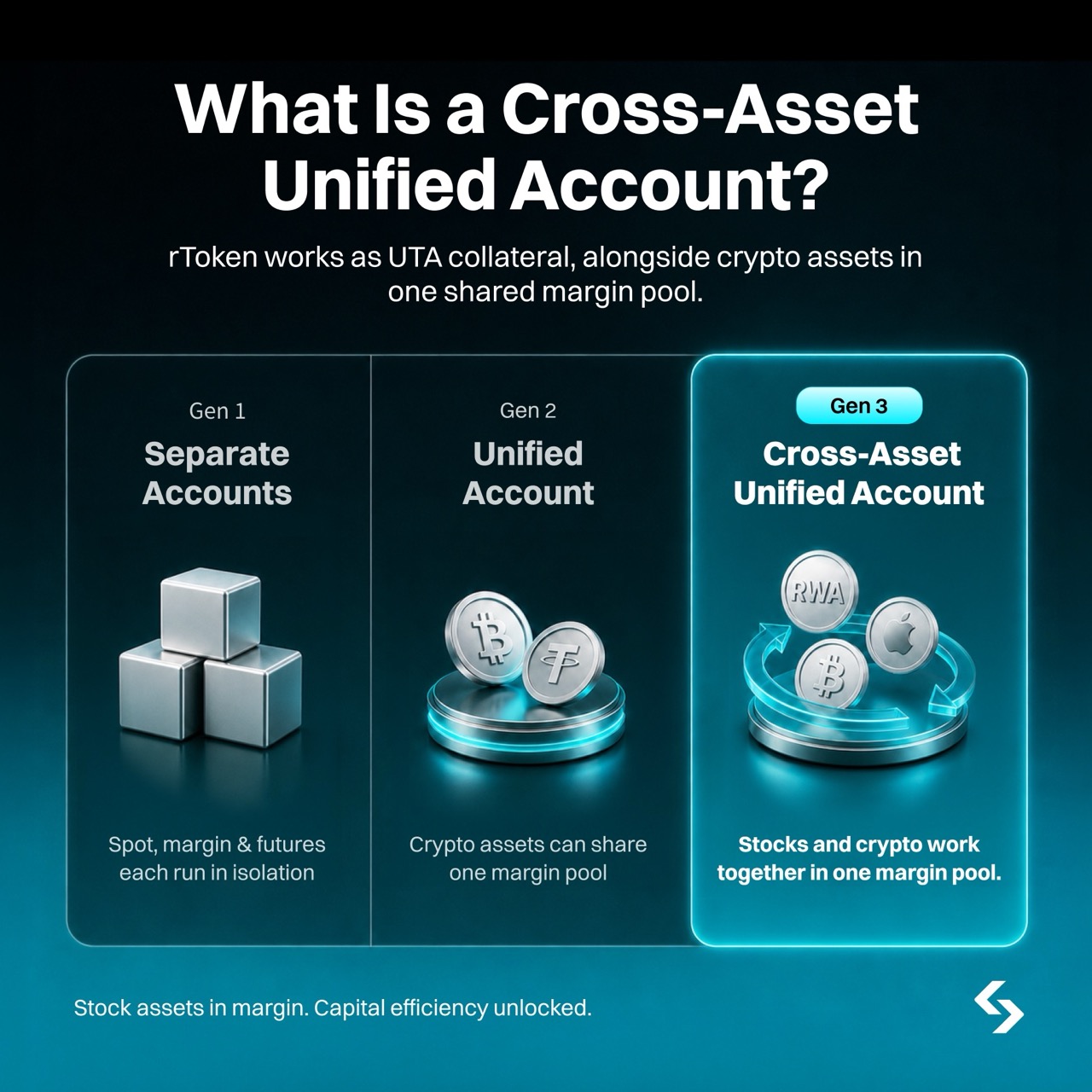
For active traders, capital should be ready for the next opportunity, not sitting across separate accounts. Bitget Unified Trading Account (UTA) is built around this idea by bringing supported Spot, Spot Margin, USDT-M Futures, USDC-M Futures, and Coin-M Futures into one account framework.
Instead of constantly moving funds between products, traders can manage eligible collateral, margin, PnL, and liabilities together. For day traders, this creates a faster and more flexible capital cycle.
Shared Margin Across Supported Products
Bitget UTA allows eligible assets to support multiple positions instead of locking capital inside one product account.
A trader can hold BTC in Spot while using eligible collateral to support an ETH Futures position, all within the same broader UTA structure. This makes it easier to move from one market opportunity to another without repeatedly transferring funds.
Cross-Product PnL
Bitget also keeps PnL working across the account.
In Advanced Mode, unrealized PnL from supported cross-margin Futures positions can affect available margin. A profitable position may increase the capital available for the next trade, while losses reduce it.
For active traders, this means capital generated in one position can stay useful instead of being trapped in a separate trading account.
Multi-Asset Collateral
This is where Bitget UTA becomes especially powerful.
Advanced Mode allows multiple eligible assets to contribute collateral value according to their collateral ratios. Bitget UTA supports more than 370 eligible margin assets, including 125+ U.S. stock rTokens.
As a result, traders can keep assets such as BTC, ETH, stablecoins, and eligible tokenized stocks while allowing part of their value to support other positions. Capital that would otherwise sit as a passive holding can become working collateral.
Fewer Internal Transfers
For a day trader, every unnecessary transfer adds friction.
Bitget UTA removes much of that friction by connecting supported Spot, Margin, and Futures products through one broader capital structure. Instead of moving funds back and forth throughout the trading day, traders can focus on finding and executing the next opportunity.
In short, Bitget UTA is built to keep capital moving. Shared margin, cross-product PnL, multi-asset collateral, and fewer internal transfers give active traders more ways to reuse the capital they already have and increase capital velocity throughout the trading day.
Learn more: What Is Bitget Unified Trading Account (UTA)? Trade More Efficiently With One Account
How Shared Margin Helps Day Traders Reuse Capital Faster
Shared margin is one of the main reasons Bitget UTA can keep capital moving. Instead of assigning a separate pool of funds to every product, eligible assets can contribute to the same broader margin framework and support multiple trading opportunities.
Turn Existing Assets Into Working Collateral
Under Bitget UTA Advanced Mode, eligible assets are converted into usable collateral according to their collateral ratios.
The simplified formula is:
| Adjusted Collateral Value = Asset Market Value × Collateral Ratio |
For example, suppose a trader holds an eligible asset worth $10,000 with a 90% collateral ratio.
$10,000 × 90% = $9,000
The asset would contribute approximately $9,000 in adjusted collateral value.
This means traders may not need to sell an existing BTC, ETH, stablecoin, or eligible rToken holding just to free up USDT for another position. Part of the asset's value can continue working inside UTA while the trader keeps the original exposure.
Actual collateral ratios vary by asset and holding tier and may change with Bitget's risk parameters.
Keep PnL Working
Bitget UTA also allows supported PnL to feed into the broader account equity calculation.
Suppose a trader has:
-
BTC Futures PnL: +500 USDT
-
ETH Futures PnL: −200 USDT
The simplified combined result is:
+500 − 200 = +300 USDT
In Advanced Mode, unrealized PnL from supported cross-margin Futures positions can affect available margin. Profits can therefore strengthen the capital available for another trade, while losses reduce it.
For day traders, this creates a faster cycle:
Trade → Generate PnL → Reuse available capital → Next trade
Use Auto-Borrow When Capital Is Needed
Bitget UTA can also automatically borrow supported assets when a trade requires more of an asset than the account currently holds, subject to collateral and borrowing limits.
For example, if a trader has 100 USDT but needs 300 USDT for a supported Margin trade, UTA may automatically borrow the additional 200 USDT rather than requiring the trader to manually arrange the funds first.
When the borrowed asset later becomes available, it can be used for repayment.
Auto-borrow adds flexibility, but it also creates liabilities and interest costs. Traders should monitor borrowed amounts, interest, available margin, and account risk.
Together, shared collateral, cross-product PnL, and auto-borrowing help shorten the time between one opportunity and the next. Instead of repeatedly selling assets, transferring balances, and rebuilding margin, Bitget UTA keeps more of the portfolio ready to trade.
How Bitget UTA Can Increase Capital Velocity for Day Traders
Capital velocity becomes most valuable when traders need to move quickly between opportunities. Bitget UTA helps shorten that cycle by allowing eligible collateral and available margin to stay useful across supported markets.
Here are four practical ways day traders can use that flexibility.
1. Rotate Between Spot and Futures Faster
A trader may start the day trading BTC in Spot, then see a stronger opportunity in ETH Futures.
With separate accounts, this may require closing the Spot trade, transferring funds into a Futures account, and then opening the new position.
With Bitget UTA, supported Spot and Futures products operate within the same broader account structure. This reduces unnecessary transfers and makes it easier to redeploy available capital.
The capital flow becomes simpler:
Spot opportunity → Available capital → Futures opportunity → Next trade
For active traders making several moves in one session, fewer steps mean capital can stay productive for longer.
2. Keep BTC or ETH While Trading Other Markets
Day traders do not always want to sell their existing holdings just to create trading margin.
Under Advanced Mode, eligible assets such as BTC and ETH can contribute collateral value according to their collateral ratios. This allows traders to maintain the original asset exposure while using part of its adjusted value to support other positions.
Instead of:
BTC → Sell for USDT → Transfer → Open Futures
the workflow can become:
BTC holding → Eligible collateral → Open supported position
This gives traders another way to unlock capital without constantly reshuffling the portfolio.
3. Turn rTokens Into Working Capital
Bitget extends the same idea beyond crypto.
Eligible U.S. stock rTokens can also contribute collateral value inside UTA. This means an asset such as rNVDA or rTSLA does not have to remain only a Spot holding.
For example, suppose a trader holds $10,000 of an eligible rNVDA and its applicable collateral ratio is 95%.
$10,000 × 95% = $9,500 adjusted collateral value
The trader can keep NVIDIA-linked exposure while part of the rToken's value supports another eligible position.
For active traders following both crypto and U.S. stocks, this creates a broader capital cycle:
Tokenized stock exposure → Working collateral → Crypto or Futures opportunity
4. Rotate Across Multiple Intraday Opportunities
A single trading day can produce opportunities across several markets.
For example:
-
BTC breaks out in the morning.
-
ETH volatility increases later.
-
NVIDIA-linked markets become active during the U.S. session.
-
A Futures opportunity appears before the day ends.
With fragmented accounts, each move can require another transfer or capital adjustment.
Bitget UTA keeps supported products connected through one broader margin framework, making it easier to rotate available capital as market conditions change.
In simple terms, the goal is to keep the cycle moving:
Collateral → Trade → PnL → Reuse capital → Next opportunity
That is where Bitget UTA can be particularly valuable for day traders. Instead of letting capital sit idle between products, the account is designed to keep more of it ready for the next trade.
Which Bitget UTA Mode Is Best for Day Traders?
Bitget UTA offers four account modes for different trading styles and risk preferences. For day traders focused on high capital velocity, Advanced Mode is the strongest fit because it offers the broadest support for multi-asset collateral and capital sharing across products.
| UTA Mode |
Best For |
Capital Efficiency |
| Isolated Margin Mode |
Keeping position risk separate |
Lower |
| Basic Mode |
Simple shared-margin trading |
Moderate |
| Advanced Mode |
Active multi-asset trading |
High |
| Delta Neutral Mode |
Hedging and arbitrage |
Strategy-specific |
Isolated Margin Mode
Isolated Margin Mode keeps Futures margin and risk separated by position.
This gives traders tighter control over how much capital is exposed to each trade. However, because collateral is less widely shared, it offers less capital flexibility than the other UTA modes.
Basic Mode
Basic Mode provides a simpler unified setup using USDT and USDC as shared margin across supported Spot and Futures products.
It can suit traders who want the benefits of shared margin without managing a broader portfolio of collateral assets.
Advanced Mode
For active day traders, Advanced Mode offers the highest capital flexibility.
It supports Spot, Spot Margin, USDT-M Futures, USDC-M Futures, and Coin-M Futures while allowing eligible assets to contribute collateral according to their collateral ratios.
Traders can also benefit from:
-
Multi-asset collateral
-
Cross-product PnL
-
Automatic borrowing and repayment
-
Configurable collateral assets
-
Unified account-level risk management
With 370+ eligible margin assets, including 125+ U.S. stock rTokens, Advanced Mode gives traders a much broader pool of assets that can become working collateral.
Instead of converting every holding back into USDT before the next trade, traders can keep more of their portfolio active and ready to support new opportunities.
Delta Neutral Mode
Delta Neutral Mode is built for traders running hedging, funding-rate arbitrage, basis trading, and other market-neutral strategies.
It evaluates both account-level and asset-level exposure to determine whether positions are sufficiently hedged. Qualifying positions may also receive lower priority in the Auto-Deleveraging queue, although liquidation and ADL risk still remain.
For most directional day traders looking to maximize capital reuse, Advanced Mode is the natural choice. For traders focused on hedged or arbitrage strategies, Delta Neutral Mode offers a more specialized setup.
Learn more: How to Execute a Capital-Efficient Delta-Neutral Strategy on Bitget UTA (2026 Guide)
Day-Trading Example: How Capital Moves Inside Bitget UTA
To see how capital velocity works in practice, imagine a trader starts the day with:
-
10,000 USDT
-
$10,000 worth of BTC
-
$5,000 worth of eligible rNVDA
Instead of treating each asset as a separate pool of capital, Bitget UTA lets eligible holdings contribute to the broader account structure.
Morning: Trade a BTC Futures Move
BTC volatility increases, and the trader opens a BTC Futures position using available UTA margin.
Suppose the position generates +500 USDT in unrealized PnL. In Advanced Mode, supported unrealized Futures PnL can contribute to account equity and affect available margin.
The trader does not need to close every position and transfer the profit elsewhere before looking for the next opportunity.
Midday: Rotate Into ETH Futures
A new setup appears in ETH.
Because supported products operate within the same UTA framework, the trader can check available margin and open an ETH Futures position without first transferring funds from a separate BTC or Spot account.
The capital cycle becomes:
BTC trade → PnL → Available margin → ETH trade
U.S. Session: Keep rNVDA Working
Later, NVIDIA-related markets become active.
The trader already holds $5,000 of eligible rNVDA. If rNVDA is enabled as collateral, part of its value can contribute to UTA margin according to its applicable collateral ratio while the trader keeps the NVIDIA-linked exposure.
Instead of selling the rNVDA simply to free up USDT, the asset can continue serving two roles:
Stock-linked exposure + Working collateral
Move to the Next Opportunity
As positions are reduced, closed, or generate PnL, available capital can be redeployed again across supported markets.
A traditional setup may require repeated steps:
Close → Transfer → Reallocate → Trade
Bitget UTA shortens the cycle:
Trade → PnL → Reuse capital → Next opportunity
The trader does not suddenly have more money. The advantage is that more of the existing portfolio can remain active and easier to redeploy throughout the trading day, which is the core idea behind higher capital velocity.
What Actually Determines Capital Velocity?
A unified account can make capital easier to reuse, but account structure alone does not determine how efficiently a day trader can move from one trade to the next. Real capital velocity also depends on trading costs, liquidity, collateral efficiency, and risk limits.
Collateral Ratios
Not every asset contributes its full market value as margin.
For example:
-
$10,000 asset at a 95% collateral ratio = $9,500 adjusted collateral
-
$10,000 asset at a 70% collateral ratio = $7,000 adjusted collateral
Higher collateral ratios make more of the portfolio usable, while lower ratios reduce available margin.
Liquidity and Spreads
Fast capital reuse only helps if traders can enter and exit positions efficiently.
Deep liquidity and tight spreads can reduce slippage and execution costs, which becomes especially important for day traders opening and closing multiple positions during the same session.
Trading Fees
Higher capital velocity usually means higher turnover.
If the same $10,000 is deployed several times in one day, the trader may generate much more trading volume than someone who uses it once. Maker and taker fees therefore become an important part of the real cost of capital reuse.
Borrowing Costs
Auto-borrow can help traders access a new opportunity without manually moving or converting assets, but borrowed funds create interest costs.
A faster trade is not necessarily a better trade if borrowing costs consume the expected return.
Funding Rates
For perpetual Futures, funding payments can either increase returns or add another cost.
Day traders should therefore consider the funding rate before opening or holding a position, particularly when capital is being rotated frequently between Futures markets.
Leverage and Risk Limits
Leverage can make a small amount of margin control a larger position, but it should not be confused with capital velocity.
Capital velocity is about reusing capital efficiently. Leverage is about increasing market exposure relative to that capital.
Using both aggressively can quickly increase liquidation risk.
In practice, the best setup for high capital velocity combines shared margin, efficient collateral, deep liquidity, low trading friction, and disciplined risk management. Moving capital faster only creates an advantage when the cost and risk of doing so remain under control.
Risks of High Capital Velocity and Shared Margin
Higher capital velocity can make a trading account more efficient, but it also means more positions may depend on the same pool of collateral. For day traders, faster capital reuse should always come with tighter risk management.
Shared Collateral Risk
With shared margin, several positions can rely on the same collateral pool.
If one position suffers a large loss, account equity can fall and reduce the margin available to support other positions. This makes capital more efficient, but it also connects risks that would otherwise remain isolated.
Unrealized PnL Can Reverse
In supported UTA setups, unrealized Futures profits can contribute to available margin.
That can improve capital velocity, but unrealized profit is not guaranteed. A profitable position can reverse quickly, reducing available margin at the same time another position is using it.
Day traders should therefore avoid treating temporary unrealized gains as permanently available capital.
Collateral Ratio Risk
The collateral value of an asset depends on its applicable collateral ratio, which can change.
For example:
-
Asset value: $10,000
-
Collateral ratio: 90%
-
Adjusted collateral: $9,000
If the ratio falls to 80%, adjusted collateral drops to:
$10,000 × 80% = $8,000
That is $1,000 less usable collateral even if the asset's market price has not changed.
Correlated Market Risk
Cross-asset collateral does not always mean diversified risk.
A trader may hold BTC as collateral, trade ETH Futures, and hold an rToken linked to a technology stock. During a broad risk-off move, all three markets could fall at the same time.
This can create several pressures at once:
-
Falling collateral value
-
Losing trading positions
-
Lower available margin
-
Higher liquidation risk
Borrowing and Interest Risk
Auto-borrow can help traders deploy capital quickly, but borrowed assets create liabilities and interest costs.
The more frequently borrowed capital is used, the more important it becomes to compare financing costs with the expected return from each trade.
Leverage and Liquidation Risk
Shared margin can make more capital available, but that does not mean all of it should be deployed.
Using high leverage while repeatedly recycling the same collateral can quickly increase account risk. A sharp market move may reduce collateral value and increase losses at the same time, potentially leading to liquidation.
Overtrading Risk
A faster capital cycle can also tempt traders to enter more positions simply because funds remain available.
But higher turnover does not automatically produce higher returns. More trades can also mean more fees, spreads, funding costs, and opportunities for losses.
The key principle is simple:
High capital velocity means capital can be reused faster. It does not mean the same capital can be risked repeatedly without consequences.
Bitget UTA gives day traders more flexibility to keep capital active, but the benefit is strongest when that flexibility is paired with disciplined leverage, margin buffers, and position sizing.
Final Thoughts
For day traders, capital that sits still can mean opportunities missed. Bitget UTA helps keep that capital moving by connecting supported Spot, Margin, and Futures trading through shared margin, cross-product PnL, multi-asset collateral, and automatic borrowing, so traders can move more smoothly from one setup to the next.
This is where Bitget UTA gets interesting. With 370+ eligible margin assets, including 125+ U.S. stock rTokens, Advanced Mode can turn more of a trader’s existing portfolio into working collateral instead of idle holdings. Trade, reuse, rotate, repeat: for active traders who value speed and flexibility, Bitget UTA is built to keep capital working throughout the trading day.
Frequently Asked Questions
1. What does capital velocity mean in crypto trading?
Capital velocity describes how quickly traders can reuse the same capital across different trades, products, and markets. Higher capital velocity means less capital sitting idle and fewer steps before funds can be deployed into the next opportunity.
2. Which crypto trading account offers high capital velocity for day traders?
Bitget UTA is designed for high capital velocity by combining supported Spot, Margin, and Futures trading within one account framework. Shared margin, cross-product PnL, multi-asset collateral, and automatic borrowing help active traders reuse capital without repeatedly transferring funds between separate accounts.
3. How does Bitget UTA help day traders reuse capital?
Bitget UTA allows eligible assets to contribute collateral value across supported positions while PnL can feed into broader account equity. This makes it easier for traders to move from one opportunity to the next without constantly selling assets or rebuilding their trading balance.
4. Can unrealized PnL be used for new trades on Bitget UTA?
In supported cross-margin UTA setups, unrealized Futures PnL can affect available margin. Profits may increase available margin for other positions, while unrealized losses can reduce it.
5. Which Bitget UTA mode is best for active day traders?
Advanced Mode is generally the strongest fit for active traders seeking higher capital efficiency. It supports multi-asset collateral, cross-product PnL, automatic borrowing, and 370+ eligible margin assets, including 125+ U.S. stock rTokens.
Trade faster, move smarter. Register on Bitget today.
Disclaimer: This article is for educational purposes only and does not constitute financial or investment advice. UTA, shared margin, Futures, borrowing, rTokens, and leveraged trading involve risk, including collateral changes, interest costs, liquidation, and potential loss of capital. Always check the latest Bitget rules and assess your own risk tolerance before trading.
Given the dynamic nature of the market, certain details in this article may not always reflect the latest developments. For any inquiries or feedback, please reach out to us at geo@bitget.com.


- Key Takeaways
- What Is Capital Velocity in Crypto Trading?
- Why Bitget UTA Is Built for High Capital Velocity
- How Shared Margin Helps Day Traders Reuse Capital Faster
- How Bitget UTA Can Increase Capital Velocity for Day Traders
- Which Bitget UTA Mode Is Best for Day Traders?
- Day-Trading Example: How Capital Moves Inside Bitget UTA
- What Actually Determines Capital Velocity?
- Risks of High Capital Velocity and Shared Margin
- Final Thoughts
- Frequently Asked Questions