
How to Execute a Capital-Efficient Delta-Neutral Strategy on Bitget UTA (2026 Guide)
Key Takeaways
-
A capital-efficient delta-neutral strategy on Bitget typically pairs a long rToken Spot position with a short, equal-notional stock perpetual on the same underlying asset. The goal is to reduce directional exposure while keeping access to funding-rate and basis opportunities.
-
Bitget Unified Trading Account helps reduce capital fragmentation. Eligible collateral, PnL, liabilities, and margin can be managed within one account framework, so traders do not need to keep Spot and Futures capital fully separated.
-
Delta Neutral Mode uses both account-level and asset-level checks. The account delta-equity ratio should be 20% or lower, while the net Futures position relative to the total position in the same underlying asset should be 5% or lower for qualifying delta-neutral treatment.
-
The strategy is not risk-free. Funding rates can change, collateral ratios can fall, hedge sizes can drift, and liquidation or ADL can still occur, so users should monitor margin, funding, basis, and position balance throughout the trade.
What Is Bitget Unified Trading Account?
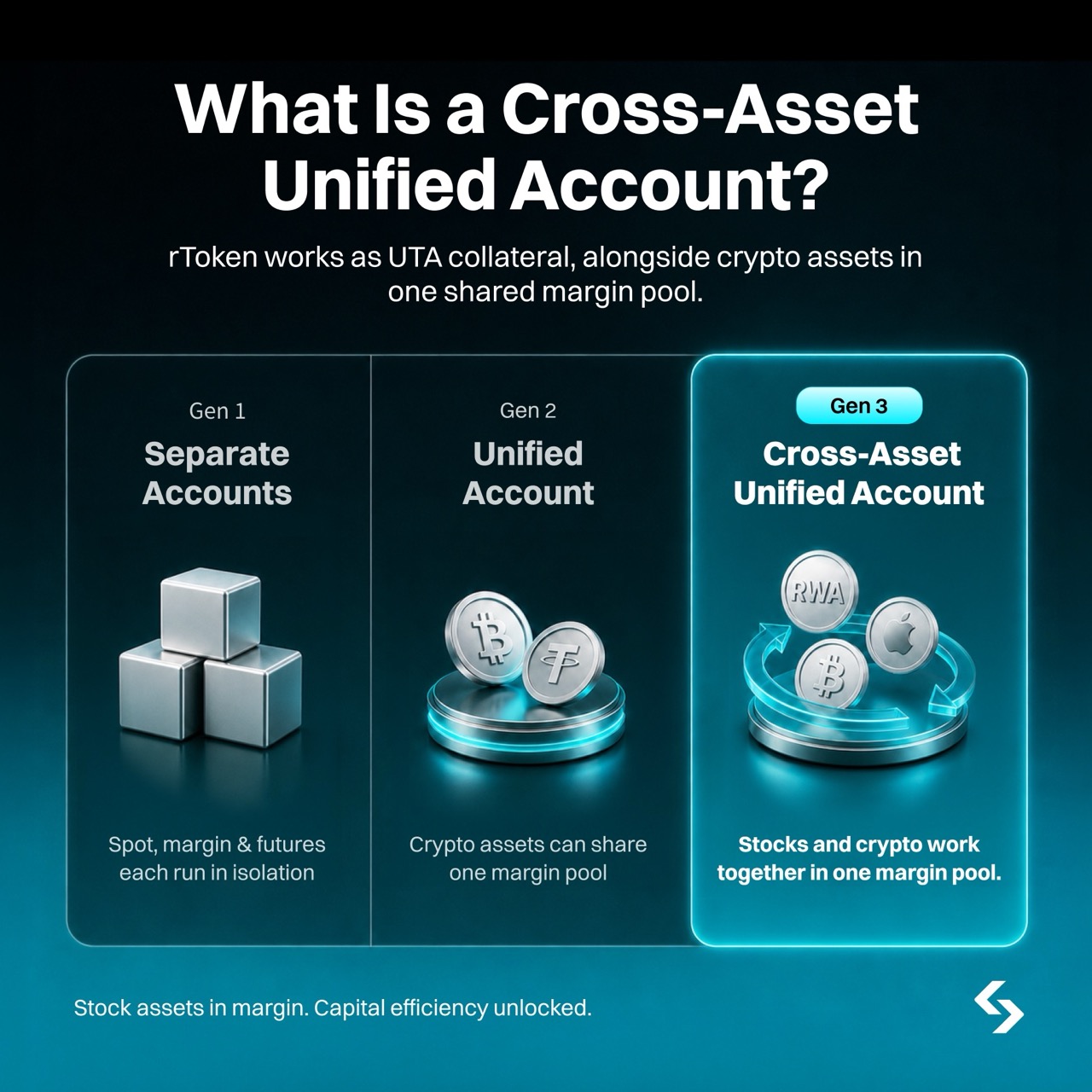
Bitget Unified Trading Account, or Bitget UTA, is an account system that brings supported Spot, Spot Margin, USDT-M Futures, USDC-M Futures, and Coin-M Futures into one shared framework. Instead of keeping funds completely separated across different product accounts, users can manage eligible collateral, margin, PnL, liabilities, and account risk more efficiently from one place.
For delta-neutral strategies, this matters because the Spot and Futures legs can work within the same broader margin structure. Eligible assets may contribute collateral value, supported profits and losses can be calculated at the account level, and users can reduce the need for repeated internal transfers.
Bitget UTA currently offers four account modes:
-
Isolated Margin Mode: Keeps Futures margin and risk separated by position.
-
Basic Mode: Uses USDT and USDC as shared margin for supported Spot and Futures trading.
-
Advanced Mode: Supports the broadest product range and allows eligible cryptocurrencies and rTokens to be used as configurable collateral.
-
Delta Neutral Mode: Designed for qualifying hedging, funding-rate arbitrage, basis trading, and other market-neutral strategies.
For the strategy in this guide, Delta Neutral Mode is the most relevant. It evaluates both account-level and asset-level exposure to determine whether a position qualifies as sufficiently hedged, while eligible positions may receive lower priority in the Auto-Deleveraging queue.
Learn more: What Is Bitget Unified Trading Account (UTA)? Trade More Efficiently With One Account
What Is a Delta-Neutral Tokenized Stock Strategy?
A delta-neutral strategy may sound complicated, but the basic idea is simple: you open two positions that are designed to move in opposite directions. This helps reduce the impact of whether the stock price goes up or down.
On Bitget, one way to do this is to:
-
Buy an rToken in Spot, which gives you exposure to a U.S. stock or ETF.
-
Short a stock perpetual linked to the same underlying asset.
For example, suppose you want to build a delta-neutral position around NVIDIA:
-
Buy $10,000 of rNVDA.
-
Short $10,000 of the NVDA perpetual.
Now imagine NVIDIA rises 5%. Your rNVDA position may gain value, while your short NVDA perpetual may lose value. If NVIDIA falls 5%, the opposite may happen: rNVDA may lose value while the short perpetual gains.
Because the two positions are similar in size and move in opposite directions, much of the price movement can offset. Instead of trying to predict whether NVIDIA will rise or fall, the strategy focuses on other potential sources of return.
Where Can the Return Come From?
There are three main possibilities:
-
Funding payments: Perpetual Futures periodically exchange funding payments between long and short traders. When the funding rate is positive, longs generally pay shorts, so the short side of the strategy may receive funding.
-
Basis opportunities: The rToken Spot price and perpetual price may temporarily differ. Traders may benefit if this price gap later narrows.
-
Eligible dividends: If the underlying stock or ETF pays a dividend, eligible rToken holders may receive the corresponding distribution in USDT.
Think of it as trying to cancel out most of the stock-price risk while keeping other potential earning opportunities open.
However, delta-neutral does not mean risk-free. Funding rates can change or turn negative, the two positions may not move perfectly together, and the hedge may become unbalanced over time. Traders still need to monitor both sides of the position and rebalance when necessary.
Learn more: How the Delta Neutral Mode Works in the Unified Trading Account
Why Bitget UTA Can Make the Strategy More Capital-Efficient
A delta-neutral strategy normally needs capital on both sides of the trade. You need funds to buy the rToken in Spot, and you also need margin to maintain the short stock perpetual. If these funds are kept in separate accounts, part of your capital may sit unused.
Bitget UTA is designed to reduce this problem. Eligible assets, including supported rTokens, can contribute collateral value within the same account framework. This means you may be able to keep your tokenized stock position while using part of its value to support other positions.
Use rTokens as Collateral
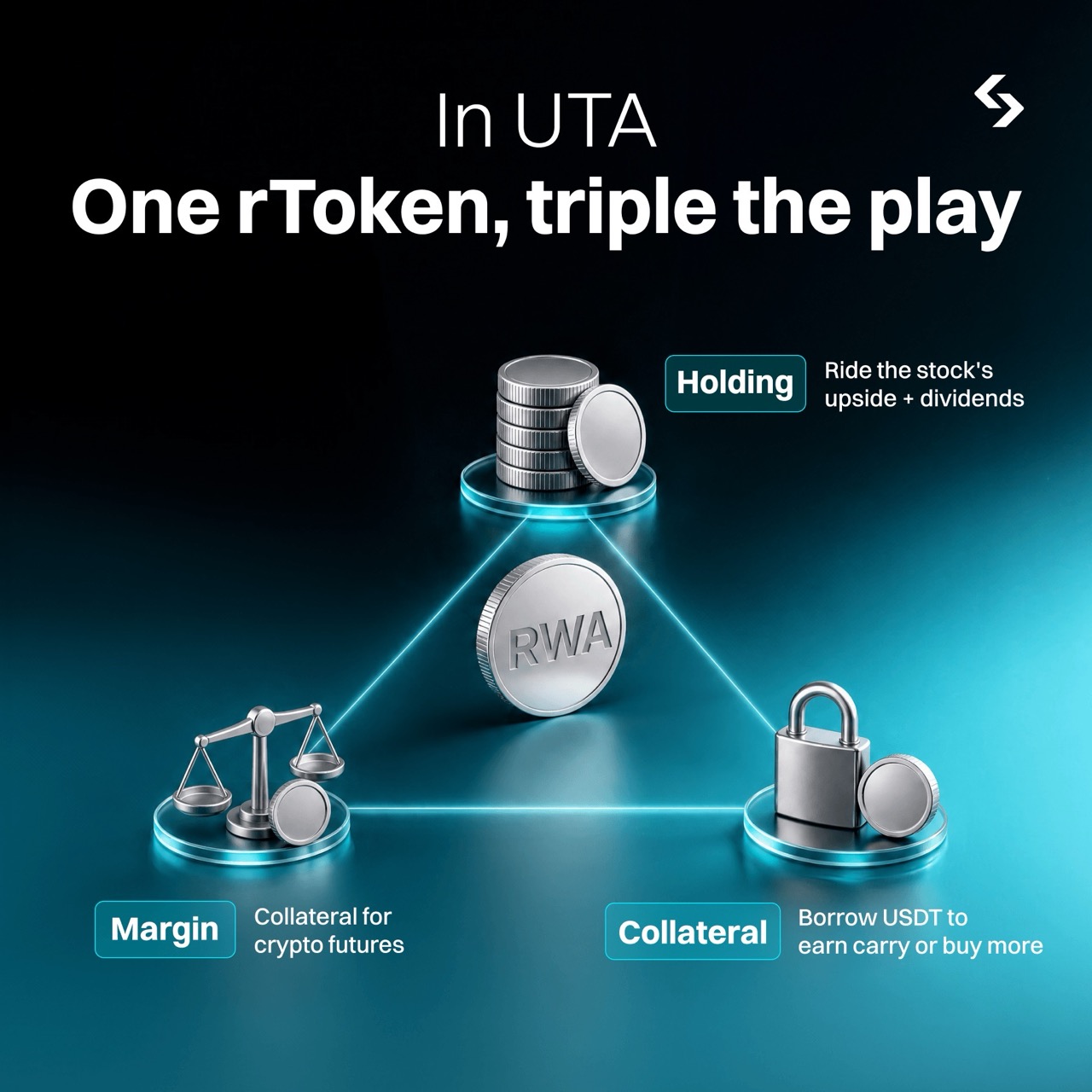
Bitget UTA supports more than 370 eligible margin assets, including 100+ rTokens linked to U.S. stocks and ETFs.
For example, if you hold rNVDA in Advanced Mode and it is eligible as collateral, part of its value can contribute to your available margin instead of sitting only as a Spot holding.
The amount that counts as collateral depends on the asset's collateral ratio.
The basic formula is:
| Adjusted Collateral Value = Asset Market Value × Collateral Ratio |
For example, if:
-
You hold $10,000 of rNVDA
-
Its applicable collateral ratio is 95%
Then: $10,000 × 95% = $9,500
So the simplified adjusted collateral value would be $9,500.
This does not mean every rToken always receives a 95% ratio. The actual ratio depends on the asset, holding tier, and current Bitget risk parameters.
Let PnL Work Across Supported Positions
UTA can also calculate supported profits and losses at the account level.
In a delta-neutral setup, one leg may be temporarily profitable while the other is losing. Instead of treating those positions as completely separate pools of capital, UTA can consider their supported PnL together when calculating account equity.
A simplified way to think about it is:
| Net PnL = Spot PnL + Futures PnL |
For example:
-
rNVDA Spot profit: +500 USDT
-
NVDA perpetual loss: −450 USDT
Then: +500 − 450 = +50 USDT net PnL
This is the basic idea behind using opposite positions to reduce directional price exposure. Actual account calculations may also include collateral values, liabilities, fees, funding, and other adjustments.
Reduce Unnecessary Transfers
Under a traditional account structure, a trader may need to:
-
Buy the tokenized stock in Spot.
-
Transfer USDT into a Futures account.
-
Add more margin if the Futures position moves against them.
-
Move funds again when adjusting the strategy.
With UTA, eligible capital is managed through one broader account structure, reducing these extra transfer steps.
In simple terms, capital efficiency means making more of the assets you already hold available to support the strategy instead of keeping separate pools of idle funds.
However, shared collateral also means shared risk. If one position loses heavily or the value of your collateral falls, the margin available to other positions can also decrease.
How to Execute a Delta-Neutral rToken Strategy on Bitget UTA
Once you understand how the strategy works, the next step is to build the two sides of the hedge. The basic setup is:
Long rToken Spot + Short Equal-Notional Stock Perpetual
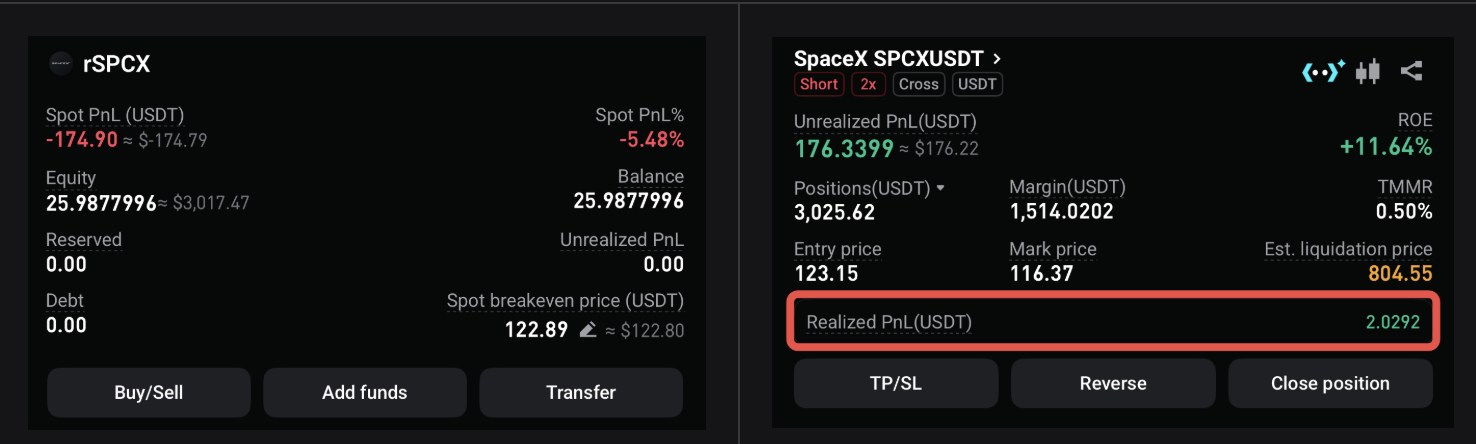
The goal is to keep the two positions close in value so that gains on one side can largely offset losses on the other.
Step 1: Choose an rToken and Matching Stock Perpetual
Start by choosing an rToken that has a corresponding stock perpetual on Bitget.
For example:
-
rNVDA + NVDA perpetual
-
rTSLA + TSLA perpetual
-
rAAPL + AAPL perpetual
-
rSPCX + SPCX perpetual
The two positions should track the same underlying asset. For example, rNVDA should be hedged with an NVDA perpetual rather than a different technology stock.
Step 2: Check the Funding Rate
Before opening the trade, check the funding rate of the stock perpetual.
When the funding rate is positive, long traders generally pay short traders. This means the short perpetual side of the strategy may receive funding.
A simple funding calculation is:
| Funding Payment = Position Notional × Funding Rate |
For example, if:
-
Short position = $10,000
-
Funding rate = 0.03%
Then: $10,000 × 0.03% = $3
The short position would receive approximately $3 for that funding period, assuming shorts are receiving funding.
Funding rates change over time and can turn negative, so traders should check them before entering and while holding the strategy.
Step 3: Buy the rToken in Spot
Next, buy the rToken that will form the long side of the strategy.
For example: Buy $10,000 of rNVDA
This gives you NVIDIA-linked Spot exposure. If rNVDA is an eligible UTA margin asset, it may also contribute collateral value according to its applicable collateral ratio.
Step 4: Short the Matching Stock Perpetual
Now open a short position in the corresponding perpetual.
For example: Short $10,000 of NVDA perpetual
The important point is to match the notional value of both positions as closely as possible.
A simple hedge ratio can be expressed as:
| Hedge Ratio = Short Perpetual Notional ÷ rToken Spot Value |
If:
-
rNVDA Spot = $10,000
-
NVDA perpetual short = $10,000
Then: $10,000 ÷ $10,000 = 1.0
A hedge ratio of approximately 1.0 means the two sides start with similar notional exposure.
Step 5: Use UTA Collateral Efficiently
Once both positions are open, eligible rTokens and other supported assets can contribute collateral value within UTA.
This can reduce the need to maintain a completely separate pool of USDT only for the Futures position.
However, traders should always keep an additional margin buffer. Using all available collateral leaves less room if the market moves quickly or collateral values decline.
Step 6: Check Whether the Position Is Delta Neutral
Opening two equal positions is only the starting point. Bitget Delta Neutral Mode also evaluates whether the account meets specific neutrality requirements.
Two important checks are:
-
Account-level delta equity ratio: 20% or lower
-
Asset-level net Futures position ratio: 5% or lower
Both will be explained in more detail in the next section.
Step 7: Monitor and Rebalance the Hedge
The two positions may not remain perfectly balanced after they are opened.
For example, if the rNVDA position grows to $10,500 while the NVDA perpetual short remains near $10,000, the hedge is no longer perfectly matched.
The trader may need to adjust the Futures position to bring the two sides closer together again.
While the strategy is active, monitor:
-
Funding rates
-
Spot and perpetual notional values
-
Hedge ratio
-
Account delta
-
Available margin
-
Collateral ratios
-
Maintenance margin
-
Borrowing liabilities and interest
-
Basis between the two markets
A delta-neutral strategy therefore requires ongoing management. The objective is not simply to open one long and one short, but to keep the two sides sufficiently balanced while the funding or basis opportunity remains attractive.
How Does Bitget Delta Neutral Mode Determine Whether a Position Is Hedged?
Opening a long rToken position and a short stock perpetual of similar size is only the first step. Bitget Delta Neutral Mode also checks whether the account is sufficiently hedged at both the account level and the individual asset level.
To qualify for delta-neutral treatment, two main conditions need to be met.
1. Account-Level Delta Equity Ratio Must Be 20% or Lower
First, Bitget measures how much directional exposure remains across the entire account compared with total account equity.
The simplified formula is:
| Delta Equity Ratio = Delta USD ÷ Account Equity × 100% |
For example, suppose:
-
Account equity = $100,000
-
Remaining directional delta = $10,000
Then: $10,000 ÷ $100,000 × 100% = 10%
Because 10% is below the 20% threshold, the account passes the account-level delta requirement.
If the remaining delta were $30,000 instead: $30,000 ÷ $100,000 × 100% = 30%
The account would not meet the 20% delta-neutral threshold.
2. Asset-Level Net Position Ratio Must Be 5% or Lower
Bitget also checks whether the Futures position is closely hedged by exposure to the same underlying asset.
The simplified formula is:
| Asset-Level Net Position Ratio = Net Futures Position ÷ Total Asset Position × 100% |
For a closely matched rNVDA and NVDA perpetual position, the remaining net exposure should be small enough that the ratio stays at 5% or below.
For example, if your total NVDA-linked position is worth $10,000 and the remaining unmatched exposure is $300: $300 ÷ $10,000 × 100% = 3%
Since 3% is below 5%, the position meets the asset-level requirement.
The Hedge Must Use the Same Underlying Asset
This rule is important for beginners: holding two assets that usually move in the same direction does not automatically create a qualifying hedge.
For example:
-
rNVDA + NVDA perpetual: Same underlying, so they can form a qualifying hedge.
-
rNVDA + TSLA perpetual: Different underlying assets, so they do not qualify as the same-asset hedge.
Even if NVIDIA and Tesla sometimes move together, Bitget evaluates the hedge based on the underlying asset itself.
Both Conditions Must Be Met
For qualifying delta-neutral treatment, the strategy needs to satisfy both tests:
-
Account Delta Equity Ratio ≤ 20%
-
Asset-Level Net Position Ratio ≤ 5%
Passing only one is not enough.
This is why traders should monitor the hedge after opening it. Price movements can cause the Spot and perpetual positions to drift apart, pushing one of these ratios above the required threshold.
What Happens If the Position Qualifies?
Qualifying hedged Futures positions may receive lower priority in Bitget's Auto-Deleveraging (ADL) queue during extreme market conditions.
However, lower ADL priority does not mean the position is protected from risk. Delta Neutral Mode does not:
-
Eliminate liquidation risk
-
Guarantee that ADL will never occur
-
Remove funding or basis risk
-
Prevent collateral values from falling
-
Guarantee profits
In simple terms, Bitget Delta Neutral Mode helps identify whether your positions are sufficiently balanced. It does not make the strategy risk-free.
Learn more: Bitget Futures: Introduction to Auto-Deleveraging
Delta-Neutral Strategy Example: rNVDA + NVDA Perpetual
Assume a trader wants to build a delta-neutral position around NVIDIA using Bitget rToken and a matching stock perpetual.
Step 1: Open Both Sides of the Trade
The trader opens:
-
Long $10,000 of rNVDA in Spot
-
Short $10,000 of NVDA perpetual
-
Funding rate: 0.03% per 8 hours
Because the Spot and perpetual positions start with the same notional value, the trader begins with a roughly balanced hedge.
If NVIDIA rises, the rNVDA position may gain while the short perpetual loses. If NVIDIA falls, the opposite may happen.
The main goal is therefore not to predict NVIDIA's price direction, but to keep the two legs balanced while potentially collecting funding.
Step 2: Calculate the Funding Payment
When the funding rate is positive, long perpetual traders generally pay short perpetual traders.
With a $10,000 short position and a 0.03% funding rate:
Funding Payment = $10,000 × 0.03% = $3
The trader would receive approximately $3 for that funding settlement, assuming shorts are receiving funding.
If funding is settled three times in one day at the same rate: $3 × 3 = $9 per day
Step 3: Estimate the Annualized Funding Rate
If the same 0.03% funding rate remained unchanged throughout the year, the simplified annualized calculation would be: 0.03% × 3 × 365 = 32.85%
Or approximately: 33% annualized
The following table shows how different funding rates would affect a $10,000 short position:
| Funding Rate per 8 Hours |
Funding per Settlement |
Daily Funding |
Simplified Annualized Rate |
| 0.01% |
$1 |
$3 |
~11% |
| 0.03% |
$3 |
$9 |
~33% |
| 0.05% |
$5 |
$15 |
~55% |
These figures are only examples. Funding rates change with market conditions and may fall, rise, or turn negative.
Step 4: Look at the Two Legs Together
Suppose NVIDIA rises and the positions temporarily show:
-
rNVDA Spot PnL: +500 USDT
-
NVDA perpetual PnL: −470 USDT
The simplified combined price PnL would be: +500 − 470 = +30 USDT
If the trader also received $9 in funding that day:
| Simplified Strategy PnL = Spot PnL + Futures PnL + Funding |
$500 − $470 + $9 = $39
This example shows why the strategy is called delta neutral. Most of the directional price movement is designed to offset, while funding can become an additional source of return.
Actual net returns may be lower after trading fees, spreads, slippage, borrowing interest, basis changes, and rebalancing costs.
Step 5: Keep Monitoring the Hedge
Even if both positions start at $10,000, they may not stay perfectly balanced.
The trader should continue monitoring:
-
rNVDA Spot value
-
NVDA perpetual notional
-
Funding rate
-
Hedge ratio
-
Account delta
-
Available margin
-
Collateral ratio
-
Basis between Spot and perpetual prices
If the two positions drift too far apart, the trader may need to rebalance the perpetual position.
The key idea is simple: the strategy works best when the Spot and short perpetual legs remain closely matched and the funding opportunity remains attractive.
How to Automate the Strategy With Bitget API
Traders who manage only one or two delta-neutral positions may be able to monitor them manually. But once the strategy covers many rTokens and stock perpetuals, automation can make it easier to scan funding rates, open matching positions, monitor hedge ratios, and rebalance when needed.
Bitget's stock API infrastructure supports systematic trading across 600+ rToken Spot markets and 250+ U.S. stock perpetuals, together with UTA integration. Bitget's August 2026 API guide also cites API access of up to 10 requests per second for supported stock-trading workflows.
What Can Be Automated?
A simple delta-neutral trading bot can follow this process:
-
Scan stock perpetual funding rates to find markets where shorts may receive positive funding.
-
Check the matching rToken market and confirm that both markets have sufficient liquidity.
-
Buy the rToken in Spot.
-
Short an equal-notional stock perpetual.
-
Monitor the hedge ratio and account delta.
-
Rebalance the Futures position if the two legs drift apart.
-
Track funding, basis, margin, and collateral ratios.
-
Reduce or close the strategy if the funding opportunity becomes unattractive.
Estimate Whether a Funding Opportunity Is Worth Trading
A high funding rate does not automatically mean a profitable strategy. Traders should compare the expected funding income with the costs of entering, maintaining, and exiting the position.
A simplified calculation is:
| Estimated Net Return = Funding Income + Basis Return + Eligible Dividends − Trading Costs − Borrowing Costs − Rebalancing Costs |
For example, suppose a strategy is expected to earn:
-
Funding income: $30
-
Basis return: $10
-
Trading fees and spread costs: $12
-
Borrowing interest: $5
-
Rebalancing costs: $3
Then: $30 + $10 − $12 − $5 − $3 = $20 estimated net return
This is why an automated strategy should evaluate more than the funding rate alone.
What Should the Bot Monitor?
A delta-neutral bot should continuously track key variables such as:
-
Funding rate
-
rToken Spot price
-
Stock perpetual price
-
Spot and Futures notional values
-
Hedge ratio
-
Account delta
-
Asset-level net position ratio
-
Available margin
-
Maintenance margin
-
Collateral ratios
-
Borrowing liabilities and interest
-
Order-book depth and spreads
If any of these conditions move outside the trader's predefined limits, the system can rebalance or reduce the position.
Example: Automated rNVDA Strategy
Suppose the bot detects a positive NVDA perpetual funding rate.
It could:
-
Buy $10,000 rNVDA.
-
Short $10,000 NVDA perpetual.
-
Check that the hedge remains close to 1:1 by notional.
-
Monitor whether the account remains within Bitget's delta-neutral thresholds.
-
Collect funding while conditions remain favorable.
-
Rebalance if the Spot and perpetual notionals drift.
-
Close both legs if funding turns negative or execution costs become too high.
The main benefit of API automation is not that it removes risk. It helps traders apply the same rules consistently across more markets and react faster when funding, margin, or hedge conditions change.
Risks and When the Strategy Works Best
A delta-neutral strategy reduces directional exposure, but it does not remove trading risk. The setup works best when funding, liquidity, collateral conditions, and execution costs all remain favorable.
When Can the Strategy Work Best?
The strategy may be more attractive when:
-
Funding stays positive: The short perpetual leg can continue receiving funding instead of paying it.
-
Spot and perpetual liquidity is deep: Better liquidity can reduce slippage when opening, rebalancing, and closing both legs.
-
Spreads are tight: Lower spreads reduce the cost of entering and exiting the hedge.
-
Collateral ratios remain stable: Higher collateral efficiency gives the trader more usable margin from eligible rToken holdings.
-
Borrowing costs are low: If borrowing is used, interest should remain below the expected return from the strategy.
-
The hedge remains closely matched: Spot and Futures notionals should stay near the intended ratio.
-
The basis is stable or favorable: Large unexpected differences between Spot and perpetual prices can reduce returns.
Funding-Rate Risk
Funding rates are not fixed.
A positive funding rate may decline or turn negative. If that happens, the short perpetual position may stop receiving funding and could instead begin paying it.
This is why traders should monitor the funding rate throughout the strategy rather than relying only on the rate shown at entry.
Basis Risk
The rToken Spot price and the corresponding perpetual price may not move perfectly together.
If the price difference between the two markets widens unexpectedly, one side of the hedge may lose more than the other gains.
This difference is known as basis risk.
Hedge-Drift Risk
Even if the two positions start with equal notional values, they may drift apart over time.
A ratio close to 1.0 indicates that the two sides remain similar in size.
If the ratio moves too far away from 1.0, the trader may need to rebalance the position.
Liquidation Risk
Delta neutral does not mean liquidation-proof.
If account equity falls or maintenance margin requirements rise, the Futures position can still face liquidation.
Users should therefore maintain additional margin rather than using all available collateral.
Collateral Risk
Eligible rTokens contribute margin according to their applicable collateral ratios.
If:
-
The rToken price falls
-
Its collateral ratio is reduced
-
The holding moves into a different collateral tier
then the usable collateral value can also fall.
If either side of that calculation decreases, available margin may decline.
Borrowing and Interest Risk
UTA borrowing can improve capital flexibility, but borrowed assets create liabilities and interest costs.
The basic profitability calculation should therefore consider:
| Net Strategy Return = Funding + Basis Return + Eligible Dividends − Fees − Interest − Rebalancing Costs |
A strategy with attractive funding may still produce a weak net return if borrowing and execution costs are too high.
Liquidity and Slippage Risk
Traders need sufficient liquidity on both sides of the strategy.
A stock perpetual may show a high funding rate, but if the matching rToken has a wide spread or shallow liquidity, the cost of entering and exiting the Spot leg may offset much of the expected funding income.
Tracking Risk
rTokens and stock perpetuals are designed to provide exposure linked to the same underlying stock, but their market prices may not match perfectly at every moment.
Price differences may become more noticeable during volatile periods or outside traditional U.S. market hours.
Corporate-Action Risk
Dividends, stock splits, reverse splits, and other corporate events can affect the economics of the two positions.
Bitget reflects supported corporate actions in its rToken products, but traders should still monitor upcoming events because they may affect prices, position sizes, or hedge requirements.
ADL Risk
Qualifying Delta Neutral Mode positions may receive lower priority in the Auto-Deleveraging queue, but this is not a guarantee against ADL.
The strategy can still be affected during extreme market conditions.
The best delta-neutral opportunities are not simply the markets with the highest funding rate. Traders should consider funding, basis, liquidity, collateral efficiency, borrowing costs, and hedge stability together before opening the trade.
Final Thoughts
A delta-neutral tokenized stock strategy is less about guessing where a stock goes next and more about making both sides of the trade work together. By pairing a long rToken Spot position with a short, equal-notional stock perpetual, traders can reduce directional exposure and focus on funding-rate and basis opportunities while still keeping stock-linked exposure inside the Bitget ecosystem.
This is where Bitget UTA becomes especially compelling. With 370+ eligible margin assets, 100+ rTokens supported as margin, Delta Neutral Mode, cross-product PnL, and integrated Spot and stock perpetual markets, traders have more ways to put existing capital to work instead of leaving it fragmented across separate accounts. The opportunity is powerful, but disciplined margin management still matters: funding can change, hedges can drift, and leverage can amplify risk.
Frequently Asked Questions
1. What is a delta-neutral rToken strategy on Bitget?
A delta-neutral rToken strategy typically combines a long rToken Spot position with a short, equal-notional stock perpetual on the same underlying asset. The goal is to reduce directional price exposure while potentially earning from positive funding rates, basis opportunities, and eligible dividends.
2. How does Bitget UTA make delta-neutral trading more capital-efficient?
Bitget UTA allows eligible assets, collateral, PnL, liabilities, and margin to be managed within one account framework. Supported rTokens can also contribute collateral value, helping traders reduce the need to keep separate pools of capital for Spot and Futures positions.
3. Can rTokens be used as margin on Bitget UTA?
Yes. Bitget UTA supports 100+ eligible rTokens as margin assets, including tokenized U.S. stocks and ETFs. Their usable collateral value depends on the applicable collateral ratio, asset tier, and current Bitget risk parameters.
4. How does Bitget determine whether a strategy is delta neutral?
Bitget Delta Neutral Mode checks both account-level and asset-level exposure. The Delta Equity Ratio must be 20% or lower, while the asset-level net Futures position ratio must be 5% or lower. The Spot and Futures positions must also reference the same underlying asset.
5. Is a delta-neutral rToken strategy risk-free?
No. Delta-neutral trading reduces directional price exposure but does not eliminate risk. Funding rates can turn negative, Spot and perpetual prices can diverge, collateral values can fall, borrowing can generate interest, and positions can still face liquidation or Auto-Deleveraging.
Build smarter, more flexible strategies. Join Bitget and discover the power of UTA.
Disclaimer: This article is for educational purposes only and does not constitute financial or investment advice. Delta-neutral strategies, rTokens, Futures, margin, and borrowing involve risk, including funding changes, liquidation, and potential loss of capital. Always check the latest Bitget rules and assess your own risk tolerance before trading.
Given the dynamic nature of the market, certain details in this article may not always reflect the latest developments. For any inquiries or feedback, please reach out to us at geo@bitget.com.


- Key Takeaways
- What Is Bitget Unified Trading Account?
- What Is a Delta-Neutral Tokenized Stock Strategy?
- Why Bitget UTA Can Make the Strategy More Capital-Efficient
- How to Execute a Delta-Neutral rToken Strategy on Bitget UTA
- How Does Bitget Delta Neutral Mode Determine Whether a Position Is Hedged?
- Delta-Neutral Strategy Example: rNVDA + NVDA Perpetual
- How to Automate the Strategy With Bitget API
- Risks and When the Strategy Works Best
- Final Thoughts
- Frequently Asked Questions