
Why did gold remain stable after Walsh's speech?

FXStreet, October 16—— On Friday, October 16, the spot gold market remained relatively steady after Federal Reserve Chair Kevin Walsh's speech in Bangkok. The speech did not provide clear guidance on the October policy path, and the market's probability expectation for a rate hike that month fell from around one-third to 15%. Spot gold surged 1.6% on Thursday, marking its largest single-day gain in over two weeks, and is currently trading near $4,180/ounce. Overall, this week’s volatility has been limited, as previous releases of U.S. September inflation data, producer prices, and retail sales have impacted market sentiment.
On Friday, October 16, the spot gold market remained relatively steady after Federal Reserve Chair Kevin Walsh's speech in Bangkok. The speech did not provide clear guidance on the October policy path, and the market's probability expectation for a rate hike that month fell from around one-third to 15%. Spot gold surged 1.6% on Thursday, marking its largest single-day gain in over two weeks, and is currently trading near $4,180/ounce. Overall, this week’s volatility has been limited, as previous releases of U.S. September inflation data, producer prices, and retail sales have impacted market sentiment.
Walsh’s Speech and Rate Expectations Adjustment
In his speech in Bangkok, Walsh reiterated his commitment to achieving price stability but clearly stated he would not pre-judge the outcome of the meeting. This statement did not dispel expectations that the Federal Reserve would leave rates unchanged this month and instead led traders to lower the odds of a rate hike. Higher rates put pressure on non-interest-bearing gold, so the probability drop provided short-term support for its price. Market analysis suggests that Walsh intentionally softened market expectations for a hawkish path to restore stability to the U.S. Treasury market. Despite persistent inflation concerns, further tightening cannot be completely ruled out; however, the latest tone indicates less urgency for consecutive rate hikes. Prior to the speech, the market priced the chance of a 25 basis point hike at about one-third, which dropped to 15% after the speech, reflecting a repricing of expectations. The Federal Reserve’s communication blackout starts Saturday, so the market will obtain limited new information before the meeting.
U.S. Inflation Data and Policy Background
In September, the U.S. consumer price index rose 3.7% year-on-year, and the core index increased 2.6% year-on-year, both exceeding some earlier expectations, with higher energy prices acting as the main driver. Energy costs remain elevated amid Middle East tensions, as the conflict has disrupted energy markets and increased inflation since late February. Last month, the Federal Reserve implemented its first rate hike of 2023, raising the policy rate by 25 basis points to the 3.75%-4% range. Walsh indicated that the economy has broadly performed as expected since the last meeting, and central banks worldwide are generally tightening in sync to address the shared inflation challenge. Worries related to AI investments briefly caused funds to flow out of tech stocks and bond yields to fall on Thursday, boosting gold in the short term. Overall, gold prices changed little this week, reflecting a continuing balance between data and policy expectations.
Review of Price Performance Since the Conflict
Since the outbreak of the Middle East conflict in late February, spot gold prices have declined by about one-fifth. The conflict has pushed up energy prices and exacerbated inflation pressures, prompting major central banks to tighten policy, forming a major macro headwind for gold. As gold does not yield interest, a higher real rate environment reduces its relative appeal. Although conflicts are generally viewed as a source of safe haven demand, this round’s price action reflects rate path and inflation expectations rather than just risk-aversion premium. Gold’s rally on Thursday was related to a bond market rebound, but overall it remained in a range this week. Over the same period, the U.S. Dollar Index fell 0.3%, silver rose 0.7%, and both platinum and palladium also climbed; this shows divergence within the precious metals sector.
Daily Structure and Indicator Status
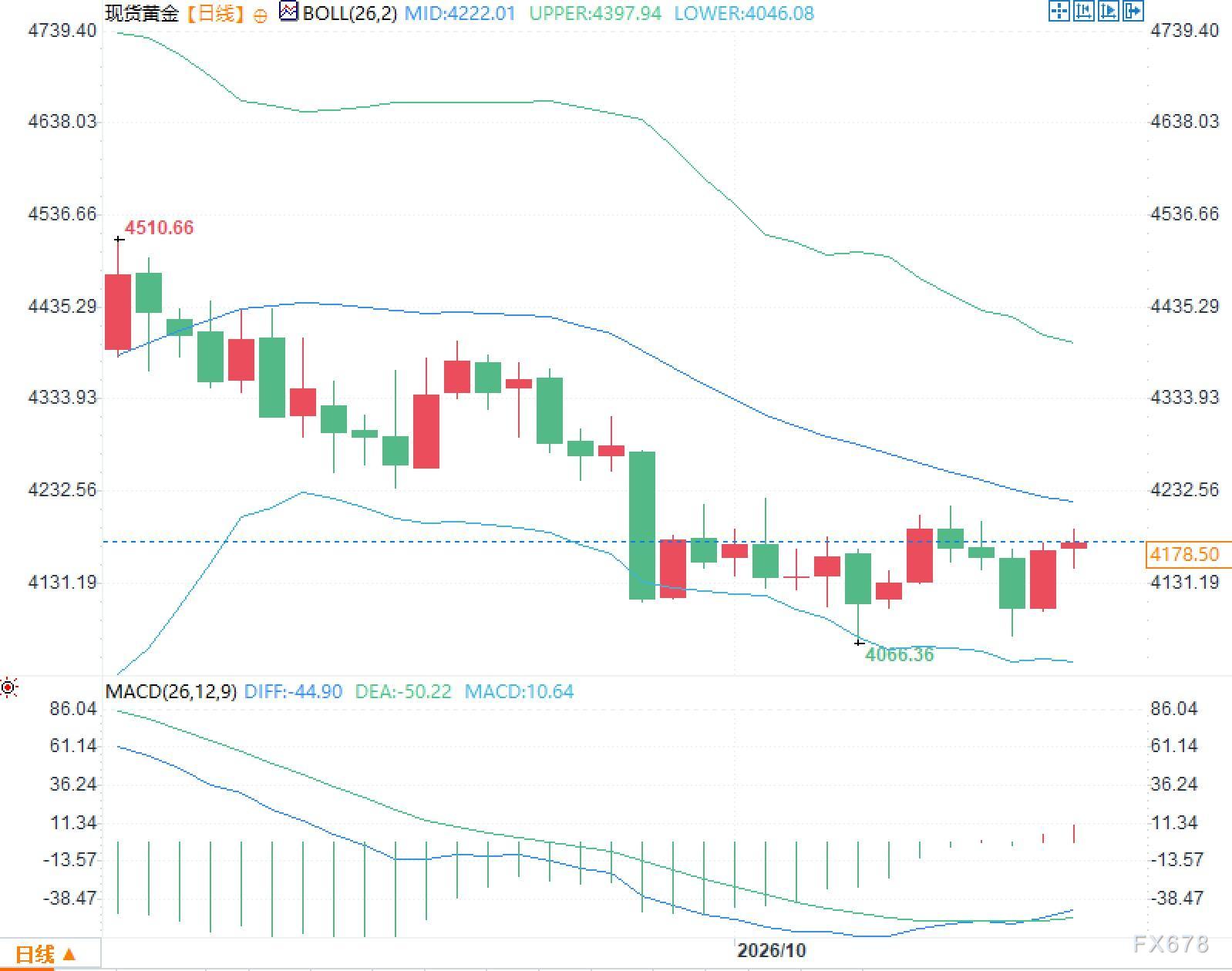
On the daily chart, spot gold price currently lies below the middle Bollinger Band. The middle band is near 4,222, the upper band near 4,398, and the lower band near 4,046. Recently, price touched a low around 4,066 and logged a high near 4,510. On the MACD indicator, DIFF stands at -44.90, DEA at -50.22, and the histogram value is 10.64, showing a positive histogram but both the fast and slow lines remain in negative territory. The price is running below the middle band, and the divergence between the histogram and lines indicates varying stages of volatility and momentum. After the release of economic data this week, prices have remained relatively stable without significant single-sided extension.
Frequently Asked Questions
Answer: The speech did not provide clear signals for a rate hike, and the market lowered October hike odds from about one-third to 15%, reducing rate pressure on non-interest-bearing assets, keeping prices relatively steady.
Answer: The year-on-year reading of 3.7% exceeded some expectations, with energy prices as the main contributor. This reinforced the tightening policy backdrop, but gold’s overall move this week was limited, suggesting this data was partly priced in.
Answer: The conflict drove up energy costs and inflation, pushing the Federal Reserve and other central banks to tighten policy. The higher interest rate environment continues to pressure non-interest-bearing gold, which has decreased by about one-fifth since late February.
Disclaimer: The content of this article solely reflects the author's opinion and does not represent the platform in any capacity. This article is not intended to serve as a reference for making investment decisions.
You may also like
U.S. Treasury Department’s investigation does not signal reduced bond issuance; U.S. Treasury yields rise as 10-year reclaims 5.12%
In a survey soliciting opinions from primary dealers, the Treasury Department asked about plans for repurchasing long-term government bonds, ways to enhance repo efficiency, the timing of short-term bond issuance, and prospects for the economy and financing, but did not directly address the issue of reducing long-term bond supply. Some investors had expected the Treasury to use this questionnaire to more clearly signal that it is considering scaling back the size of long-term bond auctions or even stopping the issuance of 20-year bonds, in response to the Trump administration's efforts to lower financing costs. The refinancing announcement to be released by the Treasury on November 4 has become the next observation point.
Dogecoin eyes daily death cross in 2026 as price trades near $0.081
Copper: Not Just Tariffs

Bitcoin ETFs attract $5.1 million inflow as Ethereum, XRP, Solana funds see outflows

Crypto prices
More


