
Eurozone Manufacturing PMI Hits 52-Month High in September, Demand Rebound Sparks Renewed Inflation Pressures

The eurozone's manufacturing recovery continues to strengthen, but the accompanying price pressures are making the market's assessment of the European Central Bank's monetary policy path increasingly complex.
On Thursday, S&P Global reported that the eurozone's Manufacturing Purchasing Managers' Index (PMI) rose to 52.9 in September, reaching its highest level since May 2022. This marks the third consecutive monthly increase and is above the previous preliminary reading of 52.7.
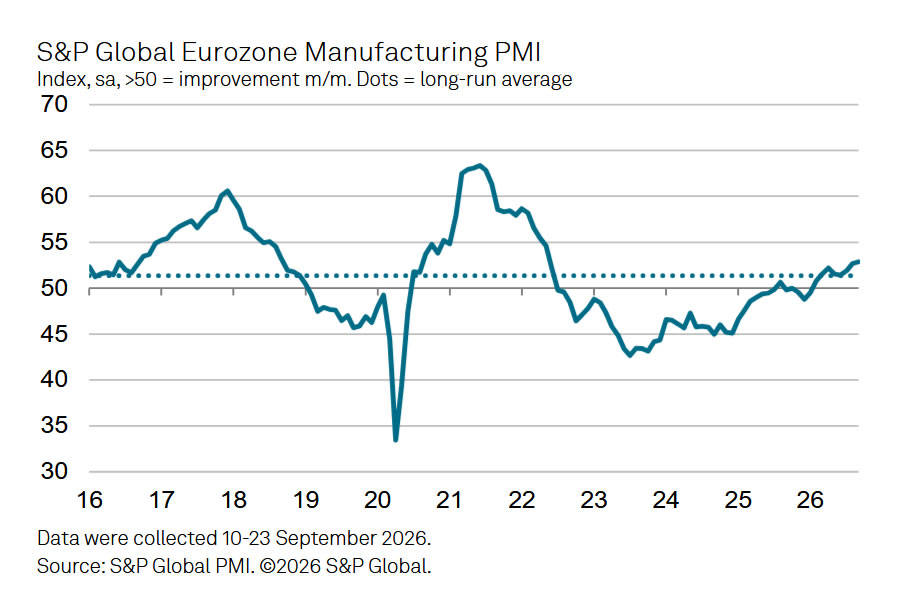
New orders grew at their fastest pace since March 2022, with export orders expanding for a second consecutive month—signaling the first sustained rebound in external demand in more than four and a half years. At the same time, both input costs and output price inflation accelerated for the first time since May. Official data is expected to show the eurozone's September inflation rate rising to 3.6%, the highest since September 2023.
The resurgence of price pressures has left a clear mark on interest rate expectations. Current market pricing indicates that the European Central Bank will implement three rate hikes before mid-2027. Chris Williamson, Chief Business Economist at S&P Global, said that demand for consumer goods continues to decline, and rising living costs are still weighing on household spending. "Against this backdrop, a renewed acceleration in input costs and output prices is worrying, as it may further fuel speculation about additional ECB rate hikes."
The recovery gains momentum, output index hits a 55-month high
The output sub-index of the manufacturing PMI rose from 53.3 to 53.6 in September, reaching a 55-month high and indicating that the strength of production expansion continues to grow.
This round of recovery has also seen the geographic scope notably broaden. All eight eurozone economies covered by the survey recorded readings above 50, marking the first comprehensive expansion in over four years. The Netherlands led the gains, followed by Ireland and Austria; both Germany and Greece also showed robust growth, while Spain, France, and Italy saw relatively moderate increases.
Business confidence has accordingly strengthened, with the business confidence index rising to a seven-month high. Backlogs of orders increased for the first time since April, purchasing activities accelerated, and supplier delivery times lengthened, though the degree of delay was the lowest since February.
Investment goods demand leads, AI and defense spending become core drivers
Chris Williamson pointed out that the core engine of this round of manufacturing expansion is demand for investment goods, especially machinery and equipment. The output growth rate for these capital goods has reached its highest level since the post-pandemic rebound.
He noted that this trend mainly reflects increased demand for artificial intelligence and defense-related equipment. In contrast, consumer goods demand remains weak, with high living costs continuing to suppress household consumption.
The employment market has also shown a positive shift. After more than three years of ongoing layoffs, manufacturing employment returned to growth in August and further expanded slightly in September, indicating that the recovery has broadened from output to recruitment and capacity expansion.
Inflation pressures reignite, expectations of ECB rate hikes intensify
Despite the increasingly comprehensive recovery picture, the return of inflation risks has become a core market concern. Both input cost and output price inflation accelerated in September for the first time since May, although the pace of growth remains below peaks observed earlier this year.
Official inflation data is expected to be released on Friday, with market projections that the eurozone's September inflation rate will rise from 3.2% in August to 3.6%. If confirmed, this would mark the highest level since September 2023.
The market's pricing of the ECB's policy path has shifted accordingly, and three rate hikes are now expected before mid-2027. With manufacturing recovery and inflationary pressures moving in parallel, the European Central Bank faces a more nuanced policy balancing act.
Disclaimer: The content of this article solely reflects the author's opinion and does not represent the platform in any capacity. This article is not intended to serve as a reference for making investment decisions.
You may also like
NEAR Intents Hacked for $3.8 Million: Is NEAR Protocol Safe?
Sky Harbour CFO Francisco Gonzalez acquires $14,535 of common shares
$15 billions IPO in jeopardy? SK Hynix (SKHY.US) latest response: Solidigm financing not yet decided
SK Hynix reiterated on Thursday that no decision has been made regarding the future financing needs of its US subsidiary Solidigm, despite media reports suggesting that the company may pursue a dual listing.
Crypto prices
More


