
Essay: Why Did I Get the Direction Right, but Still Didn't Make Money?

A friend looked at my model portfolio and joked, "Are you opening a supermarket? Why do you have everything?"
It's true, I rarely bet everything on just one or two stocks. The model keeps searching for opportunities among different targets, with each purchase usually making up about 5% of the account. Compared with those stories of going all-in on one stock and doubling up, this approach doesn’t seem very exciting.
But over the years, I've become more and more concerned with one thing: after getting the direction right, did you actually capture the gain from that move?
Many people do get the direction right, but they just can't hold on.
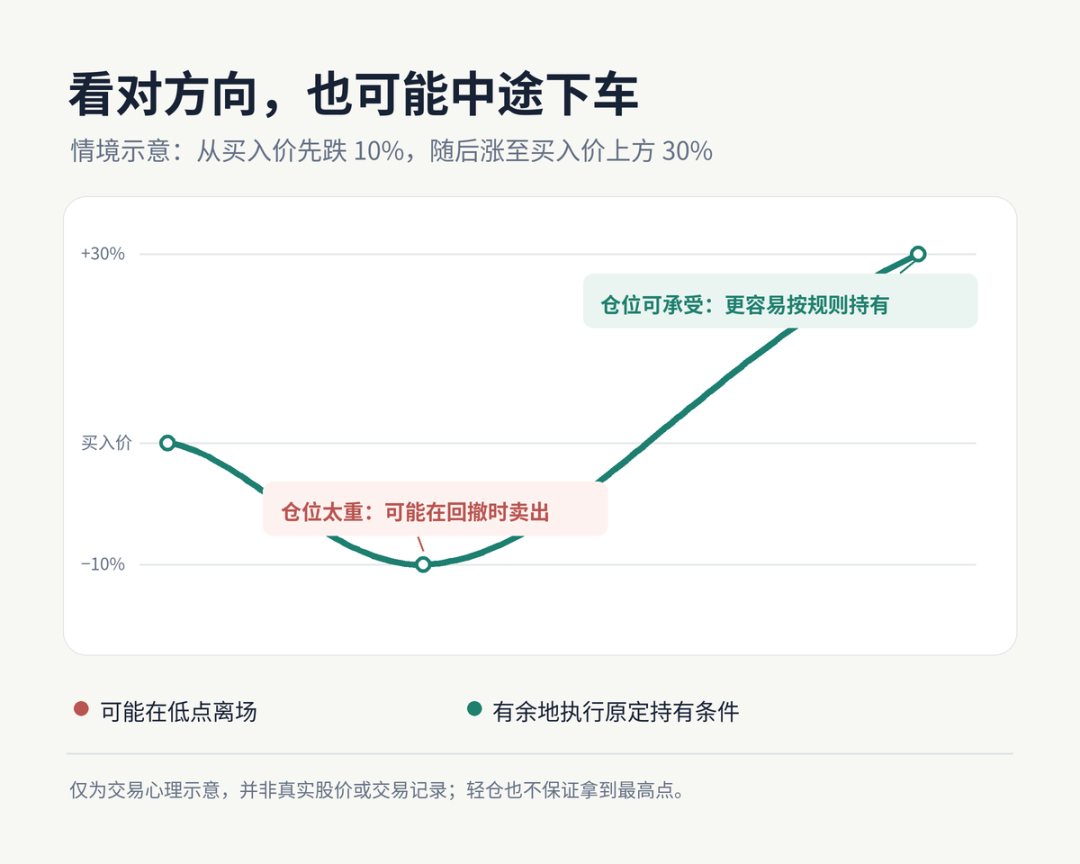
For example, a stock drops 10% right after you buy it and then rises 30% later. In hindsight, your direction was spot on. But if your position was too heavy at the beginning, that 10% loss probably would have scared you out already. When it really starts to rise, all you can say is, "I was optimistic about it from the beginning."
There’s another scenario: after buying, the price rises quickly. Afraid of losing the profit, you sell as soon as you’re up a bit. But then it keeps going and you start regretting selling too early. The direction was right, but your account didn’t get much in the end.
So I've always felt that trading must at least answer three questions: what to buy, how much to buy, and when to exit. Getting only the first one right doesn't guarantee a profit.
What’s the point of a 5% position?
Let’s talk about its downside first.
Suppose your account has $1 million, you put $50,000 into a stock, and it goes up 20%. You make $10,000. If other positions stay unchanged, this only adds about 1% to your overall account. Friends might say: "It went up so much, and you only made that?" Mathematically, that’s absolutely right.
But you must also look at the other way around. If the same position drops 20% in the short term, it only impacts the account by about 1%. Of course, I'll check why it dropped and if the buy conditions still hold, but there's no need to overturn my overall judgment just because of one stock's volatility.
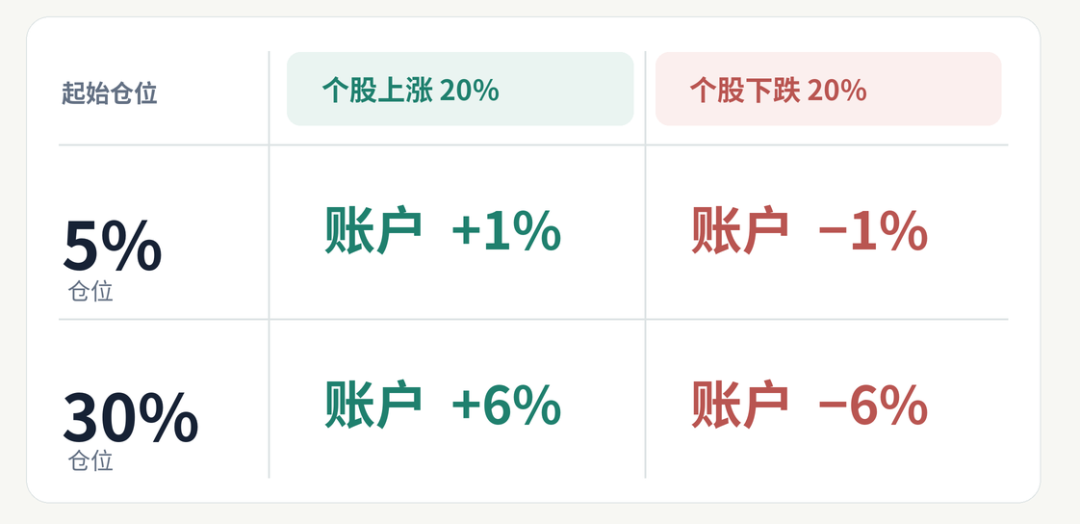
A small position can’t make me indifferent to losses, but its role is to give space for executing my rules. Sell when it's time to sell; as long as the holding conditions persist, I won’t hurriedly exit during a normal pullback. A wrong choice won’t become right, but the anxiety caused by holding too much can be greatly reduced.
Recently: TEM, CRCL, and HOOD
Recently the model bought TEM, CRCL, and HOOD, all of which experienced some gains after buying. Seeing positions rise makes me happy too.

But to say "the model is great at picking stocks" just because of these three would miss my real point: once prices rise, can I stick to the plan and keep holding?
If a stock made up 30% or 40% of my account, I'd be tempted to cash out every time there’s a pullback. Even if you got it right at the start, you may only end up catching a small portion. Now, with smaller positions, I'm more likely to stick to the trading process set by the model. If holding conditions are met, I continue to hold; if exit conditions are met, I sell.
This approach doesn’t guarantee selling at the top. Those that rise may give back gains, and those sold may continue to rise. Position management means I don’t have to guess the top every day, nor do I have to change my plan on a whim out of fear of pullbacks.
"Running a supermarket" doesn’t mean more is always better
I do trade quite a lot, with several positions often open at once. Some people say I trade too "frequently". My idea of frequent is compared with those who buy one stock and don’t touch it for ages. The model keeps searching for opportunities among different signals, and every trade follows pre-set rules.
More trades don’t bring profit on their own. Each extra trade increases the possibility of making a wrong buy or sell, not to mention the actual transaction costs. In my "supermarket", I don’t put everything on the shelf: only enter when there’s a signal, exit when conditions say so, and ultimately look at the whole account’s results.
One more point: A single 5% position doesn’t mean the overall account risk is small. If many positions drop at the same time, or several so-called different targets are actually all affected by the same market factor, small positions can still add up to a considerable drawdown. So, I watch single trade size, total position, and current market risk status together; I don’t regard 5% as a shield.
This method also has its costs. If I come across a really good stock and only buy 5%, the single trade return won’t look impressive; with many trades, I have to honestly calculate the overall return, not just cherry-pick the winning trades. I accept these costs. What matters more to me is: whether a set of rules can control losses when I'm wrong, keep me in the game when I'm right, and still work after many trades.
Getting the direction right is just the beginning
What’s most regrettable in the market isn’t not understanding at all. It’s getting the direction right, but being forced out due to heavy position losses, or being overly afraid of giving back profits and selling when the move is just starting—that’s what hurts the most.
A 5% position for each trade is just a constraint in my model and may not be suitable for everyone. I also don’t think the more diversified the holdings, the better. It allows me to follow signals repeatedly without letting the ups and downs of a single stock affect my emotions too much.
Anyone can call one stock right once. The hard part is integrating judgment, sizing, exit, and risk control into a single set of rules, and then sticking to it over the long term.
Disclaimer: The content of this article solely reflects the author's opinion and does not represent the platform in any capacity. This article is not intended to serve as a reference for making investment decisions.
You may also like
Costco Q4 Earnings Preview: Membership and Capital-Return Test After a Near-Bear Pullback
Morgan Stanley warns US stocks may fall by 10% in the short term!
Crypto prices
More


