
Fed hike is in. Tech didn’t break — it held up. How to position U.S. stocks at higher rates, plus the beneficiary list in one table.
 Bitget2026/09/17 07:03
1. What happened last night: the hike landed, and tech held up relatively well
Last night the Fed delivered its first rate hike in three years, raising the federal funds rate by 25 basis points to 3.75%–4.00%. The vote was 12–0. What was more hawkish than the hike itself was the dot plot: of the 18 officials who submitted projections, 16 see at least one more hike this year. The median points to 4.1% by the end of 2026, then on hold through 2027.
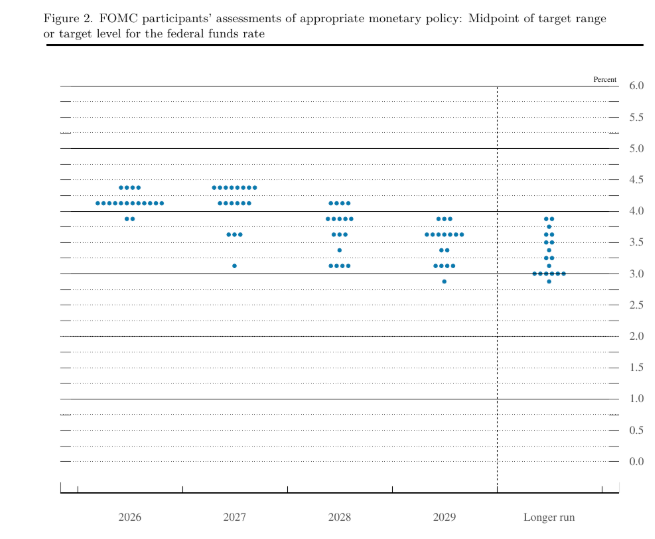
The statement was blunt — the expansion is solid, domestic demand is resilient, productivity is strong, capital investment is robust, and inflation is still elevated. At the press conference, Warsh kept repeating that inflation is “too high and has been for too long,” and said the economy can handle tighter policy.
The tape rallied first, then faded: the Dow closed down 1.21%, the S&P 500 down 0.45%, the Nasdaq was almost flat, and the Philadelphia Semiconductor Index actually rose 0.63%.
Among the marquee tech names, NVIDIA, Intel, AMD, Apple, Tesla and Palantir finished higher. Optical names such as Lumentum and Coherent rallied hard. Energy and banks took the hit. The hike itself had already been priced. What the market was digesting was “one more hike this year, and higher rates for longer.”
2. Why didn’t tech fall — why did it hold up instead?
Three things stacked on top of each other.
1. The hike itself was not a surprise. The hawkish follow-through was.
A 25bp hike was already about 90% priced before the meeting. What actually hit the tape was a hawkish dot plot and a hawkish Warsh press conference. So the first blow landed on the names that fear “higher for longer” the most: the Dow down 1.21%, energy down about 3%, and banks clearly under pressure.
2. What fell were rate-sensitive sectors, not tech names with real orders.
The Nasdaq was almost unchanged. The SOX rose 0.63%. NVIDIA, AMD, Intel, Apple, Tesla and Palantir closed green. Lumentum and Coherent surged. Microsoft, Amazon and Google only slipped modestly. This was not a broad melt-up. It was a split tape: money sold banks and cyclicals, not AI hardware.
3. The Fed itself described the economy as strong, so AI capex cannot be sold on the old script.
The statement was explicit: productivity is strong, capex is robust, domestic demand is resilient. The market’s read was simple — the Fed hiked because the economy is too strong and inflation will not come down, not because it wants a recession. That means data centers, compute and optical modules — lines with actual orders — cannot be chopped with the old “tighter money = kill growth” playbook. Mega-cap tech also has thick cash and strong buybacks, so a rate hike hurts their multiples less than it hurts high-leverage names.
One-line takeaway: the hike’s negative is already in the price. The hawkish path hit banks and cyclicals. What is left as the main line is still AI capex. Capital did something simple: it rotated out of “waiting for cuts” and into names that can absorb a higher cost of capital.
3. The trading line: screen for companies that can digest higher rates
After the hike, the job is not to blindly short the index. It is to rotate — out of rate-sensitive, low-earnings-elasticity sectors and into assets that can live with more expensive money.
A few practical notes, for reference only:
First layer: AI infrastructure — core holdings
The Fed itself has already conceded that productivity is strong and capital investment is robust. That maps to data centers, compute, optical interconnects and storage.
- Compute: NVIDIA is the pricing anchor; AMD takes training and inference share
- Process nodes: TSMC and ASML sit on the advanced-capacity bottleneck
- Manufacturing onshoring: Intel has a U.S. capacity story and fits as a satellite / high-beta sleeve
- Optics: Lumentum and Coherent are direct beneficiaries of 800G / 1.6T ramp
- Storage: names such as Micron and Seagate follow data-center expansion
Second layer: cash flow and quality growth — base holdings
Apple and Meta have thick cash and strong buybacks. A hike discounts their multiples less than it does high-leverage growth, so they are better used to absorb index-level drawdowns.
Third layer: thematic beta — satellite holdings
SpaceX (commercial space) and Palantir (enterprise / government AI) have catalysts and high volatility. Small size only. Do not make them the core.
We would also stay away from two lines for now:
- Banks — they earn more NII in the short run, then eat credit contraction later.
- Energy — it trades with oil and geopolitics, and last night’s oil pullback already showed this line is unstable.
Bottom line: the Fed hiked because the economy is too strong and inflation will not roll over, not because a recession is the base case. So the main line remains AI capex and productivity — not pure defense, and not high dividend yield.
4. How to position after the hike: keep core, base and satellite books separate
- Keep the core book on the AI hardware chain. Add on pullbacks. Do not chase the overnight spike. A workable order of priority: NVDA → TSM → AMD → LITE / COHR → INTC. Size the book so it can survive another hike in October or December.
- Use part of the book for quality-growth ballast (AAPL, META) to hedge an index-level drawdown.
- Keep a tight lid on high-multiple, high-leverage, purely thematic names. Save dry powder for companies with visible orders and capex.
Over the next two weeks, keep watching three things
- Whether the next CPI print and oil prices give the Fed an excuse to hike again
- Whether cloud and chip companies cut capex guidance in Q3 earnings
- Whether the October FOMC skips and leaves the next hike for December
A rate hike landing does not mean the bull market is over. It only changes the market from “waiting for cuts” to “screening earnings at higher rates.” The next leg in U.S. stocks belongs to companies that can turn AI spend into profit and still live with more expensive money. That’s the setup. Trade well.
Beneficiary list after the hike
| Core | AI compute | rNVDA, rAMD | Training / inference demand is still there; at higher rates, own the names with pricing power and visible share |
| Core | Leading-edge process | rTSMC, rASML | Capacity and tools remain the bottleneck; capex visibility is higher than in theme stocks |
| Core | Optical interconnect | rLITE, rCOHR | Direct hardware beneficiaries of the 800G / 1.6T ramp and data-center buildout |
| Satellite / high-beta | Onshoring | rINTC | U.S. capacity story plus potential partnership optionality; volatile, treat as a high-beta sleeve |
| Satellite / high-beta | Storage | rSTX | Data-center expansion supports HDD / nearline demand |
| Base | Quality growth | rAAPL, rMETA | Thick cash and strong buybacks; better able to absorb multiple compression |
| Satellite | Enterprise / gov AI | rPLTR | Order-driven story is independent of the rate-cut trade; keep size contained |
| Satellite | Commercial space | rSpaceX | Flight tests and Starlink deployment are the catalysts; high beta, high volatility |
This is only a trading framework based on this meeting and the tape. It is not investment advice. The hiking cycle is not confirmed over. Position sizing and Q3 capex guidance matter more than chasing strength. We will keep following this. Stay tuned.
Stock Limited-time Offer:August new user gift: Buy U.S. stocks and get free NVIDIA stock.Trade Now for Better Deals
New to stock spot trading? These videos will get you up to speed:
"Understanding Bitget Spot Stock Trading"
"Spot Stock vs. Stock Perps vs. Traditional U.S. Stocks: Pros, Cons, Ownership & Leverage"
"How to Pick the Right Stock Tokens & ETFs on UEX? 2 Key Metrics to Help You Avoid Costly Mistakes"
Disclaimer: The content of this article solely reflects the author's opinion and does not represent the platform in any capacity. This article is not intended to serve as a reference for making investment decisions.
You may also like
Around 1.8 Million BTC Could Be Permanently Lost
Gold: 'You're Not Bullish Enough'
Ethereum reclaims $2,431 as buyers absorb rate hike and regulatory setback
Crypto prices
More


