
Silver prices remain stable, gold prices fall back, oil shock increases rate hike pressure

Huitong Network, September 15—— On Tuesday (September 15), during the US morning trading session, spot gold prices fell, while spot silver prices edged higher. The Federal Reserve has begun a two-day policy meeting, with oil prices remaining high and US Treasury yields approaching multi-year highs. The market generally expects the Fed to raise rates by 25 basis points. Spot gold was trading around $4,293.97 per ounce, down 0.11%; spot silver was at $63.84 per ounce, up 0.97% on the day.
On Tuesday (September 15), during the US morning trading session, spot gold prices fell, while spot silver prices edged higher. The Federal Reserve has begun a two-day policy meeting, with oil prices remaining high and US Treasury yields approaching multi-year highs. The market generally expects the Fed to raise rates by 25 basis points. Spot gold was trading around $4,293.97 per ounce, down 0.11%; spot silver was at $63.84 per ounce, up 0.97% on the day.
The current market positioning is mainly driven by interest rate repricing after the release of the Consumer Price Index (CPI) and Producer Price Index (PPI). Last week's producer and consumer inflation data failed to provide sufficient evidence to dispel expectations of a Fed rate hike; meanwhile, the new surge in oil prices has further reinforced the market’s tendency for rate hikes. Interest rate futures indicate that the probability of a 25 basis point rate hike at this week’s Federal Reserve meeting is between 86% and 93%. The yield on the US 10-year Treasury note once hit 5.04%, the highest since 2007, before pulling back to around 5%.
For gold, the key issue is no longer limited to whether the Fed will raise interest rates on Wednesday, but whether Chair Kevin Walsh will signal that this hike marks the start of a larger tightening cycle. Relative to the expected hike itself, this policy guidance is more crucial for precious metals—it will determine whether the upward pressure from real interest rates will persist into the fourth quarter.
Currently, gold and silver are primarily seen as rate-sensitive assets, with their safe-haven properties taking a backseat. From the latest technical patterns, gold is fluctuating near its support at $4,283; after another round of yield-driven selling, silver is trying to hold above $62.34. While safe-haven buying from the Middle East still exists, a stronger dollar, higher energy prices, and the 10-year US Treasury yield above 5% continue to put pressure on precious metals. Therefore, the short-term performance of precious metals will depend on the Fed’s policy statements: if this rate hike is a one-off move, gold and silver prices may see a rebound; if signals are given of a longer tightening cycle, the upside will be limited.
The Strait of Hormuz remains a key geopolitical variable affecting oil prices, inflation expectations, and safe-haven buying. The US has made some progress in restarting shipping lanes in the strait and weakening Iran’s control over the waterway, but conflict has not subsided; Iran-backed militants launched attacks damaging Saudi energy infrastructure, and the closure of east-west oil pipelines has cut off a major alternative route bypassing the Strait of Hormuz. Brent crude has surpassed $105 per barrel, while WTI has remained above $100. Gold is currently in a contradictory environment: escalation of tensions in the Gulf and shipping risks can trigger safe-haven buying, but higher oil prices will intensify inflationary pressures, push up US Treasury yields, and further justify continued Fed rate hikes.
Before the US stock market opens, global markets are generally weak. Rising oil prices, higher yields, and Fed policy uncertainty have dampened risk appetite, with US stock index futures lower; most European stock markets closed down and Asian markets also showed weakness, while the global bond market sell-off continues. The bond market remains the core of cross-asset linkage, with the 10-year US Treasury yield hovering near 5%. Investors are watching to see if the Fed will hedge against financial market pressures or prioritize addressing inflation.
Other major external market movements: NYMEX WTI crude oil strengthened, staying above $100 per barrel; Brent crude traded above $105 per barrel; the benchmark 10-year US Treasury yield hovered near 5%; the US Dollar Index strengthened.
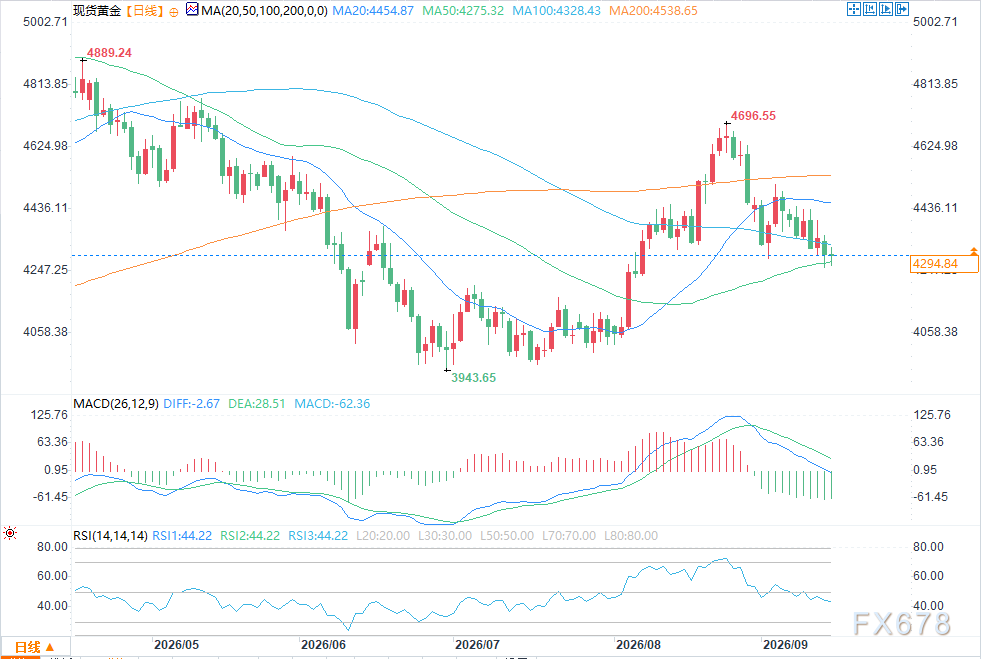
(Spot Gold Daily Chart Source: Yihuitong)
The next upward target for spot gold bulls is to push prices back above the $4,316.00 resistance level; if stabilized above this level, subsequent targets are $4,355.00, then $4,402.00. The short-term downside target for bears is to break below the $4,283.00 support, with further decline towards $4,252.00, followed by $4,223.00. First resistance is $4,316.00, followed by $4,355.00; first support is $4,283.00, followed by $4,252.00.
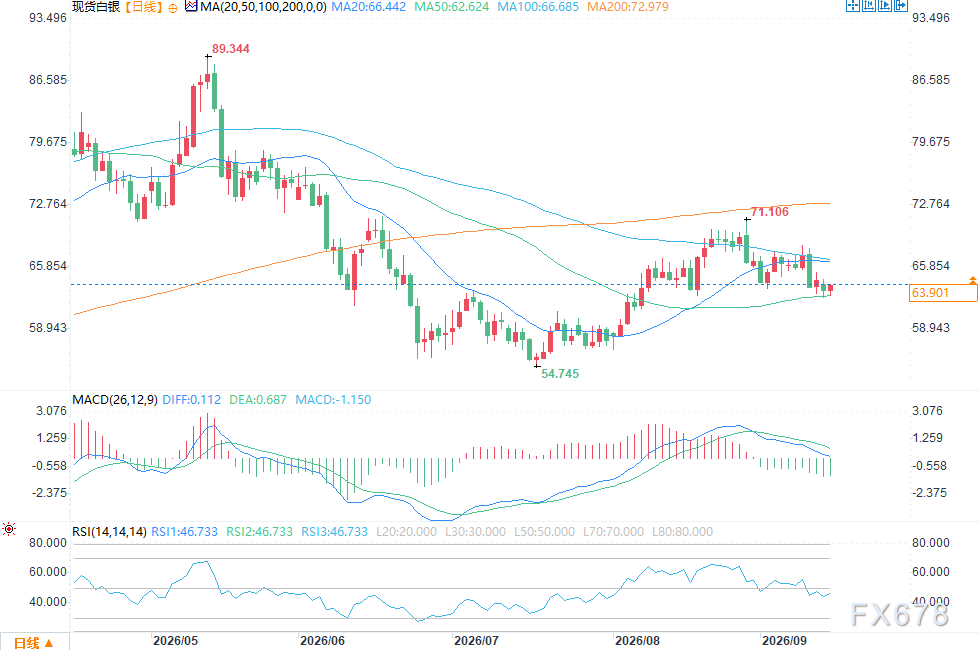
(Spot Silver Daily Chart Source: Yihuitong)
After spot silver prices stayed above $63.76, the next target is $64.51, then $65.28. The downside target for bears is to break below $62.34, with further targets at $61.60 and $60.81. First resistance is $63.76, then $64.51; first support is $62.34, then $61.60.
Disclaimer: The content of this article solely reflects the author's opinion and does not represent the platform in any capacity. This article is not intended to serve as a reference for making investment decisions.
You may also like
Dow Jones Industrial Average slides as yields beat the Fed to tomorrow's hike
Meta (META.US) strengthens self-developed AI chips! Plans to deploy data centers in the first half of next year, aiming to reduce inference costs and energy consumption
Meta Platforms plans to deploy its next-generation self-developed artificial intelligence chips to data centers in the first half of 2027, aiming to reduce the energy consumption and costs required to run AI models through customized chips.

Pundit: If You’re an XRP Holder, I’ve Some Interesting Observations for You Today
Cardano Foundation joins Mastercard’s Crypto Partner Program for global payments
Crypto prices
More


