
Out-of-control U.S. bond market and rapid debt growth significantly compress rate hike space, highlighting the long-term fundamental value of gold

Huitong Network, September 14—— This week, the Federal Reserve’s expectation of a 25 basis point rate hike has temporarily suppressed gold prices. The grave risk facing the US is not only in the bond market disruption and debt crisis: the US Treasury’s buyback of long-term bonds failed to lower yields, with the 10-year Treasury yield hitting a three-year high. The total US debt has surpassed $40 trillion, with annual interest payments exceeding $1 trillion, and the new policy of universal subsidies could add another trillion to the debt. The deteriorating fiscal situation significantly constrains the Fed’s room for further rate hikes; compared to short-term interest rate fluctuations, it is the massive debt risk that forms the core logic supporting the long-term value of gold.
Last week, the market broadly traded on the possibility that the Federal Reserve would raise rates by 25 basis points this week, and the expectation of a hike continued to suppress gold prices. However, over a more extended horizon, compared to short-term interest rate moves, the US economy is facing deeper and more severe challenges, with the federal government’s control over the bond market weakening.
The Treasury’s attempt to support long-term bonds with buybacks did not lower yields, and the federal debt burden has climbed past $40 trillion. The massive interest payment pressure, combined with new fiscal stimulus commitments, is reshaping investors' long-term views on US dollar assets.
Buyback Operations Have Minimal Impact, Long-Term Yields Defy Expectations
Last week, the US Treasury spent $510 million to buy back long-term treasuries, aiming to support these bonds and lower long-term yields. However, market reactions completely diverged from policy expectations, as long-end yields kept rising—the 10-year Treasury yield closed the week at 4.97%, a three-year high. Many analysts predict that a break above 5% is only a matter of time, and once this threshold is crossed, it will present significant new challenges for the US economy.
The market’s current focus is largely on the Fed’s impending rate decision, while the US's enormous fiscal woes are being somewhat overlooked. Recently, the US sovereign debt has officially exceeded $40 trillion. The government’s annual interest payments alone now surpass $1 trillion, and this burden continues to mount. On the day before the Treasury’s less-than-effective bond buyback, former President Trump promised that, should the Republican party win the upcoming midterm elections and retain Senate seats, a $5,000 subsidy would be distributed to every American adult—a plan expected to add another $1 trillion in government debt.
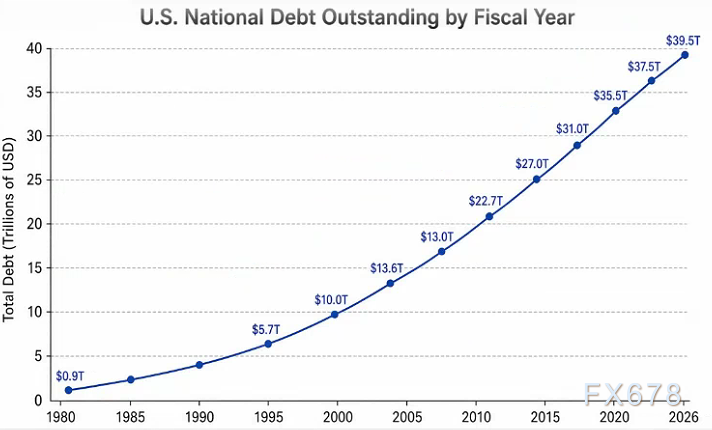
Chart: US Fiscal Year Debt Total Trend
Room for Rate Hikes Constrained by Fiscal Policy, Dilemmas in Policy Choices
Against such a heavy fiscal backdrop, investors must reconsider just how much space the Federal Reserve actually has left for rate hikes. Analysts point out that while the Fed can use rate hikes to combat inflation, a persistently worsening fiscal picture sharply limits the Fed's capacity to raise rates further. The higher the rate, the more interest the US government has to pay each year, creating a negative feedback loop between high rates and high debt. If rate hikes persist, fiscal pressure will intensify further, potentially destabilizing the entire US Treasury market.
On the one hand, the need to contain inflation motivates rate hikes; on the other, massive debt places an overwhelming fiscal burden, trapping the Fed between competing policy objectives. A short-term 25 basis point hike may temporarily suppress gold prices, but the long-term monetary credit risks brought about by debt expansion are already slowly changing capital allocation strategies.

Market Perspective Shift: Moving Beyond Basis Point Speculation to Focus on Trillion-Dollar Debt Increases
Many market participants are overly focused on each 25 basis point rate move by the Fed, regarding short-term rate volatility as the core determinant of gold prices, but are neglecting the far larger variable of the US’s continual debt expansion. Compared to each minor hike, the long-term impact of a $1 trillion increase in debt is far more significant for the global monetary system and the value of dollar assets.
Gold itself does not generate interest, and thus tends to be under pressure during periods of rising rates—this is a short-term trading dynamic. But
Conclusion
In the short term, Fed rate hike expectations remain the direct factor depressing gold prices, and turbulence in the bond market will also bring repeated asset price swings. However, the failed bond buyback and ongoing surge in US debt have exposed the structural issues of the US fiscal system. For investors, rather than focusing on each 25 basis point move, it is more important to continuously monitor the pace of US debt expansion.
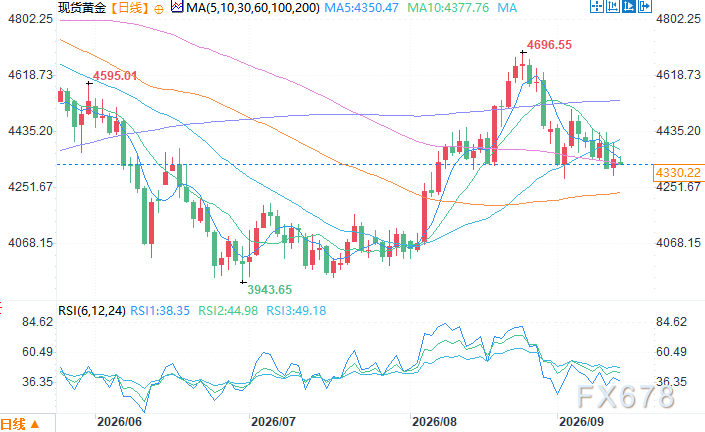
Spot gold daily chart Source: Yihuitong
As of 13:30 Beijing time on September 14, spot gold was trading at $4,330.22/oz
Disclaimer: The content of this article solely reflects the author's opinion and does not represent the platform in any capacity. This article is not intended to serve as a reference for making investment decisions.
You may also like
Apple Pre-sale Tracker: iPhone 18 Pro Series Shows Weak Overseas Demand Signals, Duo Review Positive but Hardware Lags Behind
According to a survey by Jefferies, after the launch of the iPhone 18 Pro, delivery wait times in the four major markets—the US, UK, Germany, and Japan—have shortened by 5 to 11 days compared to last year, with no wait time in the US. Given stable production capacity, this is a clear sign of weak demand. Although the China and Hong Kong markets have performed better against the trend, there are still suspicions of speculative stockpiling. The new foldable Duo has been praised for its software experience, but its $2,000 price tag comes with a 254-gram body and dual-camera setup, leaving its hardware lagging significantly behind Android competitors. Jefferies maintains an "underperform" rating, with a target price implying a 21% downside from the current level.
UBS Health Benefit Survey: Elevance Health (ELV.US) Leads, U.S. Employers Prepare for Rising Medical Costs
In the annual survey by UBS for employee benefits management institutions, Elevance Health (ELV.US) emerged as the highest-rated US health insurance company.

LINK Targets $11.50 as LINK/BTC Approaches a Critical Breakout Zone

Solana breaks resistance, holds above $100 as analysts target $147
Crypto prices
More


