

Ripple CEO Brad Garlinghouse contrasted the Dutch central bank’s recent gold transfer with the rapid transaction capabilities of digital assets. Garlinghouse highlighted that De Nederlandsche Bank (DNB) spent nearly six months, from March to August, to relocate 86 tonnes of gold reserves—amounting to approximately $11 billion—out of storage in New York and Ottawa to London. DNB is the central bank of the Netherlands, responsible for monetary stability and financial oversight.
Ripple CEO compares $10 billion DNB gold move with instant crypto transfers
By:Cointurk
Bitget offers one-stop trading for cryptocurrencies, stocks, and gold. Trade now!
A welcome pack worth 6200 USDT for new users! Sign up now!
DNB’s gold transfer and its purpose
DNB stated the move aimed to improve crisis preparedness and increase the liquidity of reserves by shifting a larger portion of gold to London, regarded as the world’s key physical-gold market. Of the 86 tonnes transferred, around 59 tonnes were sold in New York and simultaneously repurchased in London; the remainder moved physically, with roughly 27 tonnes routed via the Netherlands to avoid melting the bars.
After the move, Dutch gold is now split with London holding about 32%, the Netherlands 31%, and New York and Ottawa about 18.5% each. DNB Governor Olaf Sleijpen acknowledged that, while the bank does not expect to deploy its gold reserves, enhancing the speed and flexibility of access remains a priority.
DNB described the operation as complex, requiring months of logistical planning and traditional documentation, a process that historically would not be out of place in the mid-20th century.
Comparison with other central banks and digital approaches
Garlinghouse compared the DNB operation with Germany’s 2013 gold repatriation, where Bundesbank repatriated 674 tonnes—valued at $36 billion at the time—from Paris and New York over four years.
He argued that, despite these lengthy processes, the past decade has seen the crypto sector grow dramatically from a $1.5 billion experiment to a $2.7 trillion market, matched by notable progress in technology such as AI, autonomous vehicles, and satellite internet.
The Ripple CEO asserted that precise, near-instant transfers of value are now possible digitally, removing the need for prolonged logistics and extensive paperwork.
Garlinghouse promoted the practical advantages of digital asset infrastructure, noting that frameworks like the XRP Ledger (XRPL) can move value in seconds for minimal fees. He referenced live trials conducted by the Bank for International Settlements and cited tokenized gold, including Meld Gold’s gram-backed tokens, already issued on the XRPL.
Mini dictionary: XRP Ledger (XRPL) is a decentralized, open-source blockchain known for fast settlement times and low transaction fees, used for digital payments and issuing tokens, including stablecoins and tokenized assets.
The role of physical reserves and digital assets
He acknowledged that physical gold reserves retain a critical function for central banks during crises, but stressed the difference in settlement speed and flexibility between tangible assets and digital tokens.
Garlinghouse positioned XRPL as a key solution for central banks or institutions seeking instantly transferable, digital reserves, while recognizing that some institutions may still require the assurance of holding physical metal in major financial centers.
He noted that both systems can coexist, but highlighted the long duration still required for major gold transfers compared to the speed of blockchain settlement.
0
0
Disclaimer: The content of this article solely reflects the author's opinion and does not represent the platform in any capacity. This article is not intended to serve as a reference for making investment decisions.
Understand the market, then trade.
Bitget offers one-stop trading for cryptocurrencies, stocks, and gold.
Trade now!
You may also like
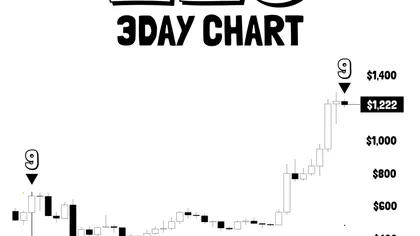
Zcash (ZEC) Prints TD Sequential ‘9’ Sell Signal — Last Time It Appeared, Price Fell 64%
Coinsprobe•2026/09/10 17:09
Why Is VTHO Up 38.57% in 24 Hours? Extreme Funding Rate and Liquidation Data Explained
Coinsprobe•2026/09/10 17:09

India’s $2B Agricultural Credit Network Moves Onchain via Avalanche and Arya.ag
Coinsprobe•2026/09/10 17:09

Crypto prices
More
Bitcoin
BTC
$77,196.92
-2.01%

Ethereum
ETH
$2,456.31
-1.55%

Tether USDt
USDT
$0.9995
-0.03%

BNB
BNB
$708.91
-4.39%

XRP
XRP
$1.36
-4.56%

USDC
USDC
$0.9998
-0.01%

Solana
SOL
$99.84
-3.56%

TRON
TRX
$0.3391
-0.26%

Hyperliquid
HYPE
$80.31
-6.37%

Zcash
ZEC
$1,139.7
-10.54%
How to buy BTC
Bitget lists BTC – Buy or sell BTC quickly on Bitget!
Trade now
Become a trader now?A welcome pack worth 6200 USDT for new users!
Sign up now