
Highlights from Marvell expert research: CPO faces delays and setbacks, NPO steps in to fill the gap, orders are scheduled out to two years later

AMD, Nvidia's biggest competitor, just returned Marvell's CPO solution—but don't rush to be bearish, because the clients couldn't even wait for the "downgraded solution", and Marvell's 1.6T DSP backlog orders have already stretched two years ahead.
(Clarification: The industry expert didn’t name the client, but based on research Meta and OpenAI are the end buyers, and Marvell happens to supply both via AMD’s supply chain. Therefore, American Stock Investment Network speculates that this client is most likely AMD.)
This is the counterintuitive aspect of the expert research: the bad news is the CPO technology fell flat, but the good news is that demand is so high, no one cares.
This project was initially prepared by AMD for major clients like Meta and OpenAI: a 6.4T bandwidth, 32-channel CPO optical interconnect solution, bundled with Marvell’s switch ASIC—since AMD itself does not have optical and switching chip technology, the supplier could only choose between Broadcom and Marvell.
Results: the early sample released in early 2026 did not meet performance standards, and had yield issues. AMD acted decisively: switching to NPO.
There’s a key detail here that retail investors are prone to misunderstand: the shipment volume forecast has not changed, only the delivery solution has. What Meta, OpenAI and other customers care about is—delivering on time.
CPO is the ideal answer, but if NPO can be delivered, it’s acceptable. As for NPO’s higher power consumption and cost? That’s not a priority during this rush to build AI infrastructure.
So don’t be rattled by headlines about “CPO setbacks.”
The expert’s original words:
NPO is only a transitional product with a 2-3 year lifecycle; by 2028, market demand could reach 30 million units—even this transition phase results in a huge market.
Why did CPO fail?
Ideally, CPO means the optics module and GPU are packaged together. But the current reality is that both Marvell and Broadcom are implementing “separately packaged and soldered on the same motherboard.”
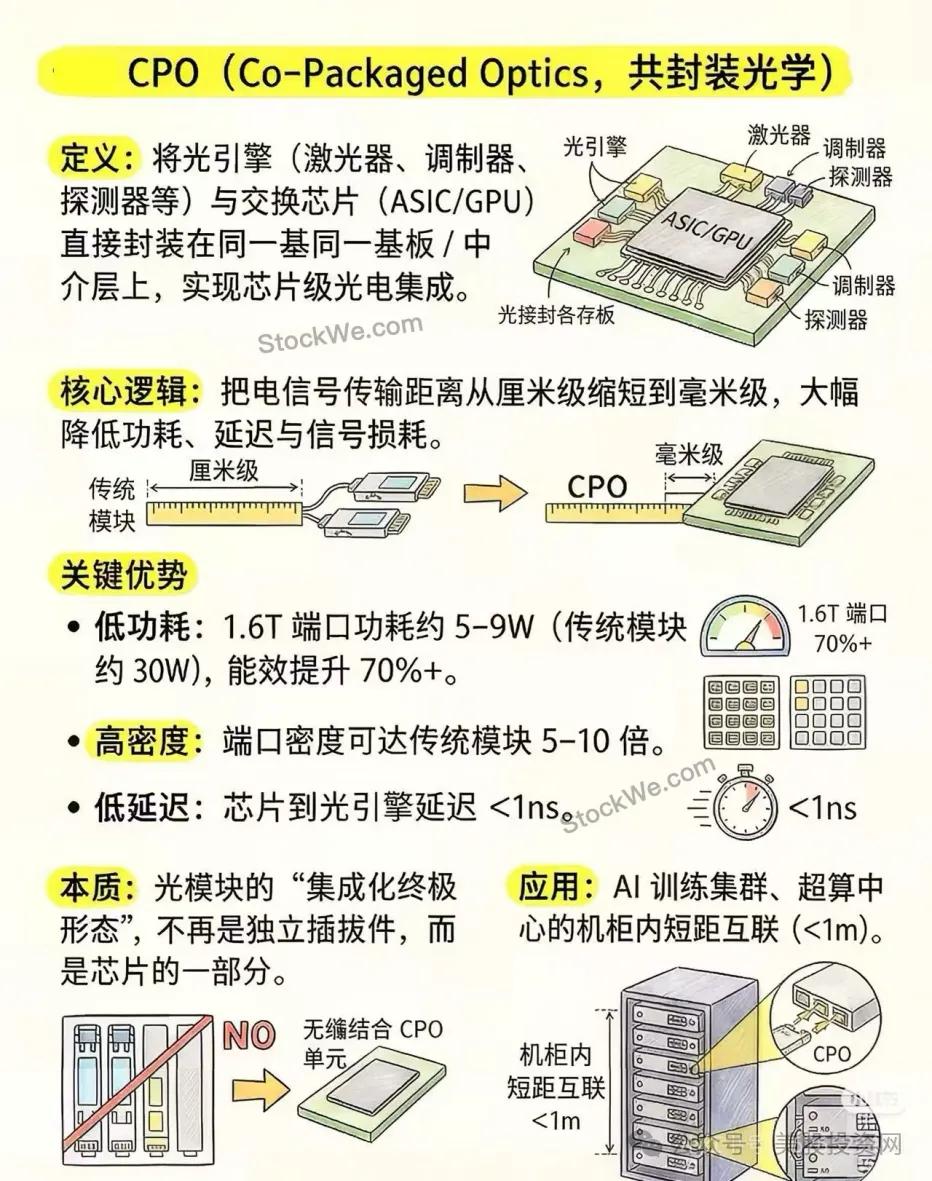
200G high-speed electrical signals travel through layers of substrate and solder joints, resulting in excessive signal loss that cannot be fixed. In the end, a retimer (simplified DSP) has to be added to reshape the signal—four for 32 channels, squeezing these chips and the optical engine onto the same board.
This form is called NPO.
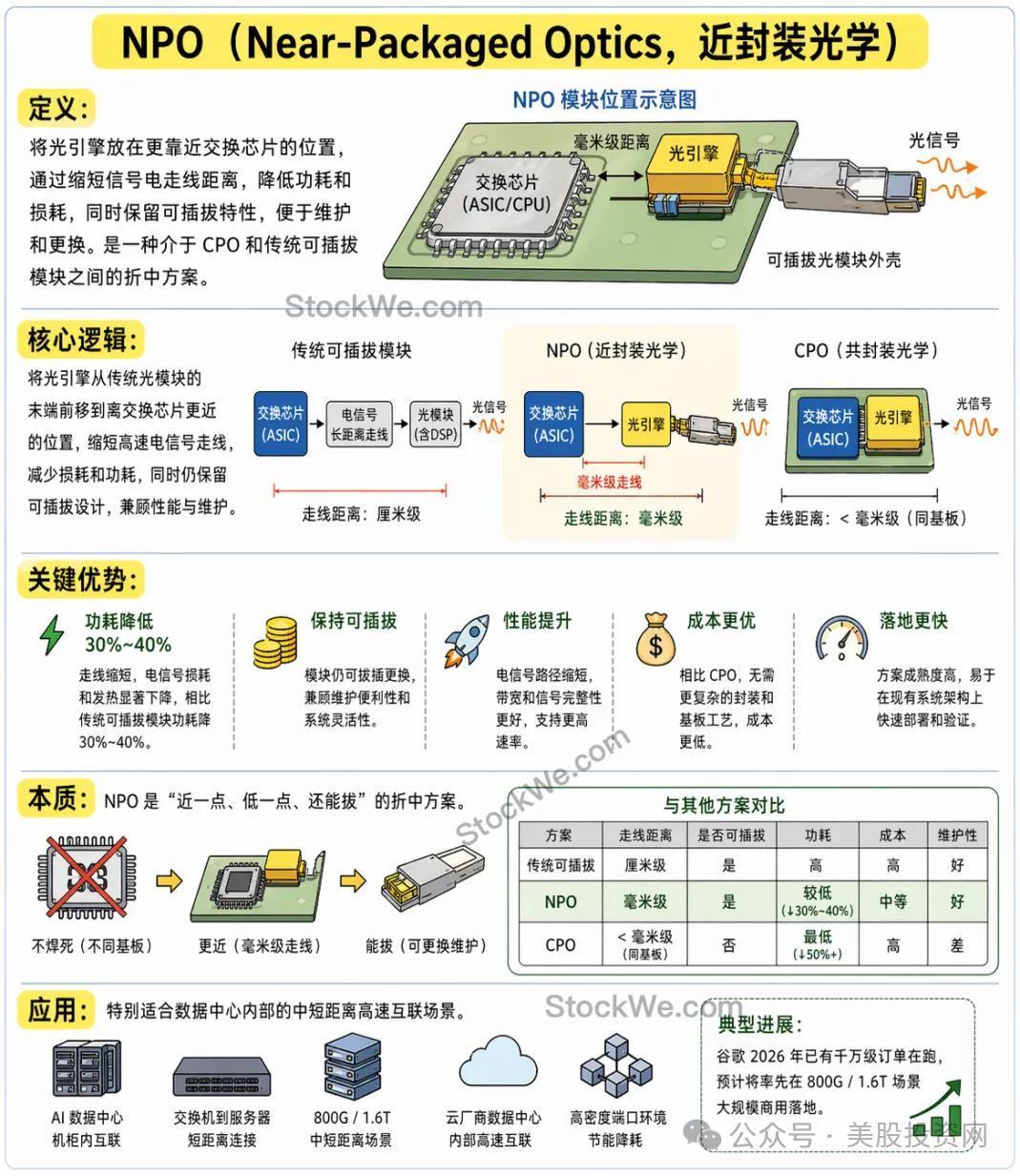
Interestingly, this is an industry-wide challenge, not just Marvell's embarrassment. The expert stated plainly: Broadcom, Nvidia, AMD, Google, and Amazon—all took too aggressive a technical path. Nvidia bet on TSMC’s real co-packaging and suffered even worse yields, and there is no room for a DSP in that structure—after switching to NPO, this part was reportedly outsourced to InnoLight.
In short: optical interconnects are a must-have, and if CPO can't be realized now, use the NPO solution for the time being. But no one is giving up on CPO—everyone is working on both tracks simultaneously, since CPO is the ultimate goal.
So after this industry overview, you’ll understand why Marvell’s position is so comfortable right now.
Amazon is the most pragmatic buyer. Trainium 4 (2H 2027) will fully adopt optical interconnects; if CPO isn’t ready, NPO is chosen decisively; the Trainium 5 project has already started, and Marvell’s acquired Celestial AI solution is highly favored.
Google talks as if they don’t need it, but actions speak louder than words—they have been privately seeking CPO/NPO solutions, have consulted Marvell, and recently signed big contracts largely to counterbalance Broadcom and Nvidia. The logic is simple: TPU can be developed in-house, but optics cannot, so this part has to be outsourced.
Microsoft is the most stable base: the largest customer for ZR coherent optical modules, and next-generation products are basically locked in with Marvell. As for the rumored mass production of hundreds of thousands of MicroLED devices by the end of 2027, the expert’s comment is—a definitive delivery schedule is "surprising"; currently it is more like early-stage research.
OpenAI, on the other hand, proposed an aggressive 400G PAM4 project, but experts judge this unfeasible within the next two or three years, since the entire technical chain (TIA, Driver, SerDes) is not yet mature enough.
The most valuable data in this research
1.6T DSP: backlog orders are scheduled two years out. It is widely rumored in the industry that a channel on this generation of DSPs underperformed and the company is reworking a fix (respin)—this is true but does not affect winning orders at all;
ZR modules: shipping 40,000 to 50,000 units per month with unit prices of $2,000–$3,000, making Marvell No.1 in global revenue; Google places open orders—any 800G ZR meeting the standard, they will take as many as are produced. The current issue is production bottlenecks across the whole supply chain;
Chinese companies: world-class assembly capabilities, but high-margin core chips such as DSP, TIA, and Driver almost all need to be bought from Marvell. Orders go to module makers, but the lion’s share of the profit goes to chip makers—this is the expert’s most accurate remark about China’s optical module stocks.
Where are the risks?
A fair argument has to be two-sided.
NPO is a transitional business with only a 2–3 year window, and ultimately the CPO battle must be fought;
Broadcom, Nvidia, COHR, and even ALAB (expert's analogy: Broadcom is the all-rounder, Marvell a slightly smaller Broadcom, Astera an even smaller Marvell) are all scrambling for a place beside big clients;
For those Silicon Valley startups, the technology is not the barrier, it’s the inability to obtain TSMC wafer capacity—without an endorsement from large clients, they don’t even get an entry ticket.
So, returning to the initial conclusion: this research is not a technological failure story, but one of “such strong demand that failure is tolerated”.
The inflection point for optical interconnects has passed, and now it's about who can deliver on time and reliably—ironically, failing to deliver is currently the only industry-wide pain point.
American Stock Investment Network VIP fully upgraded



US Market Big Data
American Stock Investment Network
Disclaimer: The content of this article solely reflects the author's opinion and does not represent the platform in any capacity. This article is not intended to serve as a reference for making investment decisions.
You may also like
Solana price holds above key EMAs as trading volume drops and rally pauses
U.S. equity risk premium hits lowest level since 2002, JPMorgan: Impact of rising interest rates will be more painful than in the past two decades
The buffer for risk in the US stock market is running thin. JPMorgan warns that the equity risk premium of the S&P 500 has fallen to 2.1%, its lowest level since 2002, more than 100 basis points below its historical average. The era of low premiums hides three major risks: a systemic increase in the stock market's sensitivity to interest rate shocks; global investors have overweighted equities to a twenty-year high, facing rebalancing pressure; and the strengthening positive correlation between stocks and bonds is causing risk parity strategies to continuously fail. If real interest rates rise further, this silent repricing of valuations may erupt violently.
UK Crime Agency Maps How Crypto Laundering Routes Shift Between Platforms
Why Is ZEC Being Shorted? $27M TRUMP Trader Opens $6.49M Short on Zcash

Crypto prices
More


