
Speech by OpenAI CFO at the Goldman Sachs Communacopia Conference is full of information!

At the Goldman Sachs Communacopia conference, OpenAI CFO Sarah Friar gave an information-rich presentation. While she didn't provide new numbers on the surface, she thoroughly laid out OpenAI's business model, demand structure, and compute strategy from start to finish.

First, enterprise business now sustains half the company, and the revenue structure has changed.
As OpenAI heads into 2026, the consumer to enterprise revenue ratio is about 60 to 40. The original goal was to reach 50:50 by year-end, but they achieved that target already by midyear—"the enterprise business has always been thriving." In July, total run-rate revenue grew approximately 20% year-over-year, with enterprise revenue up 32% year-over-year—on a significant base, no less.
Why does this structural change matter? US Stocks Investment Web (originally 美股投资网) analysis indicates that once enterprise clients integrate into their workflows, migration costs become extremely high and revenue predictability is much stronger than with consumer subscriptions. The quality of OpenAI’s income is deepening.
Second, usage intensity is more significant than just seeing the revenue figures.
The top 10% of customers are consuming tokens at about eight times the rate of the average customer per user per week—previously, it was three times; while OpenAI’s own internal usage is 33 times the average client.
Her point: "We ourselves are a preview of the future customer." The way leading customers use the platform today is how regular customers will be using it in two years. Token consumption is a one-way amplifier.
Specific scenarios: Canva's code is "100% from OpenAI," with users creating billions of images each week; Travelers' AI claims assistant expanded from eight states to a nationwide rollout in just two months;
Codex users grew from about 100,000 at the beginning of the year to 25 million now.
Her exact words: "Automated coding is key; no developer now regards AI as just an auxiliary tool any longer."
Third, advertising is an undervalued segment.
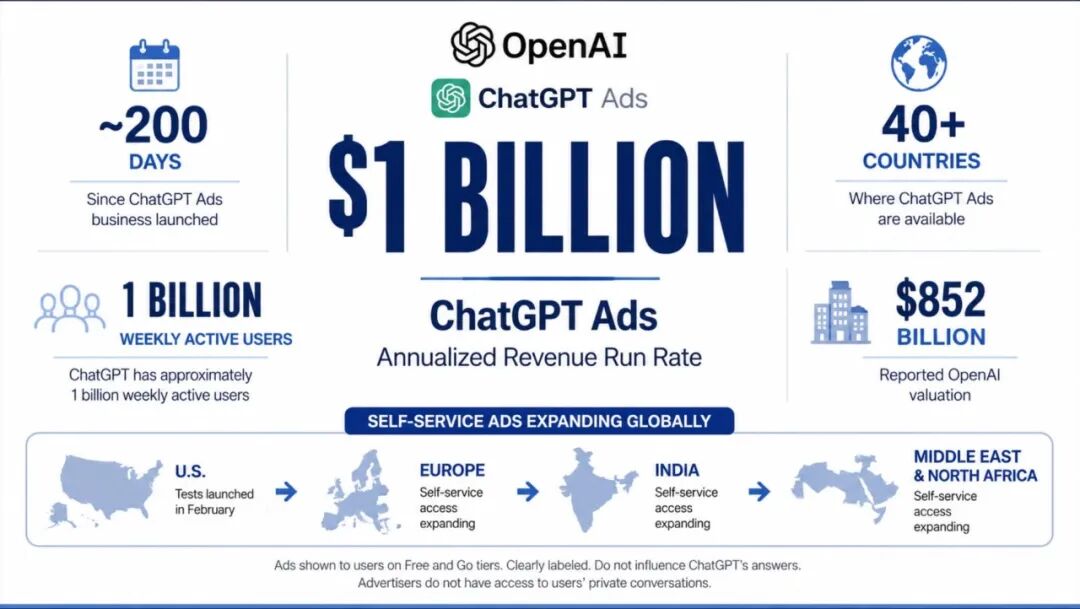
The advertising business reached a $1 billion run rate in just seven months after launch. She described it as "the fastest product to reach $1 billion," now available in 40 countries, with WPP and Dentsu already onboard, and AI-native ad formats have yet to roll out.
Her analogy is quite interesting: "If Google and Meta had a child, it would be ChatGPT"—high-intent search plus memory, sitting at the crossroad of the commercial models of both tech giants. The ceiling is far from being reached.
Fourth, Astra and pricing address longstanding industry debates.
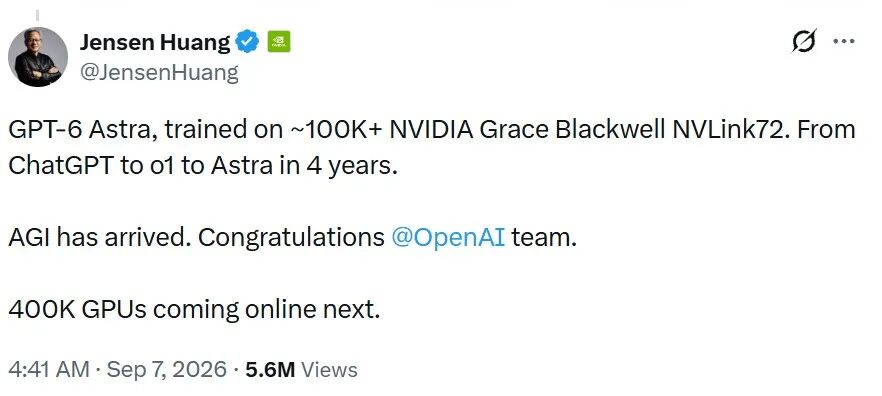
Astra is trained on 100,000 GPUs, representing OpenAI’s largest training run in history.
Two key points:
First, the industry should evaluate models based on "cost per task" rather than "cost per token"—according to Artificial Analysis, Astra requires 68% fewer tokens than competing frontier models to achieve the same results;
Second, Luna’s price was cut by 80%, with usage soaring 10x—now it surpasses the next Chinese model on OpenRouter by market share.
With an 80% price cut and usage up 10x, revenue still increased—demand is highly price-elastic. She added: Luna on Cloudflare is even cheaper than GLM 5.3, and frontier labs can provide inference at lower cost than open source deployments. Open source weights "have their place," but customers pay for the entire stack: compute, data integration, enterprise context, and reliability.
Fifth, compute power is still "severely constrained."
Her words: "We still feel severely constrained," with weekly trade-offs between compute for training, research, and production services. Coping strategies involve full stack advancement: cloud partners, custom chips, OpenAI-designed Texas data centers, and "increasingly more" self-built resources.
Two details: The hardest part is forecasting a business "the world has never seen," which requires planning two to three years ahead—in the past two years, some criticized OpenAI for "over-investing," but "this year, it really paid off."
ROI discipline: For each model family, using accumulated revenue and projected revenue for the next 12 months, compare these with compute input, aiming for not just positive but extremely positive ROI. Revenue per gigawatt rising and cost curves dropping are, in her view, key to expanding gross margin.
Sixth, three new demand directions
The area with the most client inquiry is cybersecurity, described as "very urgent."
Her view is clear: "Locking models inside a box" is a fallacy—OpenAI itself uses Astra to discover and patch vulnerabilities at machine speed. Last week in San Francisco, OpenAI hosted about 300 CISOs, seeing expanded access for defenders as "an incredible business opportunity." Vertical sectors mentioned: chip design, life sciences, financial services—hinting at a financial announcement in New York later this week.
The life sciences model is called GPT Rosalind; the in-house Jalapeño chip completed tape-out in nine months, running the model for the final 30 days on engineering boards before sending it to TSMC, not allowing time for further optimization.
So, how should we view this?
This speech verified two key points and presented the market with a very direct industry chain conclusion.
First, AI demand is shifting from "user growth" to an "increase in usage intensity."
Enterprise revenue now accounts for more than half, leading customers’ token usage is eight times the average, and coding is shifting from auxiliary tool to automated execution. What truly matters is no longer just how many new users there are, but how much compute each user and each company will consume in the future.
Second, OpenAI's business model is broadening.
From subscription, to usage-based charges, to outcome-based charges, plus advertising as a second growth curve, revenue is no longer reliant solely on ChatGPT memberships.
The most direct signal for US equities is still compute capacity. One of the world's largest model companies just admitted that compute remains "severely constrained," with much capacity needing to be planned two to three years ahead.
As long as per-user usage continues to rise, and revenue per gigawatt keeps climbing, the upstream compute, storage, networking, and data center supply chain will hardly be seen as just a short-term capex cycle.
US Stocks Investment Web VIP Fully Upgraded





Disclaimer: The content of this article solely reflects the author's opinion and does not represent the platform in any capacity. This article is not intended to serve as a reference for making investment decisions.
You may also like
SHIB Holds Critical Support as Bulls Target $0.00000537 Resistance

The UK's new government budget becomes the market focus; after a strong rebound, the pound may face a downward storm
This year, the British pound has largely remained unaffected by government changes and geopolitical shocks, performing better than many major currencies. However, its recent weakness may intensify further.

Solana price today tests $105.67 resistance as Raydium fees jump 363%

Crypto prices
More


