
Oracle Q1 Earnings Preview: Can ~115% OCI Growth Offset Capex Concerns?
 2026/09/09 03:18
1. Investment Snapshot
Oracle (ORCL.US) will report fiscal 2027 first-quarter results after the U.S. close on September 10, 2026 (conference call at 4:00 p.m. CT). Company guidance calls for total revenue growth of +27% to +29% YoY, cloud revenue growth of +58% to +64% YoY, and non-GAAP EPS of $1.72–$1.76 (about +17% to +20% YoY). Street consensus is roughly $19.13 billion in revenue (+28.2% YoY) and adjusted EPS of about $1.74 (+18.4% YoY).
The market is not asking whether Oracle will grow. It is asking whether OCI can deliver ~115% or faster growth, whether the $638 billion RPO converts into recognized revenue, and whether capex and financing will further pressure free cash flow. After a sharp pullback from the 2025 peak, this print is a high-stakes test of sentiment repair versus another valuation reset.
2. Four Things to Watch
Focus 1: Can OCI land triple-digit growth?
Year-ago OCI revenue was about $3.35 billion; last quarter it accelerated to about $5.8 billion (+93% YoY). Wall Street expects OCI of about $7.2 billion this quarter (~+115% YoY). If total cloud hits the high end of guidance, implied OCI could approach $7.5 billion (~+125% YoY). The key checks are whether roughly 1 GW of new capacity comes online and starts billing on time, and whether quarterly GPUaaS revenue lands in the $3.8–$4.2 billion range. A print well below ~115% would raise questions about capacity conversion.
Focus 2: High-end cloud guidance and GPUaaS economics
Oracle guided cloud revenue to +58% to +64% YoY in U.S. dollars. Scale alone is not enough. Investors will focus on GPUaaS margins and contract mix: large AI capacity deals are typically non-cancellable for 5–6 years, and some use prepay or bring-your-own-chip (BYOC) structures that reduce Oracle’s funding burden. Street models have raised FY28 GPUaaS gross-margin assumptions, but they remain below the long-term 30%–40% steady-state target. Pricing, higher prepay mix, or sustained high utilization on the call would matter more than growth for its own sake.
Focus 3: Quality of the $638 billion RPO
RPO ended last quarter at $638 billion (+363% YoY), roughly eight times current annualized revenue. Management has previously said about 12% could be recognized over the next 12 months, with another ~34% in months 13–36. Watch whether RPO keeps growing sequentially, whether the next-12-month recognition mix is revised higher, and whether new AI bookings remain concentrated in a few customers. A large backlog is not the same as quarterly revenue conversion.
Focus 4: Capex, financing, and the $90 billion full-year target
Oracle’s FY2027 targets are about $90 billion in revenue and non-GAAP EPS of $8.05. Management has framed Q1’s +27% to +29% as the low point of a back-half-weighted year. The other side of the story is spending: Street capex for FY27 is around $95 billion, above annual revenue. Company language emphasizes net cash capex of about $70 billion and roughly $40 billion of debt-and-equity financing, including a ~$20 billion ATM equity program. Another capex raise or weaker financing terms would reprice the growth story through the balance sheet.
3. Upside and Downside
Upside catalysts:
- OCI at or above about $7.2–$7.5 billion, confirming triple-digit growth and 1 GW monetization.
- Cloud revenue near or above the high end of guidance (+64% YoY), with management holding or reinforcing the FY27 $90 billion target.
- Higher prepay/BYOC mix and better GPUaaS economics, easing cash-flow and leverage concerns.
Downside risks:
- OCI growth well below ~115%, or delayed capacity go-live and billing.
- A print that merely meets the midpoint, with no stronger full-year message and infrastructure mix diluting margins.
- Another capex or funding step-up, plus questions about RPO customer concentration and conversion quality.
4. Trading Framework
Bull case: OCI and cloud both beat consensus, capacity converts on schedule, and management is clear on RPO conversion, second-half acceleration, and funding. That mix could shift the tape from a “high-capex discount” to an “AI infrastructure execution” re-rating.
Bear case: Growth is merely adequate while economics and cash flow do not improve, or capex guidance moves higher. With elevated implied volatility, that setup can produce a “good growth, stock still falls” gap.
Key numbers:
- Total revenue and YoY growth versus the +27% to +29% guide
- Cloud growth, plus OCI dollars and YoY growth versus ~+115%
- RPO balance and the share recognizable in the next 12 months
- Capex / net cash spend, financing updates, and margin / free-cash-flow commentary
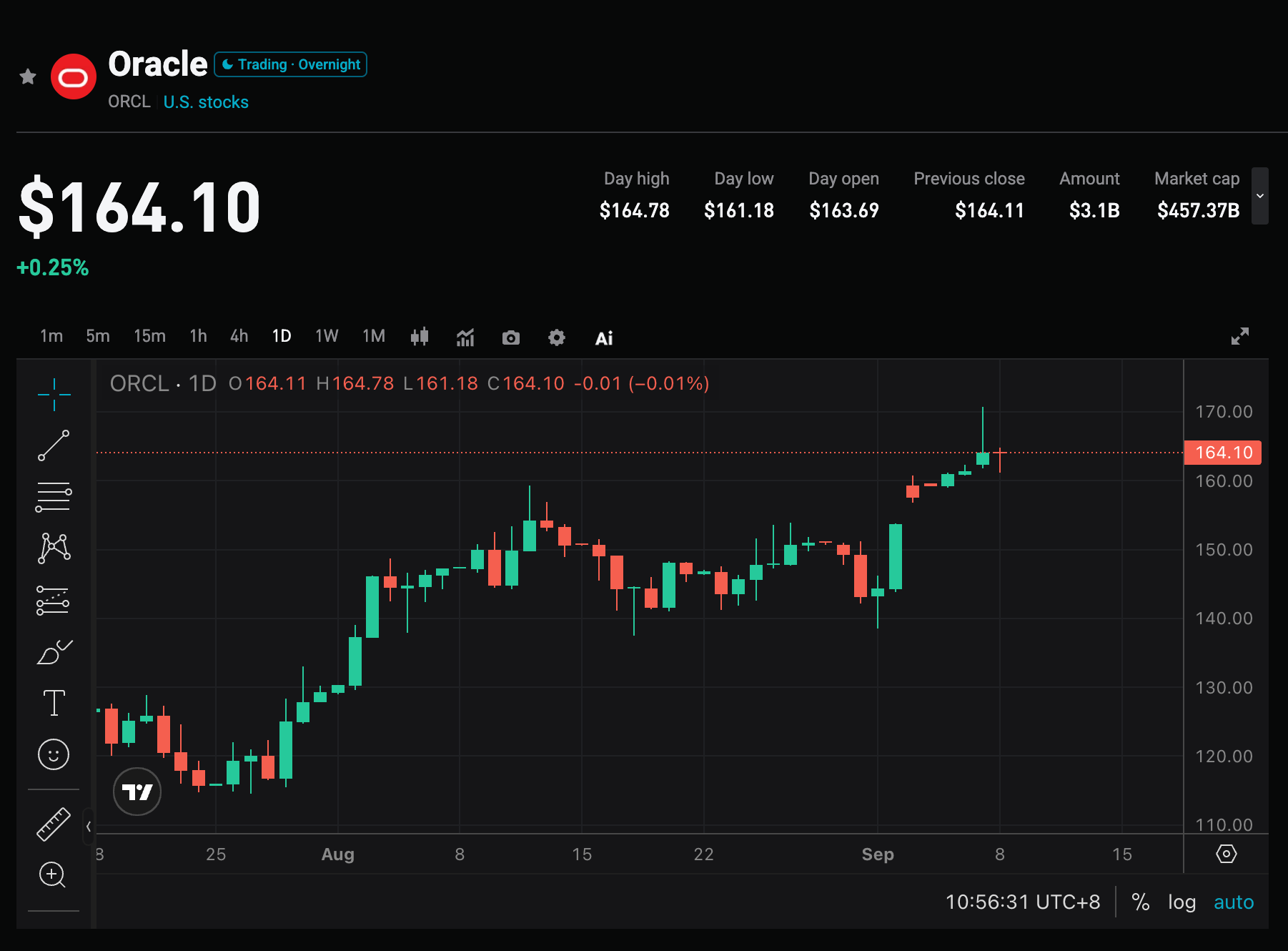
Tactical notes (ORCL, as of Sep 8 close $162.52):
- Into the print: Price is approaching the 200-day moving average from below (~168.5) after rejecting the session high at 171. Risk/reward into the event is only average. Implied move is wide (~11%), IV elevated. Keep event risk light. Avoid adding leveraged longs below 158.
- Long setup: A close back above 168–171, with pullbacks holding 158. Upside references 182 / 200. Stops can sit at 155, or below 148 depending on risk tolerance.
- Short / hedge setup: A gap that cannot reclaim 158, or a failed push through 168–171. Downside references 148 / 140 / 115.
How to use it: If results and guidance are both strong, look for a post-spike pullback rather than chasing the first move. If Oracle only meets the print and sounds hawkish on capex, respect the after-hours gap and IV crush. Size and stops should match personal risk tolerance; do not chase a one-way bet into a high-vol event.
Disclaimer: This is for informational purposes only and is not investment advice.
Disclaimer: The content of this article solely reflects the author's opinion and does not represent the platform in any capacity. This article is not intended to serve as a reference for making investment decisions.
You may also like
Hedge funds aggressively go long on the yen: Betting on breaking above 150 by year-end, aiming directly for 140
Hedge funds are betting that USD/JPY will fall below 150 by the end of the year.

XRP and the CLARITY Act: Why September 15 Could Be a Major Test
Global sugar prices soar, US faces “even higher costs”: Food giants such as General Mills (GIS.US) sue sugar industry oligarchs for price manipulation
General Mills (GIS.US), Mars, and McKee Foods have recently joined the U.S. food industry antitrust lawsuit, accusing top U.S. sugar producers of colluding to raise sugar prices.

Crypto prices
More


