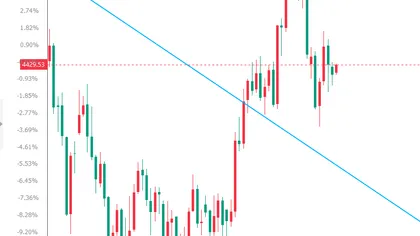
Celestia [TIA] cleared $0.42 resistance and jumped to a four-month high of $0.48 before retracing.
At press time, Celestia was trading around $0.43, marking an 11.5% jump on the 24-hour timeframe. This upside move was backed by a 298% jump in trading volume, highlighting strong market activity.
But what’s driving Celestia’s uptick?
TIA’s recent gains have captured market attention, leaving the community deliberating on the factors behind the surge.
Firstly, its role in the modular blockchain as a data availability (DA) layer. As such, Celestia’s modular architecture is gaining fresh attention.
With the network’s focus on data availability and scalable rollups, TIA is positioned around Web3’s biggest problems: making blockchain scalable without compromising flexibility.
Additionally, Celestia is seeing strong demand from stakers. According to Coinbase, there are over 393.9 million tokens staked, or 43% of the total supply.
Notably, Celestia has a staking reward rate of 5.48%, which has made it overly attractive to crypto investors.
Profit takers causing intense pressure
As expected, with Celestia rallying, investors who have held underwater rushed to cash out. On the Futures side, for example, Celestia recorded $92 million in outflows compared to $87.6 million in inflows in the past 24 hours.
As a result, Futures Netflow dropped 998% to -$4.4 million as of writing, suggesting that traders aggressively closed their positions.
On the Spot side, the same market behavior was evident. The altcoin saw $15.3 million in exchange inflows compared to $14.7 million in outflows.
As a result, Spot Netflow climbed 1163% to $595k, a clear sign of spot selling. When sellers dominate both the Spot and Futures, it weakens market structure and often leads to price drops.
Can TIA absorb the pressure and extend the rally?
Although Celestia rose to $0.48, its pullback to $0.43 showed internal market weakness. The weakness mostly emerged from increased profit-taking.
Despite the rising pressure, the altcoin’s bullish structure remains intact. In fact, its stochastic RSI has held within an upward trajectory, rising to around 88, at press time.
Likewise, the DMI indicator was positive, rising to 40. With both of these indicators on the rise, they suggest the uptrend is strong and most likely to continue.
Therefore, if the market bulls can absorb the rising sell pressure, we could see Celestia reclaim $0.48 and flip $0.5 resistance. However, if profit-taking continues, TIA will drop below $0.40 and maybe even towards $0.34.
Final Summary
- Celestia [TIA] surged 11%, cleared $0.42 resistance, and jumped to a four-month high of $0.48.
- Celestia rallied, driven by rising demand from stakers and its growing in the modular as a data availability (DA) layer.