
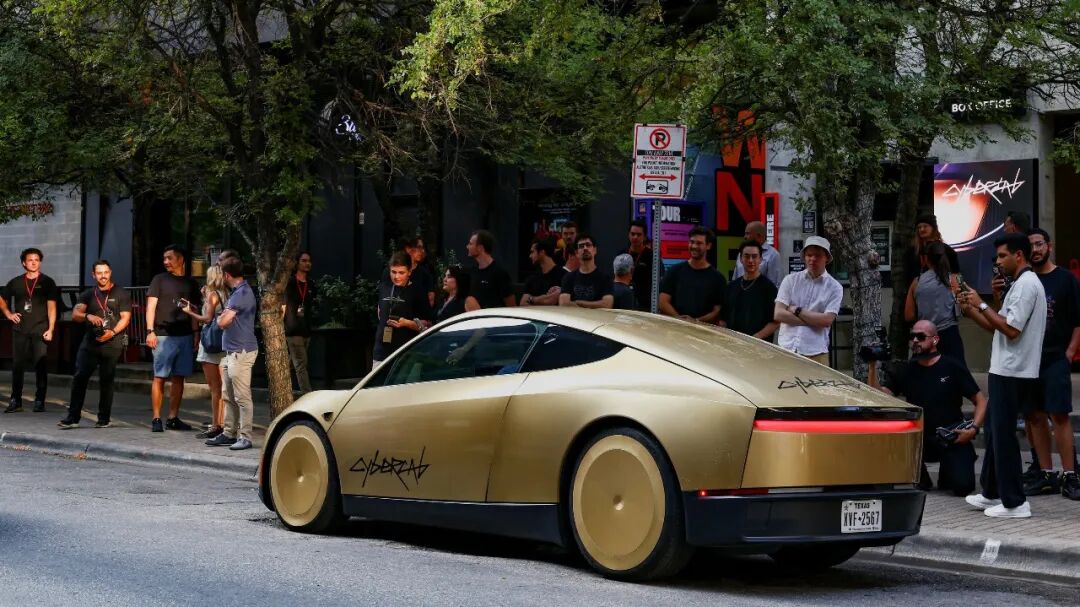
In California, using the same amount of money, buying a Tesla Cybercab yields a higher return than purchasing a rental property.


Let’s do a very interesting rough calculation first
Assume the final price of Cybercab
If it actually operates every day:
Even after subtracting:
- Tesla platform/commission
- electricity cost
- cleaning
- insurance
- maintenance
- tires
- depreciation
- deadheading miles
- accidentsdowntime
- taxes
Assume the final net remaining is
So for a $35,000 Cybercab: the net return rate could reach 85%–130%/year.
If this number can really be achieved,
The biggest question for Cybercab isn’t “can you make money”, but rather:
Tesla officially describes theRobotaxi network as expanding, but gives no definite income-sharing formula for individual car owners.
Moreover,Cybercab is designed entirely for autonomous operation: no steering wheel, no pedals, just two seats.
So it's completely different from buying a regularTesla for Uber rideshare.
What you’re really betting on is:
This is, in fact,
Assume you invest
Many residential rental properties in California have acap rate that is not high, especially in the core areas of Southern California.
Currently, residential rental properties commonly seen on the market have about: 3%–5% cap rate
Hot coastal areas might even be only
For example: $500,000
Assume: house price: $500,000, annual rent: $30,000, NOI: $20,000
So: Cap Rate = 4%
Annual net operating income is only: $20,000
But real estate properties have one very important attribute: leverage.
For example: $500K down payment + $500K loan
What you control: $1M

If housing prices rise by4% in the future, that’s: +$40,000
Meanwhile, your tenant helps you repay part of the principal. So the true return on real estate:
It's not just about the rent yield.
CybercabCalifornia Rental Property
| Initial capital | ~$30–40K | ~$500K+ |
| Theoretical cash return rate | Very high | Low |
| Income certainty | ⭐⭐ | ⭐⭐⭐⭐ |
| Potential growth | ⭐⭐⭐⭐⭐ | ⭐⭐⭐ |
| Depreciation speed | Very fast | Slow |
| Liquidity | High | Low |
| Maintenance risk | Medium-high | Medium |
| Manual management | Low | Medium-high |
| Policy risk | Very high | Medium |
| Technical risk | Very high | Low |
| Leverage capability | Very low | Very high |
| Long-term asset appreciation | Basically none | Has |
| Passive income potential | Could be extremely high | Moderate |
According to US Stock Investment Network, California rentals also have costs like insurance, property management, and maintenance; for example, property management typically charges about 7%–10% of rent, depending on the property and service.
But I actually think Cybercab has a huge advantage over real estate
Assume in the future, it's really achieved that:
$35,000 for a car, netting $100/day
One year: $36,500
So: $35,000 → $36,500/year
That’s close to 100% ROI.
What’s wilder is, if you could in the future: buy 10 vehicles → $350,000
Becomes: $300K–$400K/year net income
That’s not just “buying a car” but:
Building a self-driving taxi fleet.
At that point, its investment nature is completely different.
But there is a huge pitfall
Never buy a Cybercab assuming $100/day in net profit.
The correct approach, according to US Stock Investment Network, should be:
Phase 1: Buy 1 unit. Not for profit.
But to get real data:
Revenue/day
↓
Tesla commission
↓
Electricity cost
↓
Insurance
↓
Maintenance
↓
Depreciation
↓
Net profit/day
Run for 3–6 months.
Phase 2
If the actual data reaches:
$80/day net profit
Then:
$80 × 365 = $29,200
If the car price is $35,000:
83% annualized
That’s very worth considering.
Phase 3
If the reality is only:
$30/day
One year:
$10,950
ROI:
31%
Still very good.
If it’s only:
$10/day
One year:
$3,650
ROI:
10.4%
That’s no longer as attractive.
So what really matters isn’t the Cybercab price
But a single figure:
Net Revenue per Cybercab per day
I would even set the investment criterion as:
>$70/day: Expand aggressively
$40–70/day: Worth buying more
$20–40/day: Observe
<$20/day: Not worth large-scale investment
If I had to pick one now
My answer would be:
If you have $1 million in cash:
I wouldn’t put it all into rental properties.
Nor would I buy only Cybercabs.
I would consider:
$700K–800K → Real estate
$100K–200K → Cybercab/Robotaxi experiment
Rest cash → Working liquidity
Because the greatest value of Cybercab may not be how much profit the first car makes.
But rather:
If Tesla eventually proves “one car can stably generate $30K–50K net profit per year,” then what you really own is a replicable automated cash flow machine.
That’s very hard for real estate to do.
You can buy the first, second, or third property, but each home requires a lot of capital.
If the Cybercab business model works, it could be like:
1 unit → 5 units → 20 units → 100 units
The capital efficiency is on a whole different level.
However, I want to especially remind you of one issue
Currently, Tesla Robotaxi itself is not yet a mature personal car owner profit-making model in California. At present, Tesla's official list of Robotaxi service cities does not include California; so if your assumption is “I buy a Cybercab in Los Angeles now and immediately let it go make money automatically,” this premise doesn’t stand right now.
So if you ask me:
“In September 2026, if I have $500K, which has a higher expected return in the next five years?”
My judgment is actually:
Cybercab: Potential returns >>> Rental property
But:
Cybercab: Certainty <<< Rental property
This is very much like your investment logic in the stock market:
Cybercab is a high payoff, high uncertainty.
Rental property is low payoff, low volatility and can be leveraged.
US Stock Investment Network VIP Fully Upgraded





Disclaimer: The content of this article solely reflects the author's opinion and does not represent the platform in any capacity. This article is not intended to serve as a reference for making investment decisions.
You may also like
Coldcard Exploiter Moves 45% of Wave 3 Loot as Stolen Bitcoin Enters CoinJoins
The world has enough Crude Oil and not enough diesel
The Euro waits for the sentence after the rate hike
Ethereum outflows top $300 million as price nears $2,530 resistance
Crypto prices
More


