
Gold Price Reacts in Advance to September Interest Rate Hike; Short-term Bearish Factors Unlikely to Break Long-term Logic

FX168 Financial News, September 7—— Currently, the probability of a rate hike is indeed not small, but the long-term logic for gold is also difficult to be falsified in the short term.
Influenced by stronger-than-expected US non-farm payroll data, expectations for a Federal Reserve rate hike in September have reignited, pushing international gold prices downward at the beginning of September, retreating to near the $4,400 per ounce threshold.
Although the hawkish comments from Federal Reserve officials and robust economic data have put short-term pressure on the zero-yield asset gold, and despite the current probability of a rate hike being less than 60%, the market response has basically been inclined toward the realization of a hike. However, whether a single rate hike can fundamentally alter the upward trend in gold prices is still debatable.
With the Fed entering the "blackout period" and ahead of key CPI/PPI data releases, the gold market is at a sensitive turning point with fierce battles between bulls and bears.
Non-farm payrolls exceed expectations, probability of a September rate hike approaches 60%
In August, US non-farm payrolls surged by 162,000, well above the market expectation of 53,000; the unemployment rate stayed at 4.1%, and wages rose 3.1% year-on-year.
Strong labor market data pushed up the probability of a September rate hike shown by the CME "FedWatch" tool from 50% to nearly 60%.
Federal Reserve Chairman Kevin Warsh sent hawkish signals at the Jackson Hole annual meeting, bluntly stating that inflation is above the 2% policy target, with several officials reiterating their determination to reduce inflation.
While the White House (including President Trump) has strongly called for rate cuts and even tariff threats, the Federal Reserve is communicating its stance that if inflation rebounds, it will not hesitate to raise rates and will uphold policy independence.
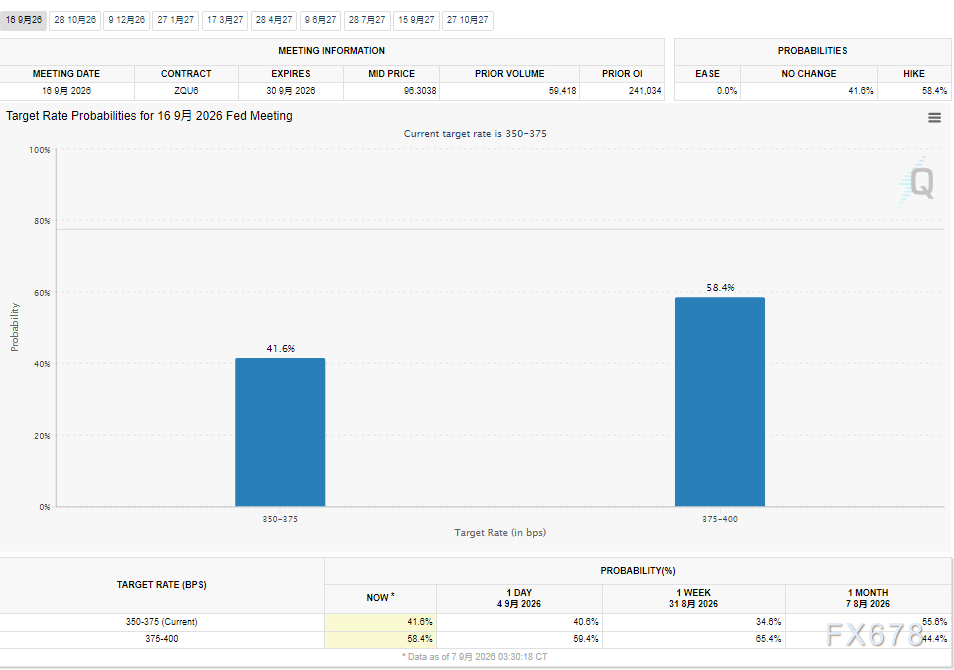
(FedWatch Interest Rate Futures Monitor, Source: CME)
Possibility and cost of political compromise
It's worth noting that there is a viewpoint in the market that Washington politics exhibit a "Potomac Two-Step" phenomenon, where public statements by officials often diverge from actual actions.
With the U.S. midterm elections approaching on November 3, to avoid monetary policy disrupting congressional election outcomes, the likelihood of rate hikes landing at the meetings on September 16 and October 28 may be reduced.
Previous articles have mentioned that existing economic data is not yet sufficient; more sample observations may be needed to determine whether inflation has reached a level that requires rate hikes. The recently deceased Greenspan once delayed rate hikes, and inflation eventually receded, which the Fed has previously attempted to emulate effectively.
Of course, it would be best if Friday's US CPI pulls back, as this would make it easier to soften the hawkish remarks from Jackson Hole with the above logic.
However, there is a major downside: if the market forms the impression that "Federal Reserve decisions are being influenced by political factors," institutional funds will accelerate "currency depreciation hedging trades." US Treasuries could be dumped again. Although gold and other precious metals have the ability to hedge against the US's massive fiscal deficit and monetary and fiscal policy risks, they are also affected by Treasury yields, which is not what the US wants to see. Therefore, the probability of a rate hike remains considerable.
Currently, US federal debt has surpassed $40 trillion, further amplifying market concerns about the weakening credibility of the US dollar, which overall should be bullish for gold prices.
Market breakdown: Gold's pullback is mainly profit-taking
Looking at the market, gold prices retreated after Warsh's hawkish comments, largely due to profit-taking by momentum traders following August's surge.
Gold ETFs saw a maximum increase of about 15% in August, closing up 11% for the month. A short-term correction does not signal the start of a long-term downtrend for gold. Overseas and domestic institutions' willingness to allocate precious metals continues to rise, with central banks (led by China) continuously purchasing gold to diversify US Treasury holdings and hedge against high US deficit risks, thus reinforcing gold's core support.
At the same time, rising tensions in the Strait of Hormuz and higher oil prices have heightened concerns about supply-side inflation, combined with continued physical gold reserve demand from central banks so that even after a sharp decline, gold prices remain significantly above previous lows, showing strong resilience.
Summary of mainstream institution insights
According to recent assessments by several authoritative commodity research institutions, the current correction in gold is a phase of sentiment adjustment, not a trend reversal. There is clear divergence in the market in the short and medium term, but long-term consensus remains intact.
Ashish Rajodiya, commodity analyst at PL Capital, pointed out that the exceptionally strong non-farm data boosted Fed rate hike expectations, directly pressuring precious metal prices. However, market demand is still strong, and physical and institutional investment demand remains robust. Gold’s overall upward trend has not been disrupted, and this decline is simply a short-term pause in the larger uptrend.
Rajeev Sharan, research director at Brickwork Ratings, supplemented that gold prices will remain under pressure for the next two weeks. The September 16 Fed meeting is a key inflection point: whether there is a rate hike or hawkish guidance, US Treasury yields are expected to stay high, undermining the appeal of zero-yield gold holdings.
Additionally, Fed officials are speaking cautiously, inflation data will ultimately decide policy direction, and the continued political pressure for rate cuts in Washington means the probability of a sharp tightening in monetary policy is limited, leaving room for gold prices to stabilize and rebound later on.
Summary and technical analysis:
Top investment banks generally maintain an optimistic medium- and long-term outlook. With global central banks continuously buying gold, a weakening US dollar, and ongoing global debt crises, short-term corrections do not change the long-term upward trend for gold. However, there are indeed short-term risks of rate hikes. Even if a hike occurs, it might instead offer a good buying opportunity for gold that day, since US debt is a long-term issue and any policy shift will be slow.
If the market widely believes the Federal Reserve’s policy is subject to political interference, funds will rush into gold and other assets seen as immune to policy interference, and gold prices could see a rapid rally.
Technical perspective: Gold prices are being supported near the lower edge of the trading range. Watch for the 4430 level, as it is the recent bull-bear dividing line for gold. If this resistance is broken, gold could reverse course upward.
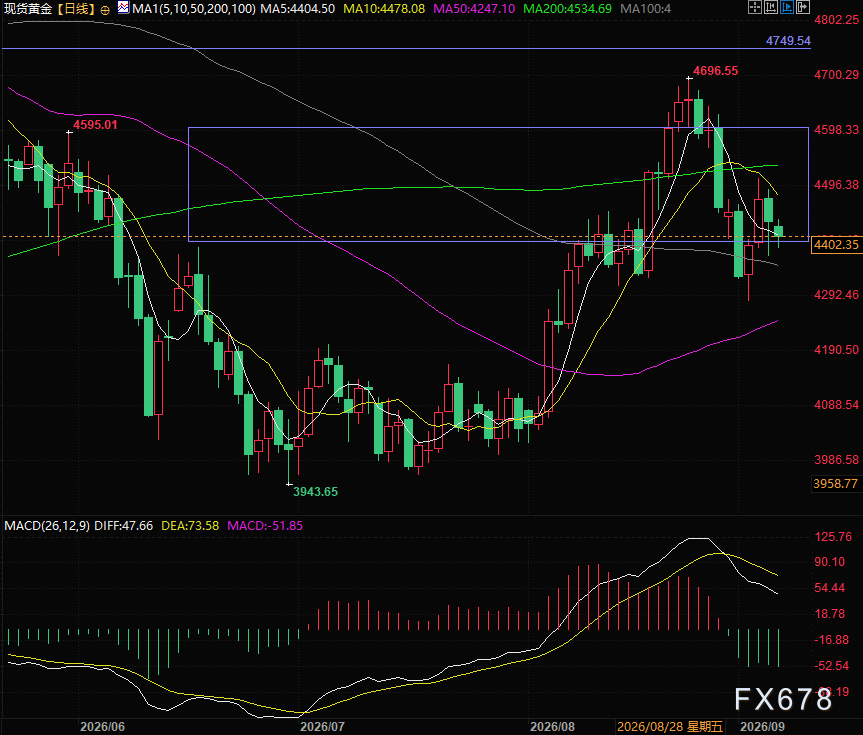
(Spot Gold Daily Chart, Source: FX168)
East 8th District 21:27, spot gold is quoted at $4,404/ounce.
Disclaimer: The content of this article solely reflects the author's opinion and does not represent the platform in any capacity. This article is not intended to serve as a reference for making investment decisions.
You may also like
Irish gangs turn private vaults into hiding spots for crypto keys
New Zealand Dollar struggles to gain traction as cautious RBNZ outlook weighs
$200B Hanwha builds tokenized securities platform on Avalanche as AVAX climbs
Bitcoin chips away at weekend upside as $80K hangs in the balance
Crypto prices
More


