
Bank of America: Gold market sees the strongest wave of institutional inflows in nearly a year

Huitong Network Sep 1—— According to fund flow statistics tracked by Bank of America, the gold market is experiencing the strongest wave of institutional funds inflow in nearly a year, with the size of inflows reaching the highest level since October 2025. This new wave of capital return reflects that a large number of institutional investors are truly increasing their positions in defensive assets like gold; investors are re-evaluating the trend of Federal Reserve interest rates, the strength of the US dollar, and various potential risks at the global macro level.
According to fund flow statistics from Bank of America, the gold market is seeing the strongest wave of institutional capital inflow in nearly a year, with the scale of investor inflows reaching the highest level since October 2025. This capital return reflects a substantial increase in positions by institutional investors in defensive assets like gold; they are reassessing Federal Reserve rate direction, the performance of the dollar, and a spectrum of global macro risks. Investors are no longer just chasing high-risk equity assets, instead turning to gold as a physical tool to hedge uncertainty. This change is likely to provide another upward push for spot gold prices as well as gold-pegged ETF products.
The latest fund flow statistics show that weekly buying demand for gold in 2026 has seen a notable increase, while the four-week moving average for capital inflows has also risen in tandem. The four-week moving average can filter out sudden large transactions that cause short-term data disruptions, removing occasional short-term volatility to restore the true mid- to long-term capital trend—making this a core indicator frequently referenced by institutional traders in practice. This is crucial: it shows that the recent strengthening in gold is not just the result of a single-week, large-scale fund entry, but rather a broader range of market participants and ongoing capital inflows that are driving an overall market rebound.
Compared to market conditions in 2023 and 2024, this latest round of capital flows is particularly remarkable. During those two periods, gold market capital flows were relatively muted with no large-scale betting on either side. Since the second half of 2025, weekly gold inflows have repeatedly surpassed $6 billion; yet, this has also been matched by outflows of similar magnitude, which straightforwardly shows that current market participants have strong swing attitudes and rapid in-and-out characteristics, with no one-sided, long-term consensus to go long having yet formed.
The big-picture backdrop for this new wave of buying is that investors are repeatedly weighing the future path of interest rates and the US dollar. Gold doesn’t generate interest income itself, so when bond yields fall, the opportunity cost of holding gold is reduced, making gold relatively more attractive; when the US dollar weakens, buyers in other countries have lower exchange costs when buying gold, further supporting demand for both physical and financial gold. Put simply: the higher US Treasury yields are, the less attractive it is to hold gold; the more expensive the dollar, the costlier it is for overseas buyers to acquire gold. These two variables directly cap gold’s upside potential.
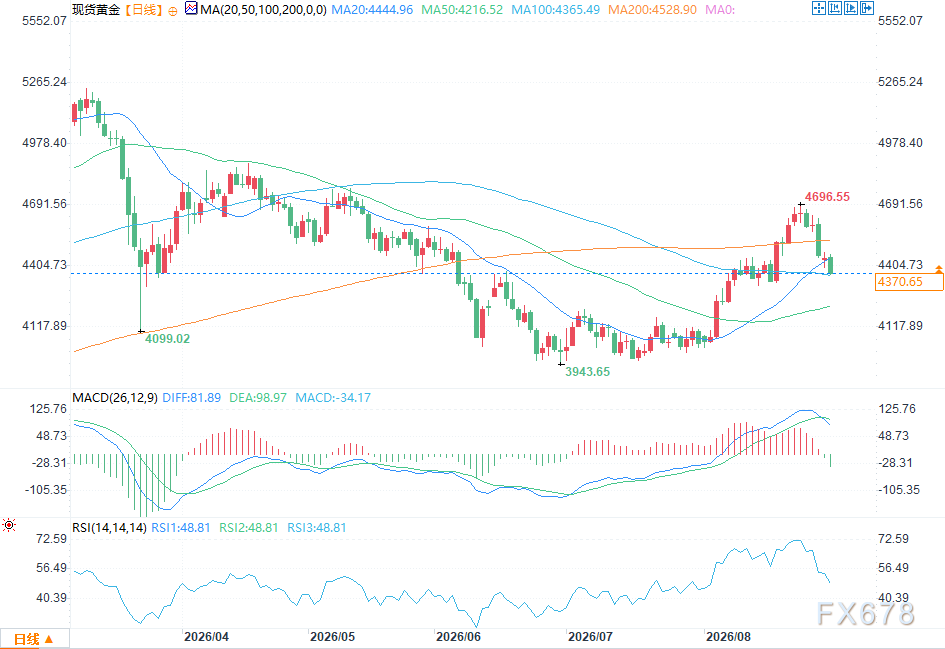
(Spot gold daily chart, source: Easy Huitong)
For investors positioning in gold, the most crucial observation signal is to determine whether this explosive wave of capital inflow can continue in the long term, or if it is merely a short-term temporary pulse.
However, one cannot ignore hidden risks: current market capital fluctuations are already very pronounced. Should US Treasury yields rebound and strengthen, the dollar rally, or gold ETFs suddenly experience large redemptions and outflows, the short-term accumulated upward momentum could dissipate rapidly, making a quick market correction very likely. However, based on the current four-week average fund flow data, institutional capital’s interest in gold allocations has already shown a marked increase—this can no longer be easily ignored.
Disclaimer: The content of this article solely reflects the author's opinion and does not represent the platform in any capacity. This article is not intended to serve as a reference for making investment decisions.
You may also like
Strategy hits back at MSCI proposal, calling it 'discriminatory' against DATs
Gold weakens below $4,400 as US Treasury yields surge, Fed rate hike bets rise
Stocks Down Pre-Bell as Traders Weigh Renewed US-Iran Tensions
New Zealand Dollar slumps against US Dollar amid firm hawkish Fed bets
Crypto prices
More


