
Hawkish signals from the Federal Reserve raise rate hike expectations; gold continues to adjust, awaiting this week's non-farm payroll data.

Financial Associated Press, September 1st—— Gold retreated to around $4,445 during the Asian session as the market reevaluates the Fed’s future policy path. The hawkish signals released at the Jackson Hole Symposium have significantly increased expectations of a rate hike in September, and combined with inflation worries brought by rising oil prices, gold is under short-term pressure. However, prices remain above key medium- and long-term moving averages, with the trajectory of the US dollar and real interest rates set to determine the next direction.
In the Asian session on Tuesday, the gold market cooled noticeably, with spot gold prices pulling back to around $4,445/ounce, stalling the momentum of its consecutive rallies. This adjustment is not simply due to a decline in safe-haven demand; rather, the market has started to reassess the Fed’s future interest rate path. Against the backdrop of escalating tensions in the Middle East and rising energy prices, investors worry that higher energy costs could bolster inflationary pressures once again, thereby limiting the Fed’s room to loosen monetary policy.
Recently, the Middle East situation has experienced renewed volatility, with military clashes reigniting between the US and Iran, leading the market to focus heavily on energy supply and international oil prices. Rising oil prices not only amplify the risk premium in the crude oil market but could also be passed on to end prices through fuel, transportation, and production costs. For gold, this brings about a complex impact: geopolitical risks typically benefit safe-haven assets, but if risk events primarily push energy prices higher and elevate inflation expectations, thereby forcing the Fed to keep rates elevated, then a stronger dollar and higher US bond yields may offset the safe-haven demand for gold.
The market, therefore, has turned its primary focus from mere geopolitical risks to Federal Reserve policy expectations. Fed Chair Kevin Walsh delivered relatively hawkish inflation signals at the Jackson Hole Annual Meeting, stressing that price stability remains the core goal of monetary policy and that the current decline in inflation is not yet sufficient to fully reassure policymakers. His remarks prompted investors to raise their expectations of a subsequent rate hike. Traders now see the probability of a Fed rate hike in September at about 65.4%, notably higher than the roughly 39.9% before Walsh’s speech. This marks a significant shift in short-term rate expectations. For gold, which does not yield interest income, rising rate expectations usually mean higher opportunity costs for holding, and thus, gold prices tend to be suppressed.
More importantly, current inflation risks have not entirely disappeared. Although US inflation data had signaled some cooling off, rising energy prices may alter the inflation trajectory in the months ahead. Should crude oil remain strong, leading to renewed increases in US gasoline and transportation costs, the market could start to worry that inflation will slow its descent. In this case, even if the Fed does not hike rates immediately, it could prolong its period of elevated rates, also pressuring gold valuations. Some institutions believe Walsh’s recent policy messaging is markedly hawkish. Rajeev De Mello, global macro portfolio manager at GAMA Asset Management, commented that the more hawkish stance caught many investors off guard, so gold may still face some headwinds in the short term. This assessment highlights the core short-term contradiction in the gold market: geopolitical risks enhance gold’s safe-haven appeal, while rising rate expectations lift the cost of holding gold.
Meanwhile, the US dollar has regained some support. The Fed’s tough stance on inflation helps US dollar assets maintain higher yields. For dollar-denominated gold, a stronger dollar generally increases the cost for non-dollar investors, adding another layer of pressure on gold prices. Thus, whether gold can resume its uptrend depends not only on geopolitical risks but also on whether the dollar index and US Treasury yields show significant declines.
On a technical level, gold’s medium-term structure has not yet fully weakened. On the daily chart, XAU/USD remains above the 100-day moving average, currently around $4,370, and is near the 20-day moving average at approximately $4,430. The 20-day moving average still provides some support, indicating that the prior medium-term uptrend remains intact. The RSI is currently around 54, sitting in a neutral-to-bullish zone, signaling a cooling off in market momentum, but has not yet moved into a clearly bearish state.
Looking at the daily structure, $4,430 is the most important short-term support, as it is near the 20-day moving average and represents a rebalancing point for bullish and bearish forces. If gold can stabilize above $4,430 and break back above $4,500, the market may test the resistance area near $4,600; further upward, focus turns to the $4,700–$4,725 region, close to the upper Bollinger Band, likely an important threshold for further advances. Conversely, if $4,430 is breached, gold may retest support at the 100-day moving average near $4,370. Should the 100-day moving average give way as well, corrective room could expand towards the $4,200–$4,140 region.
On the 4-hour chart, gold has shifted from a previous strong rally to a more choppy, bearish short-term move; after breaking the short-term uptrend, bulls need to find new support. The $4,430–$4,440 range is now key for the short-term battle between bulls and bears. As such, a quick reclaim of $4,500 would suggest the current pullback is more of a technical correction within an uptrend, with potential for another test of the $4,550–$4,600 zone; extended action below $4,430 might see further weakness towards $4,370. From a technical indicator perspective, short-term momentum is cooling, but there is yet no definitive reversal signal for the medium-term trend. Thus, it is prudent to closely watch key support and resistance breakouts rather than assume a trend reversal.
Looking ahead, attention should focus on upcoming Fed statements, US inflation figures, labor market performance, the dollar index, and the 10-year Treasury yield. If inflation heats up again and stokes even higher expectations of rate hikes, gold could remain under valuation pressure; if subsequent economic data weakens, rate expectations subside, and geopolitical risks persist, safe-haven demand for gold could retake the lead.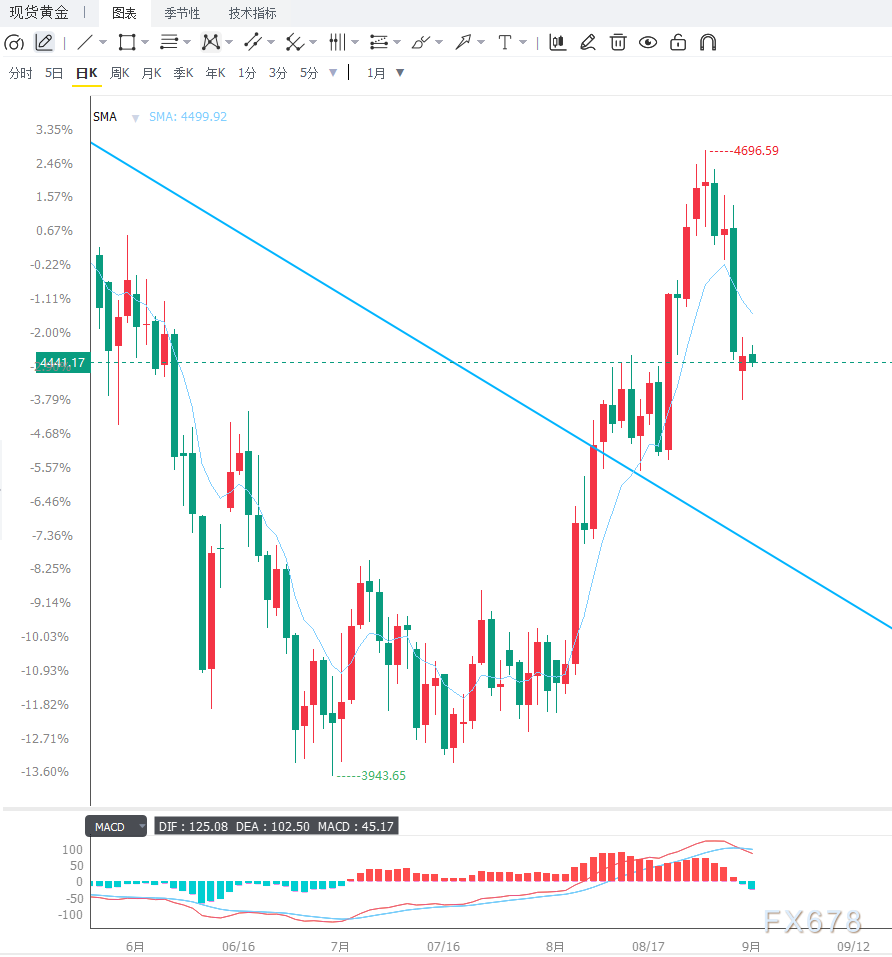
The core contradiction currently facing gold is shifting from “safe-haven demand” to a tug-of-war between “safe-haven and rate expectations.” While escalating Middle East tensions should theoretically boost gold’s appeal, inflation risks from rising oil prices have, in turn, strengthened expectations that the Fed will maintain or even raise rates, thus making the US dollar and US Treasury yields major factors suppressing gold prices. The market must continue to closely monitor US inflation and employment data as well as Fed policy signals, also watching whether higher oil prices truly feed through to inflation expectations. In the medium and long term, gold still holds safe-haven and asset allocation value, but its short-term moves will hinge more on actual interest rates, the dollar, and changes in monetary policy outlook; investors should be wary of high volatility triggered by macro policy repricing.
Disclaimer: The content of this article solely reflects the author's opinion and does not represent the platform in any capacity. This article is not intended to serve as a reference for making investment decisions.
You may also like
Why crypto could face its first September test as U.S. labor data looms
Gold declines as rising Fed hike bets and US‑Iran tensions support USD
HBAR targets $0.34 as double-bottom pattern and RWA growth signal reversal
Crypto prices
More


