

A sweeping 25-year oil agreement giving the US access to about a fifth of Venezuela’s crude reserves is drawing scrutiny from energy experts and lawyers over its legality, transparency and ability to deliver the promised production.
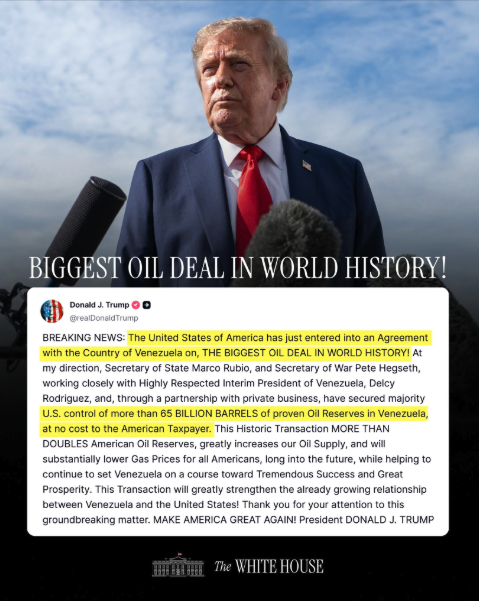
The unprecedented pact, announced by US President Donald Trump on Friday in social media and confirmed by Venezuela’s interim President Delcy Rodríguez on Saturday, covers 65 billion barrels of recoverable oil — more than the 46 billion barrels of proved reserves in the US. Trump said much of Venezuela’s oil reserves would come under “majority US control.”
“This 25-year bilateral project envisages the development of 17 strategic oilfields with a production target of more than 1.5 million barrels per day,” Rodríguez said in a late-night address on state broadcaster VTV. “That figure relates solely to the bilateral agreement between Venezuela and the United States.”
The deal could reshape Venezuela’s oil industry and deepen its dependence on the US at a time when Washington already oversees much of the country’s petroleum trade. But its secret negotiation, lack of competitive bidding and unclear operating structure are raising questions over whether the agreement can withstand future legal challenges and attract the investment required to meet its ambitious targets.
Rodríguez called the pact “historic” and said it complies with Venezuela’s Hydrocarbons Law. She said it would secure $100 billion in investment and $209.3 billion in royalties and taxes, leaving Venezuela with nearly $19 from every barrel produced.
“It will revive Venezuela’s economy and increase government revenue,” she said.
The agreement did not go through a competitive process, and negotiations remained secret until last week. They took place as Venezuela pursued a sweeping overhaul of its main hydrocarbons law and moved dozens of joint ventures and contracts to new terms, a process authorities and operators have yet to complete.
Canada ‘on notice’
The announcement also comes just days after US-Canada trade talks collapsed, raising the prospect that Canadian crude could eventually compete barrel-for-barrel with Venezuelan oil for access to the US market, according to energy experts.
Trump sharpened that threat in a social media post, saying the Venezuela deal puts “Canada on notice.” He also said the agreement would involve “a partnership with private business,” but the US has not disclosed which companies could operate the fields on its behalf.
North American Blue Energy Partners, or NABEP, led by controversial Venezuelan investor Alejandro Betancourt, has been acting as a bridge between Caracas and Washington. The company told the New York Times it looks forward to working with the US amid media reports linking it to the agreement.
“If the goal was to try to reduce the risk of investing in Venezuela, the US might be doing the exact opposite with this transaction: further weakening the country’s already fragile institutional framework,” Luisa Palacios, adjunct senior research scholar at Columbia University’s Center on Global Energy Policy, told Reuters.
Legal experts have also questioned an arrangement under which the US, rather than Venezuela, is expected to choose the operating model and participating companies.
“Despite being formally recognized by the US, the agreement can be brought to court in the future,” Juan Carlos Apitz, head of the Central University of Venezuela’s law faculty, said.
The White House referred Reuters’ questions to the US Department of Energy, which did not respond to a request for comment. Venezuela’s oil ministry and state energy company PDVSA also did not respond.
The government’s projected tax take has drawn separate criticism.
“Taxes to be collected, announced by the interim government, are incredibly low,” Francisco Monaldi of Rice University’s Baker Institute said in a social media post Saturday. He also criticized the lack of transparency surrounding Venezuelan oil policy, which has been under US oversight since the capture of former President Nicolás Maduro in January.
Production challenge
The 65 billion barrels would come from 17 oilfields, with most reserves concentrated in eight large blocks in the Orinoco Belt, Venezuela’s main producing region, and the remainder around Lake Maracaibo, its mature and investment-starved oil hub, according to a list quoted by Reuters.
An analysis by Caracas-based consultancy Gas Energy Latin America found the fields hold 63.7 billion barrels of proved reserves using a technically feasible 20% recovery factor that has yet to be achieved. Some experts estimate producing the recoverable reserves would take more than 25 years.
The portfolio combines greenfield and brownfield assets, giving operators existing production that could support exports while they repair aging infrastructure around Lake Maracaibo. Developing undeveloped areas of the Orinoco Belt would pose a different challenge because its deposits consist largely of extra-heavy crude and require substantial investment and infrastructure.
The proposed US participation with a 55% stake would further increase the share of Venezuelan oil flowing to the US, which currently receives about 60% of the country’s exports.
Trump said Sunday that additional Venezuelan barrels could also help replenish the US Strategic Petroleum Reserve as his administration faces political pressure over gasoline prices amid the conflict with Iran. The reserve fell this month to 290 million barrels, near a 44-year low.
The scale of the resources gives the agreement potentially enormous strategic value, but converting those barrels into sustained production will depend on investment, infrastructure and a legal framework strong enough to survive challenges well beyond either government’s current tenure.


