
Preventing Gold from Hijacking the Thai Baht: Will the Thai Central Bank's Restrictions on Gold Trading Be Effective?

On August 28, the Bank of Thailand stated that the previously implemented gold trading restrictions have effectively reduced the impact of international gold prices on the Thai baht exchange rate, and said it will further tighten policies if necessary. Since March this year, Thailand has set a daily limit of 50 million baht for personal online gold trading, and has encouraged large investors to settle in US dollars rather than baht. In addition, regulators have strengthened scrutiny of physical gold withdrawals, large cash transactions, and fund flows.
These measures aim to actively block the transmission channel from international gold prices to the Thai baht exchange rate at the gold trading level. The initial policy results have been relatively significant: the 60-day rolling correlation coefficient between the baht exchange rate and international gold prices dropped from a peak of 0.85 last year to 0.3 in April this year, the lowest level in nearly four years. In particular, after implementing the requirement to declare physical gold withdrawals exceeding 2kg, such withdrawals fell by about 70%. However, as gold prices have recently risen, the correlation coefficient between the two has rebounded to 0.65.
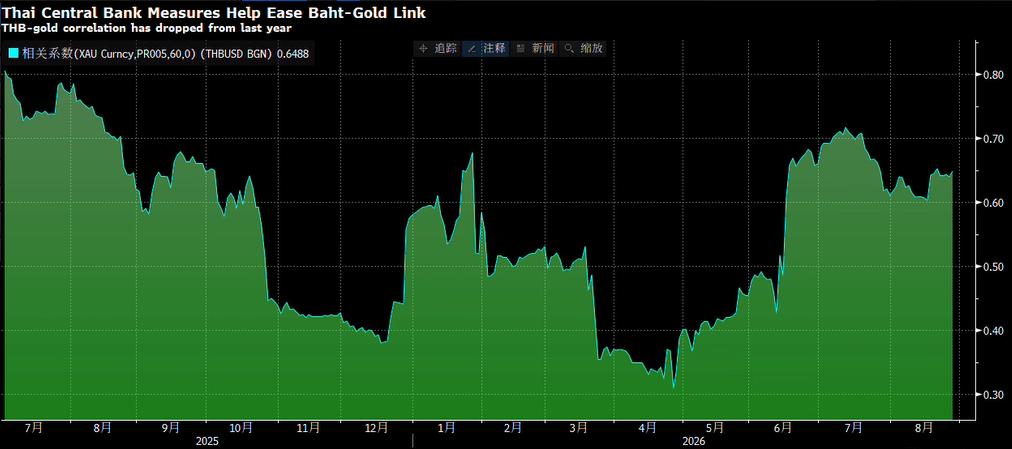
The background of this policy is that Thailand's gold market has a much greater impact on the foreign exchange market than in most economies. During peak gold trading periods, related transactions once accounted for 50%-60% of Thailand's total US dollar transactions. Each major fluctuation in international gold prices results in a simultaneous impact on the baht's exchange rate. Especially since the end of January this year with significant gold price volatility and the recent frequent changes in the gold market, the urgency for the Bank of Thailand to implement this policy and to further tighten it has become more evident.
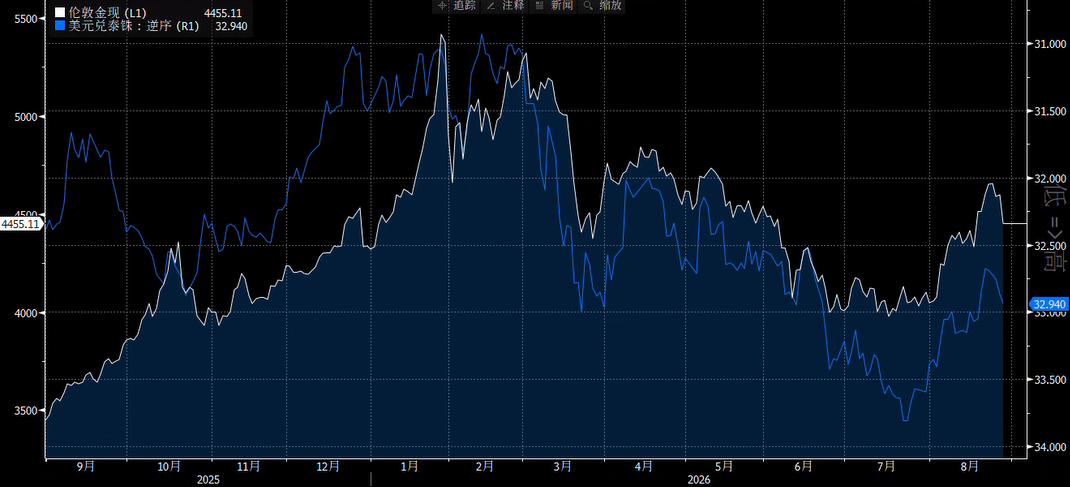
The Bank of Thailand tries to build a firewall between gold prices and the baht exchange rate
In the second half of August, Besant announced an expansion of long-term bond repurchases, which led to a weaker US dollar index and lower US Treasury yields, further fueling US dollar depreciation trades. As a result, gold ETF saw large-scale capital inflows in a short period. Speculative funds and systematic strategies such as CTA rushed into the gold market, and within just three weeks, speculators accumulated a nominal net purchase of gold futures totaling more than 2.2 billion US dollars, setting the largest nominal net purchase record in more than a decade. In the week of August 28 alone, gold and Bitcoin ETFs saw a combined capital inflow of about 7 billion US dollars. Driven by these factors, gold prices quickly surged from around 4,400 US dollars per ounce and broke through 4,600 US dollars per ounce.
Disclaimer: The content of this article solely reflects the author's opinion and does not represent the platform in any capacity. This article is not intended to serve as a reference for making investment decisions.
You may also like
Today's Fear & Greed Index rises to 69, indicating the market is in a "Greed" state.
Goldman Sachs predicts gold will reach $4,900 by the end of the year
Prospera Energy extends C$20.74 million senior term loan maturity to Aug. 31, 2028
Crypto prices
More


