

Bitcoin has seen a significant change in how it moves relative to traditional markets during its latest rally. According to Grayscale research, Bitcoin’s 90-day correlation with gold has soared above 50%, compared with nearly zero at the start of 2026. At the same time, its correlation with the Nasdaq 100 has declined from over 60% to about 33%.
Bitcoin’s correlation with gold hits 50% as ETFs add $3 billion in August
By:Cointurk
Bitget offers one-stop trading for cryptocurrencies, stocks, and gold. Trade now!
A welcome pack worth 6200 USDT for new users! Sign up now!
Correlation shifts amid price surge
These shifts suggest that Bitcoin has recently acted less as a high-volatility technology asset and more as a scarce, macro-oriented investment. However, analysts caution that such rolling correlations can change quickly as new price data emerges, and do not necessarily point to a permanent transformation.
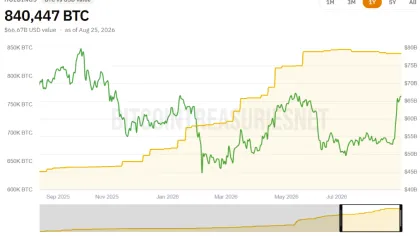
The changing relationship between Bitcoin, gold, and tech stocks has become especially pronounced during one of Bitcoin’s strongest runs this year. Between August 17 and August 21, BTC rallied from around $62,679 to $79,500, marking a 27% surge in just four days. Market participants attributed the move to changes in Treasury bond buyback operations, a weaker US dollar, significant short liquidations, and revived institutional interest.
During this period, weekly spot Bitcoin ETF inflows reached approximately $1.9 billion as improved Treasury liquidity helped ease long-term yield pressures, according to Coinpaper.
Flows into spot Bitcoin ETFs continued afterward, with another $242.3 million added on August 27. This extended the ETF inflow streak to nine sessions, lifting cumulative inflows during the rally to around $3.04 billion based on current ETF data.
ETH
SOL
BSC
ROBINHOOD
PAY
USDT
RECEIVE
AAPL
Date Spot Bitcoin ETF Inflows BTC Price (approx.)
| Aug. 17 | – | $62,679 |
| Aug. 21 | $1.9 billion (weekly) | $79,500 |
| Aug. 27 | $242.3 million (daily) | – |
| Aug. 17–27 | $3.04 billion (total) | – |
Macro backdrop and fiscal worries
Underlying these moves is mounting concern about US fiscal health. On August 18, US gross federal debt exceeded $40 trillion, rising to approximately $40.10 trillion by August 25. The Congressional Budget Office forecasts a federal deficit near $1.9 trillion for fiscal 2026.
Investors have responded by turning to so-called debasement trades, which involve buying limited-supply assets when high debt, persistent deficits, or inflation risk erode confidence in fiat currencies.
Reuters linked the recent gains in both Bitcoin and gold to a softer US dollar and Treasury measures designed to keep long-term government borrowing costs in check. Bitcoin briefly climbed above $80,000 this week and is up nearly 28% in August. Both crypto and traditional scarcity trades have benefited under this macro environment.
Gold has remained the better established defensive asset, while Bitcoin still displays higher volatility and faces unique crypto-related risks, analysts noted.
Comparing gold and bitcoin as macro hedges
Gold is recognized globally as a defensive holding in times of uncertainty, whereas Bitcoin continues to exhibit more price swings and risk factors specific to the cryptocurrency market. Investors evaluating the two assets often reference guides detailing Bitcoin’s capped supply of 21 million coins.
The next key development will occur if there is a broader flight to safety among investors. Should Bitcoin maintain its strong connection with gold while technology stocks weaken, the current shift in market relationships would become more meaningful for long-term asset allocation.
Mini dictionary: Grayscale, a leading digital asset management firm, conducts cryptocurrency market research and provides investment products such as the Grayscale Bitcoin Trust.
0
0
Disclaimer: The content of this article solely reflects the author's opinion and does not represent the platform in any capacity. This article is not intended to serve as a reference for making investment decisions.
Understand the market, then trade.
Bitget offers one-stop trading for cryptocurrencies, stocks, and gold.
Trade now!
You may also like
British Pound tumbles as Warsh revives Fed hike bets
FXStreet•2026/08/28 15:03
Crypto Biz: Bitcoin pumps, Wall Street does the paperwork
Cointelegraph•2026/08/28 15:00
Federal Reserve Chairman Waller Signals Rate Hike! Warns Inflation Has Not Yet Consistently Slowed, Firmly Defends 2% Target
Federal Reserve Chair Waller said on Friday that there has not yet been a meaningful and sustained slowdown in U.S. inflation. The Fed must be confident that underlying inflation is falling toward the 2% target at a sufficiently fast pace; otherwise, policymakers will still need to take action.
智通财经•2026/08/28 14:56

Euro slides below 1.1600 as Warsh brings Fed rate hike back into play
FXStreet•2026/08/28 14:51
Crypto prices
More
Bitcoin
BTC
$79,443.19
-1.07%

Ethereum
ETH
$2,507.5
-0.59%

Tether USDt
USDT
$1
+0.02%

BNB
BNB
$705.01
-0.67%

XRP
XRP
$1.43
-2.21%

USDC
USDC
$1.0000
+0.00%

Solana
SOL
$105.77
-1.43%

TRON
TRX
$0.3405
+0.83%

Hyperliquid
HYPE
$84.14
-0.45%

Dogecoin
DOGE
$0.08728
-2.19%
How to buy BTC
Bitget lists BTC – Buy or sell BTC quickly on Bitget!
Trade now
Become a trader now?A welcome pack worth 6200 USDT for new users!
Sign up now