
US tech software stocks' reversal just getting started? CRM, SNOW, CRWD, OKTA surge together

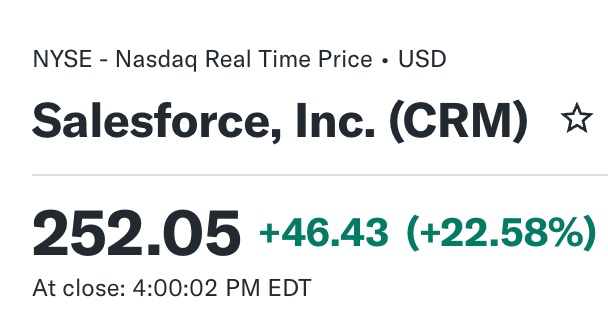
On Thursday, US stocks saw Nvidia surge by 8.72%, driving the Nasdaq up by 1.6%; Salesforce (CRM) soared by 22.55%, Snowflake (SNOW) gained 4.35%, while CrowdStrike and Okta rose by 20.5% and 28.6% respectively.
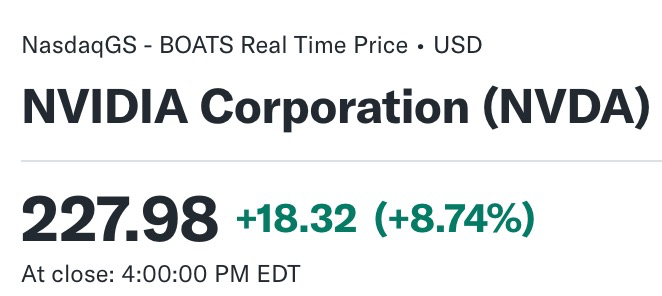
According to analysis from US Stock Investment Network, the market corrected two overly pessimistic views in one day:
- AI capital expenditure has not peaked
- Enterprise software is not destined to be eliminated by AI.
Capital is now seeking new opportunities in alignment with the direction of AI spending—Nvidia maintains the compute cycle, storage and networking are taking larger hardware budgets, and software is beginning to prove it can turn AI into recurring revenue streams.
AI spending hasn't stopped, and Nvidia can still raise prices
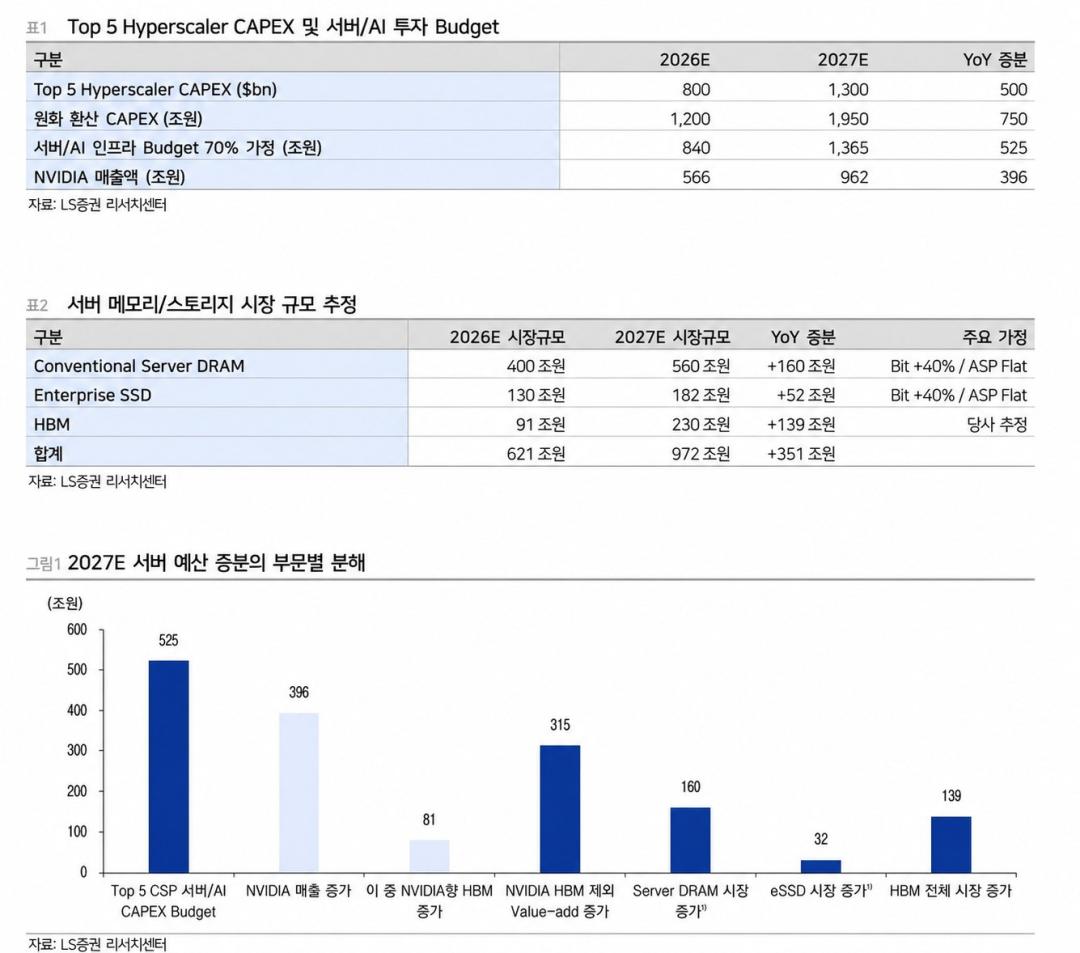
A forecast by South Korea's LS Securities estimates that the top five cloud service providers will have new AI and server capital expenditures of about $350 billion, of which about $264 billion could be converted into Nvidia's revenue.
The forecast period and calculation methodology of the full report still need verification, but the implication is clear: major players aren't hitting the brakes and are still expanding compute power.
Nvidia's strength lies in its pricing power. This quarter, gross margin reached 75%, with a third-quarter guidance of 74%; the industry expects that as components like memory continue to rise in price, the next-generation server prices could increase by about 20%, while FY2028 gross margin is still expected to remain at 72%–73%.
These figures shouldn't be simply interpreted as "Nvidia's memory gross margin exceeds 50%". More accurately: if server prices rise by 20% and overall gross margin falls to 72.5%, the implied incremental gross margin from price increases is still about 60%.
Nvidia is not only able to pass on most of the cost increases but can also continue to increase its dollar gross profit. Customers are willing to pay more, yet orders aren't decreasing as a result—this might be Nvidia's strongest moat.
Storage and networking start to take a share of the budget
Looking further down Nvidia's cost structure, the biggest surprise lies in storage.
According to LS Securities, the incremental HBM market is around $92.7 billion, server DRAM adds about $106.7 billion, and enterprise SSDs about $21.3 billion.
These three figures may have overlapping forecast periods or definitions and can’t be simply added together, but collectively they indicate that the increase in AI servers involves not just more GPUs, but also more high-bandwidth memory, server DRAM, and data storage capacity.
HBM is memory stacked alongside AI GPUs, feeding them high-speed data. If next year's HBM prices really rise by nearly 50% as the industry expects, market estimates for storage industry revenue and profits in 2027 may still be underestimations.
Samsung, SK Hynix, and Micron (MU) will not only compete on shipment volumes going forward, but also on who can expand premium capacity, improve yields, and lock in higher prices with long-term agreements. For US equity investors, Micron is the most direct play here.
Networking is the second budget increase
Susquehanna (SIG) supply chain research shows 1.6T networking is beginning deployment, the next-gen systems need more high-speed connections, and laser orders have even reached nearly twice actual demand.
This number shouldn't be interpreted as a doubling of demand, since customers, worried about shortages, might place advance or duplicate orders. But at the very least, it shows: the next round of AI network upgrades hasn't fully begun, but the upstream is already scrambling for capacity.
Additionally, this money won't all go to optical modules.
For short distances between adjacent racks, AEC (active electrical cables) can be used, which are usually cheaper and lower power; over longer distances, optical modules and lasers are more necessary.
So the future increase in AI network budgets will flow to optical modules, lasers, high-speed copper cables, switch chips, and SerDes—not just one technology monopolizing everything.
There’s also a more important competition taking place here.
Nvidia hopes to lock GPUs and networks together into its ecosystem through NVLink, switches, and full-rack designs; however, Google, Meta, OpenAI, and AMD are all adding their own alternatives.
Google continues to develop TPUs and its own high-speed interconnects, while OpenAI and AMD are promoting Ethernet-based scale-up.
Put simply:
In the short term, GPUs are hard to bypass Nvidia, but how GPUs are interconnected—cloud providers don't want to rely entirely on Nvidia.
MRVL shows the industry's strength, but not necessarily a stock price boost
Marvell (MRVL)’s earnings report validated demand for high-speed connectivity and custom chips.
The company's Q2 FY2027 revenue was $2.739 billion, up 37% year-over-year;
Data center business grew at 46%.
Management again raised guidance for FY2027 and FY2028 revenues and expects custom chip business to accelerate in the second half of the year.
Marvell sells high-speed interconnects and custom ASICs designed for cloud providers. The more cloud companies want to develop their own AI chips, the more they need a second solution outside Nvidia, and that's the incremental market Marvell is capturing.
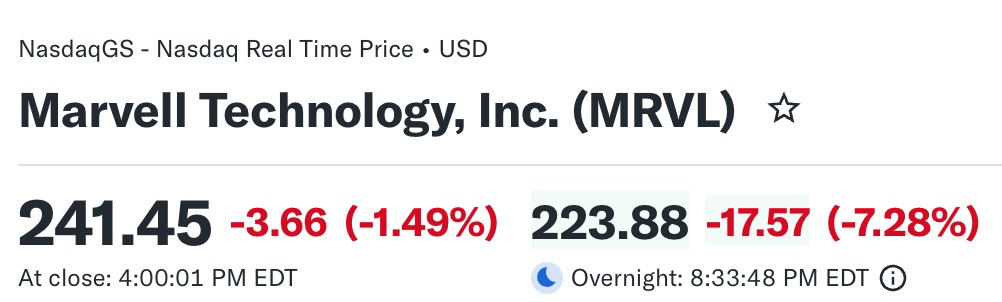
However, MRVL shares fell after-hours. The company gave Q3 revenue guidance of $3.15 billion, fundamentals remain strong, but the share price gave it no reward because expectations for AI and custom chips were already priced in.
CRM surges 23%: “AI killing software” thesis begins to soften
The other major change on Thursday happened in software.
Salesforce (CRM) surged 22.55%, marking its best performance since 2020.
Second quarter revenue was $11.345 billion, up 11% year-over-year; cRPO, or contracted revenue expected to be recognized in the next 12 months, rose 14% year-over-year; Agentforce and Data 360’s annual recurring revenue reached about $3.9 billion, up more than 210% year-over-year.
These numbers at least prove one thing: AI hasn’t killed Salesforce’s business.
Even more crucial, Salesforce and Anthropic further launched Claudeforce, integrating Claude into Salesforce’s data, permissions, and business processes.
This relationship is actually easy to understand.
Anthropic provides the intelligent model, but for the model to really function inside a large enterprise, it needs to know where data is stored, who can view or modify it, and which processes allow automation.
All this is exactly what Salesforce has accumulated over the past two decades.
So, the two aren’t simply substitutes.
Claude provides the brain, and Salesforce provides the enterprise’s data, rules, and entry points. This is why the notion that “AI will directly eliminate SaaS” is starting to loosen.
August must-buy stock: SNOW
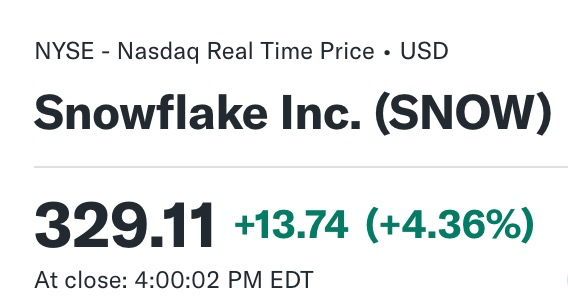
Our must-buy stock for August, Snowflake (SNOW), rose 4.35% on the day, bringing its share price to 330!
On the day of publication of “My Top US AI Stock Pick for August: SNOW!”, SNOW was priced around $292. Calculated based on the intraday high of $341.95 in August, the maximum gain during this period was about 17%.
The logic is very similar to CRM, but with a different focus.
Salesforce specializes in customer relationships and business processes, while Snowflake is closer to the enterprise data layer.
For AI agents to operate, they must first have data—and this data must be well-managed: Where is it accessed, who can access it, can it be used across departments, what’s the cost, and does it comply with corporate policies? All of this needs proper oversight.
Therefore, the more AI models there are, the more valuable enterprise data becomes.
However, it's important to distinguish here: CRM produced new earnings and Agentforce growth data, while SNOW’s rise that day was more about software sector valuation recovery.
CRWD, OKTA: The stronger AI gets, the less you can skimp on security
CrowdStrike rose 20.5%, and Okta advanced 28.6%—a different story here.
In the future, those accessing internal enterprise databases and APIs won’t just be employees, but an increasing number of AI agents and automated programs.
Previously, companies mainly managed “Can this employee log in?”
Now, they also need to manage:
What data can this agent see? Can it operate on behalf of employees? Is there over-permission? Has the account been hijacked?
The more agents, the trickier these problems become.
Therefore, identity authentication and network security are not the easiest expenses to cut as AI scales—in fact, the larger the AI deployment, the more enterprises need to invest in these areas.




Disclaimer: The content of this article solely reflects the author's opinion and does not represent the platform in any capacity. This article is not intended to serve as a reference for making investment decisions.
You may also like
Believing that "SpaceX is undervalued," Morgan Stanley predicts "revenue will reach $3.5 trillion by 2040." Musk responds, "No, I estimate it will reach that by 2033."
Elon Musk personally refuted Morgan Stanley: the bank predicted that SpaceX's revenue would reach $3.5 trillion by 2040, but Musk responded that this figure could be achieved as early as 2033, seven years ahead of schedule. Morgan Stanley set a target price of $300, stating that the current stock price almost entirely ignores the company's AI valuation. Meanwhile, the new mega base in Louisiana, with investments in the hundreds of billions, and Starship's costs being reduced nearly tenfold over ten years, may rewrite the entire commercial logic of the space economy.
Tokyo inflation accelerates for the third consecutive month! Case for Bank of Japan rate hike in September further strengthened
Despite measures by the Japanese government to reduce energy costs, Tokyo's key inflation indicator has accelerated for the third consecutive month, further strengthening the case for another rate hike by the Bank of Japan as market expectations for a September rate increase continue to rise.

Rifts Emerge Within the Federal Reserve—Can Waller's Speech Set the Tone for Policy Direction?
The market is paying attention to how Waller will articulate his views on the economy, inflation, and interest rate outlook at the Jackson Hole meeting, as well as whether he will signal a new policy path.

Crypto prices
More


