
Gold Reclaims Long-Term Trendline as 28 Tons of Capital Inflow Sends Important Signal

Huitong Financial, August 26—— On Wednesday, August 26, spot gold entered a high-level consolidation phase after consecutive rapid gains, currently trading near $4,640/oz, having recently reached the highest level in over three months. The core variable in the market has shifted from a single safe-haven narrative to a composite valuation framework, driven by the U.S. fiscal funding costs, U.S. Treasury term premium, Federal Reserve's inflation constraints, and precious metals capital flows.
On Wednesday, August 26, spot gold entered a high-level consolidation phase after consecutive rapid gains, currently trading near $4,640/oz, having recently touched a three-month high. The market’s core variables have shifted from a single safe-haven narrative to a composite pricing framework jointly influenced by U.S. fiscal funding costs, U.S. Treasury term premiums, Federal Reserve inflation constraints, and precious metals capital flows. Meanwhile, the U.S. Personal Consumption Expenditures Price Index (PCE) for July will be released during the current trading day, and Federal Reserve Chair Kevin Walsh will deliver an important speech this Friday at the Jackson Hole Symposium, placing macro pricing into a window dense with data and policy communication.
In the past week, the most noteworthy aspect of the gold market was not the magnitude of the rise, but the change in the driving forces. Previously, the U.S. Treasury expanded its long-term bond buyback program, leading to a pullback in long-term yields. The market is reassessing the financing cost and duration risk under the backdrop of massive debt. As a result, gold received double support. On one hand, as a non-yielding asset, its opportunity cost decreases when real interest rates fall; on the other hand, as the market re-examines the relationship between fiscal deficits, long-term debt supply, and monetary purchasing power, gold’s value as a non-sovereign credit asset is re-priced.
Recently, spot gold climbed to a three-month high near $4,696/oz but pulled back in the latest trading session, indicating that the market has moved from unilateral risk repricing into a stage of high-level consolidation.
The significance of this shift is that gold can no longer be explained solely by short-term fluctuations in the U.S. dollar. Even if the dollar index remains stable, as long as long-term rates, fiscal risk premiums, and expectations for real interest rates change significantly, gold may exhibit independent moves. Conversely, if energy costs push inflation expectations higher again, nominal rates are likely to remain elevated, creating a constraint on the valuation of non-yielding precious metals.
This week’s macro focus is on the July U.S. Personal Consumption Expenditures (PCE) Price Index. The market generally expects the core metric to register a month-on-month increase of around 0.2%, with annual core inflation still significantly above the Federal Reserve’s long-term target of 2%. Meanwhile, the Federal Reserve policy rate is currently maintained in the 3.50%-3.75% range, with interest rate futures markets pricing in about a 61.6% probability of no change in September.
Boston Fed President Susan Collins recently stated that if data do not show inflation continuing to decline, rates may need further adjustment. This suggests that the focus of internal Fed discussions is not simply economic strength or weakness, but whether inflation is slowing enough to offset the risk of renewed upward pressure from energy, import costs, and long-term inflation expectations. Current estimates place the core PCE inflation at about 3.3%, still noticeably above the 2% target.
Therefore, the market value of the Jackson Hole speech lies mainly in the policy reaction function, not just specific wording. Kevin Walsh needs to explain how the Federal Reserve will balance interest rate levels, the balance sheet, and financial conditions, in the context of high fiscal funding costs, increased volatility in long-term yields and persistent inflation. For gold, what truly impacts valuation is the path of real interest rates and policy credibility—not whether a single meeting immediately changes policy.
From a daily chart perspective, gold has previously risen steadily from a low near $3,959.56—breaking above the middle Bollinger Band and then operating close to the upper band. The middle Bollinger Band is near $4,276.02, the upper band near $4,688.87, and the lower band around $3,863.18. After quickly moving away from the middle band, the Bollinger Bands obviously expanded, indicating significantly increased volatility, rather than simply a trend that can extend indefinitely.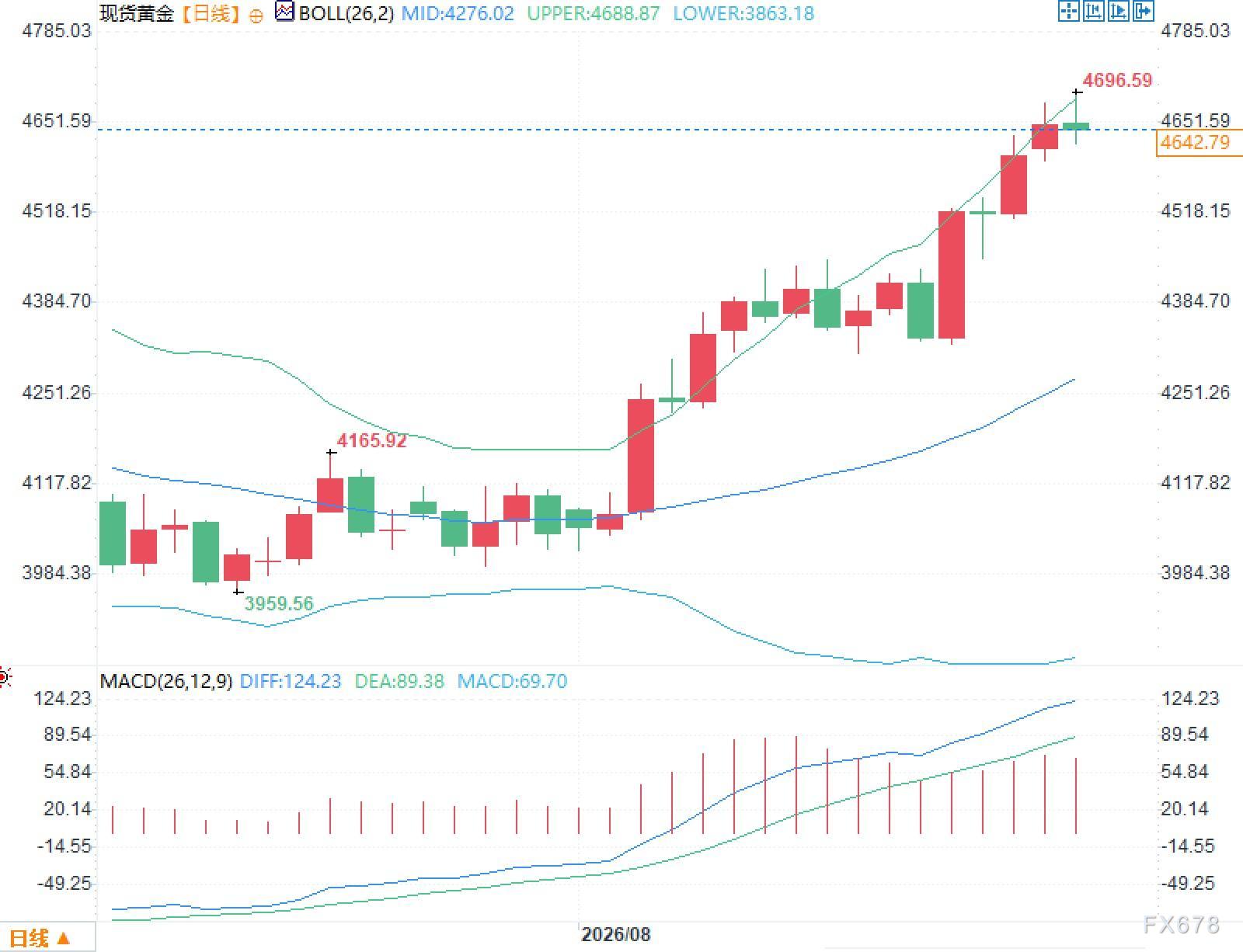
In terms of MACD, the chart shows DIFF at about 124.23, DEA around 89.38, both above the zero axis and the bars remain positive, reflecting strong trend momentum during the previous rally. However, it can also be seen that as prices approach recent highs, the K-line bodies are shortening and both upper and lower shadows are increasing, indicating that trading is shifting from trend continuation to high-level exchange between bulls and bears.
Capital flows are equally noteworthy. Gold-backed exchange-traded funds saw a significant net inflow last week, with statistics showing an increase of over 28 tons in a single week—one of the largest since January. The return of capital indicates this round of movement is not entirely driven by short-term covering but also includes medium- to long-term asset allocation demand. On the other hand, after an abrupt surge in inflows, market concentration may also rise, making subsequent gold prices more sensitive to inflation data, yields, and Federal Reserve communication than before.
From a cross-asset relationship perspective, as easing tensions in the Middle East led to a pullback in oil prices, U.S. Treasury yields simultaneously dipped by about 5 to 7 basis points. This means gold is currently influenced by both declining inflation expectations and changes in real financing costs. The former reduces demand for inflation hedging, while the latter lowers the opportunity cost of holding gold. This contradictory effect is precisely the reason behind the recent elevated volatility around gold’s high levels.
Disclaimer: The content of this article solely reflects the author's opinion and does not represent the platform in any capacity. This article is not intended to serve as a reference for making investment decisions.
You may also like
PCE data surprises, Iran situation settled! Gold consolidates strongly
Update: US Equity Indexes Slip as Investors Await Nvidia's Earnings After July's PCE Inflation Rate Accelerates
Escaping a $1.4 Trillion Fine! Meta Reaches Settlement in Social Media Addiction "Life-or-Death Case," with Maximum Payment of $18 Billion
Meta has denied accusations from 29 US states that it induces addiction in children and teenagers through product design and illegally collects children's data, but has nonetheless agreed to a settlement of up to approximately $18 billion. As part of the settlement, Meta will limit daily usage time for minors, implement mandatory "pause" features and nighttime restrictions, strengthen age verification, parental controls, and harmful content protection, and restrict features such as "likes" and beauty filters that might enhance social comparison, while also accepting independent audit supervision.
Abercrombie & Fitch Lifts Full-Year Outlook as Fiscal Second-Quarter Results Top Views
Crypto prices
More


