The most important change for Tower Semiconductor (
TSEM) is that the market is starting to redefine the company. Tower was traditionally viewed as a specialty analog foundry, but
silicon photonics (SiPho) demand driven by AI data centers is now emerging as its strongest growth engine.
Q2 revenue reached $460 million, up 24% year over year. Excluding one-off items, net income rose to $91 million, implying a 20% net margin. More importantly, Tower guided for record Q3 revenue of $520 million, representing 31% year-over-year growth. This suggests that the silicon photonics capacity ramp is already translating into reported financial results.
Silicon Photonics Expands the Growth Runway
Tower’s strongest fundamental support now comes from improving order visibility. The company has signed
$1.3 billion of silicon photonics revenue contracts for 2027 and received $290 million in customer prepayments, while capacity reservations for 2028 are even larger.
Following Q2 results, Tower also raised its 2028
target model to
$3.6 billion in revenue and $1.2 billion in net income. At the same
time, the company continues to expand 300mm capacity in Japan and is working with partners such as OpenLight and IQE on InP-on-Silicon and next-generation high-speed optical interconnect platforms.
As a result, the market is gradually shifting Tower from a traditional specialty-foundry valuation framework toward an
AI optical interconnect growth story.
High Growth Still Comes With a High Valuation
As of August 25, TSEM closed at $212.85, around 33% below its June 22 52-week high of $319.94.
Consensus EPS estimates for 2026 and 2027 are roughly $3.57 and $6.20, implying forward P/E multiples of approximately
60x and 34x, respectively. The valuation remains elevated, but earnings growth is also accelerating rapidly.
If the $1.3 billion SiPho contracts are successfully converted into revenue in 2027 and Tower moves closer to its $3.6 billion 2028 revenue target, earnings growth could continue to absorb part of the current valuation premium.
Recent price targets from BofA, Benchmark and Susquehanna have moved above $330, highlighting the sell side’s increasingly
bullish view of Tower’s long-term earnings potential.
The main risks are clear: slower-than-expected silicon photonics capacity expansion, relatively high customer concentration, and potential trade or policy restrictions affecting the optical supply chain. With the stock still trading at a premium valuation, any delay in orders or margin disappointment could amplify downside volatility.
Wait for Technical Confirmation After the Pullback
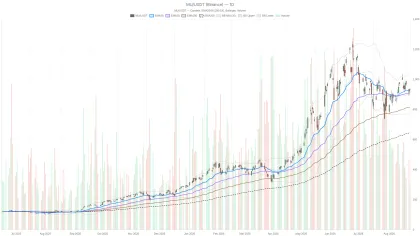
Technically, momentum has cooled significantly. The stock is currently trading below both its 20-day and 50-day moving averages, leaving the near-term trend weak.
The
$208–210 area is the first key support zone, followed by
$200 if that level breaks. On the upside,
$224–230 is the first major resistance area. A stronger breakout would then reopen the path toward $240–250.
At current levels, the better strategy is to wait for stabilization rather than chase the stock while the downtrend remains intact. If TSEM finds support around $200–210, investors could begin watching for a staged entry opportunity. A recovery above $230 accompanied by stronger volume would provide a clearer signal that capital is returning to the silicon photonics growth theme.
A decisive break below $200, however, would argue for tighter risk control, as further valuation compression remains possible.

 2026/08/26 09:27