
Citadel: Computing Power Scarcity Remains the Biggest Bottleneck for AI, Hyperscale Cloud Providers May Become the Ultimate Winners

The competitive landscape of the AI industry is accelerating in its differentiation, and the key variable that will determine the winners is not model capability, but the availability of physical computing power.
According to the latest analysis by Citadel Securities, demand for computing power continuously surpasses the growth of supply,the truly scarce asset isn’t the chips sitting in warehouses, but computing power that is powered-on and ready for immediate use.
This structural bottleneck is hard to eliminate in the short term—the cycles for grid connection and project approval often take years. Even massive capital expenditure plans cannot close the gap in the near term. This means the current cash flow of hyperscalers might be underestimating the true profit potential of their existing infrastructure.
From market signals, the rental price for computing power—including older model GPUs—remains robust,indicating that existing capacity is still being continuously absorbed and the tight supply-demand dynamic has not been noticeably alleviated by large-scale investments in construction.Meanwhile, the rise of AI agents is amplifying consumption of computing power—a single human command can trigger dozens or even hundreds of model calls, increasing the computing power required for each task, thereby further supporting the demand side.
01
The Essence of the Computing Power Bottleneck: It’s More Than Just Chips
Citadel Securities analyst Nohshad Shah points out that "computing power" does not refer solely to GPUs,but encompasses the totality of GPUs, electricity, data center space, memory, networks, cooling systems, and operational expertise. What is truly scarce is "powered-on, readily available computing power," not hardware lying idle in warehouses.
Futures curves for computing power show that while supply is increasing, demand is growing even faster. Due to grid connection and project approval cycles measured in years, even large-scale capital expenditure plans can’t fill the gap in the short term. The constraint that AI is facing right now is not a lack of users, but a lack of computing power that can actually be switched on and run.
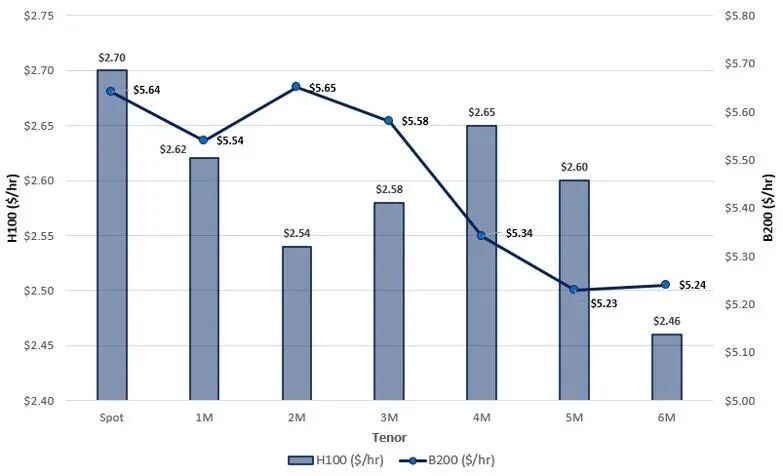
It’s worth noting that much of the current computing power capacity is tied to contracts signed in 2024–2025, when the true intensity of demand had not yet become apparent. As these contracts gradually expire, existing infrastructure can expect to be repriced while utilization improves, with a largely fixed cost base and gradually unlocking operating leverage.The analysis believes that the market currently tends to immediately account for the cost of capital expenditures, but might be underestimating the upside of future profitability.
Moreover, a decline in token prices may not necessarily be negative. Lower smart costs will make more application scenarios economically viable, and combined with the multiplying consumption of computing power by AI agents, total computing power demand is likely to continue expanding. The key variable is demand elasticity: if usage grows faster than the decline in unit price, lower prices will expand the market rather than shrink it; the real negative scenario would be if tokens become cheaper, but usage doesn’t substantively increase.
02
Industry Polarization Intensifies, Hyperscalers Enjoy Dual Advantages
Citadel Securities’ analysis outlines the increasingly clear bipolar pattern in the AI industry:on one side are pure frontier labs like OpenAI and Anthropic, whose product is intelligence itself; on the other are diversified hyperscalers like Google and Microsoft, who can monetize through full-stack coverage regardless of which model ultimately prevails.
In this framework, frontier models will focus on high-value tasks such as planning, reasoning, programming, and task scheduling, earning premium returns on a smaller token share. Cheaper or open-source models will handle highly concurrent execution-layer work. Frontier labs may retain pricing power at the high end, but hyperscale cloud vendors and inference service providers benefit at both ends—because regardless of the workload, chips, memory, networking, and electricity remain indispensable.
The takeaway is: frontier models handle planning, cheap models handle execution, and those who own "powered-on computing power" will harvest economic value from both ends. For investors, given persistent uncertainty in the AI commercialization path, hyperscalers with physical computing infrastructure might be the bets with the clearest risk-return ratios in this competition.
If you enjoyed it, please click “Watching”
Disclaimer: The content of this article solely reflects the author's opinion and does not represent the platform in any capacity. This article is not intended to serve as a reference for making investment decisions.
You may also like
From "What can AI do" to "Who will pay": Goldman Sachs analyzes the threefold logic behind the continued pressure on tech stocks
Nvidia has fallen for seven consecutive days, putting pressure on the Nasdaq. Goldman Sachs points out a restructuring of pricing logic: the credit market is sending early warning signals, with CDS spreads quietly widening; inventory concerns are emerging in the supply chain, and although WFE orders are surging, there are underlying risks of overheating; power constraints and policy resistance are casting a shadow over data center expansion. The forward P/E ratio of the Philadelphia Semiconductor Index has plummeted from 22 times to 15 times. The core issue of AI has shifted from "what can be done" to "who will pay."

Aster Launches TMX Perpetual Futures With $50K ASTER Trading Rewards
Crypto prices
More


