
$22 Billion Flowed into Gold in Three Weeks, "Currency Depreciation Trade" Crowds In Quickly—How Much Further Can This Rally Go?

The US dollar has weakened and expectations of currency devaluation are resonating, resulting in a rapid surge in gold prices recently. However, the market structure has quietly changed.
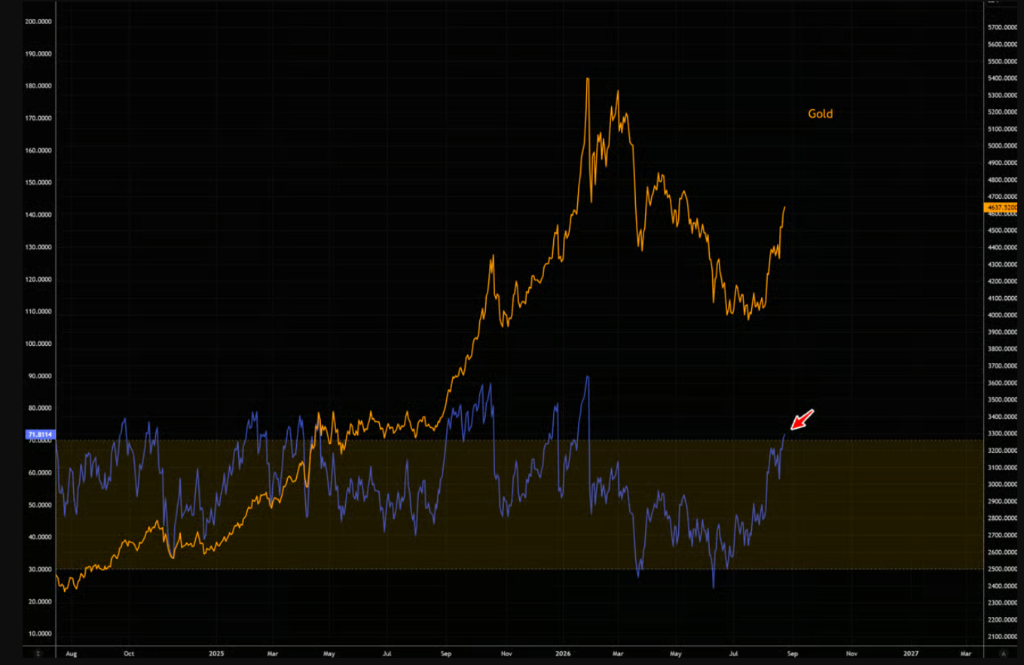
US Treasury Secretary Yellen has vigorously promoted policies to suppress long-term yields, reinforcing the logic for weak dollar and currency devaluation trades, leading to a sharp rally in gold. In the past three weeks, speculators have collectively purchased over $22 billion in gold futures, setting the largest single increase in over a decade. Net long positions have now risen to the 93rd percentile over the past two years.
However, as positions swiftly shifted from extremely under-allocated to crowded, the nature of gold trading is undergoing a fundamental change—from being driven by fundamentals and position repair, to momentum chasing and systematic buying. Technical indicators clearly show overbought signals, and potential hawkish comments at the Jackson Hole Symposium pose the main short-term pullback risk.
Position Squeeze Fully Realized, Record-Breaking Buying Surge
This round of gold’s rally began from historically low positions. According to Quinn data, over the past three weeks, speculators bought $22 billion worth of gold futures, with $13.6 billion contributed by new long positions and $8.6 billion by short covering. Net long positions are now at the 93rd percentile in the two-year range.
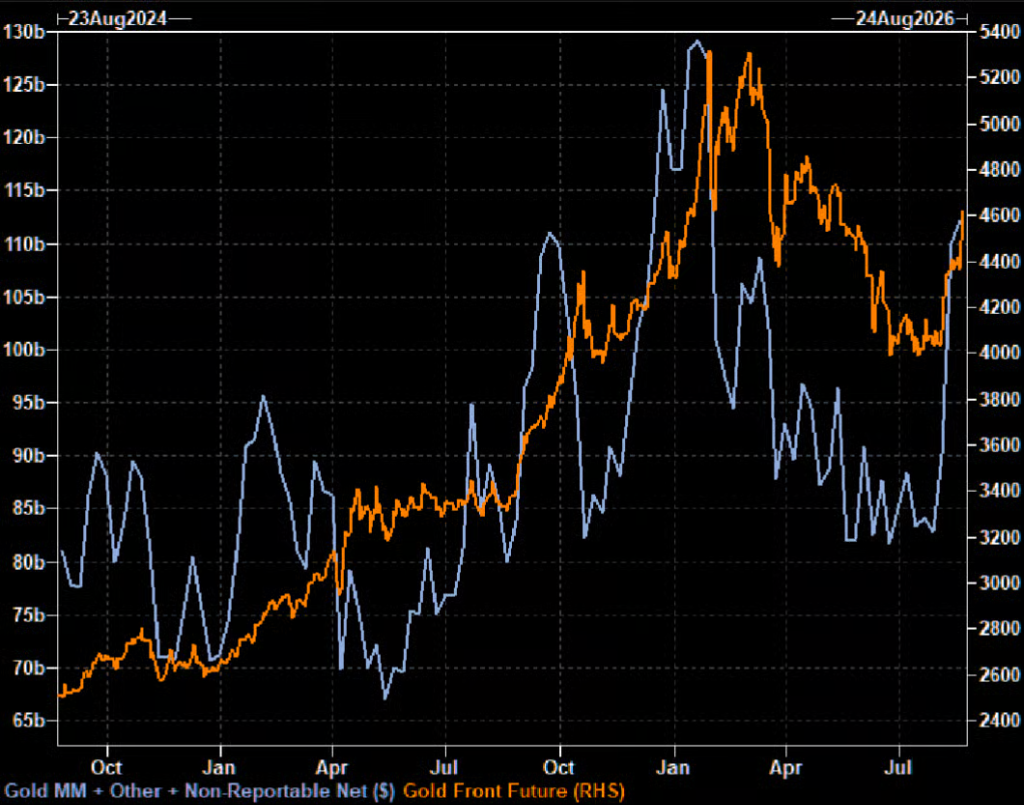
This aligns closely with previous market assessments. At the beginning of August this year, market observers noted that, by historical standards, gold positions were still relatively subdued; once prices broke out upwards, there was still plenty of room for a position squeeze. Now, that squeeze has fully played out.
At the same time, Commodity Trading Advisors (CTAs) have entered the market with large-scale systematic buying, further amplifying the upward momentum.
On August 5, the market previously noted that CTAs still held net short positions in gold and predicted that a confirmed breakout would give the market notable convexity from systematic buying. Afterward, the CTA buying volume far exceeded expectations.
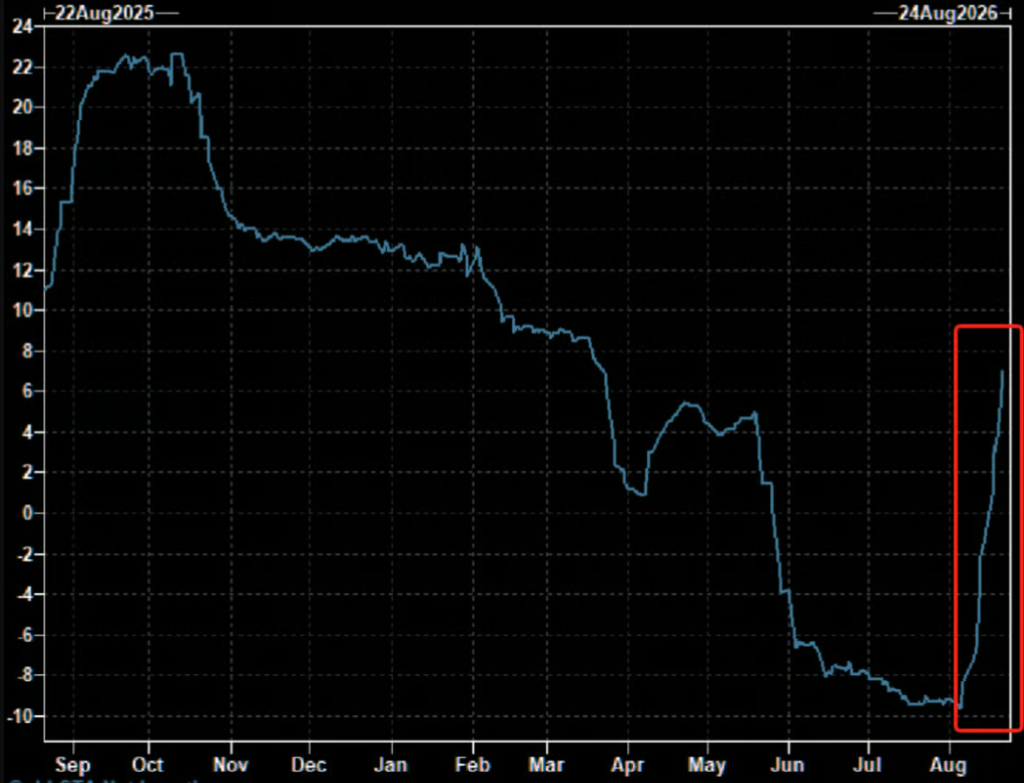
Options Market Sentiment Reverses, Upside Skew Sharply Repriced
Structural changes in the gold options market have clearly reflected a shift in investor sentiment. Although implied volatility remained relatively contained during this gold rally, skew underwent a dramatic repricing—investors shifted from being eager to hedge downside risks to actively pursuing upside exposure and are willing to pay significant premiums for calls.
Meanwhile, open interest has risen in tandem with prices, indicating that this rally is being driven not just by short-covering, but by new risk capital continuously entering the market, further solidifying the basis for the uptrend.
Macro Catalysts Fade, Momentum Takes Over as Main Driver
The initial phase of this gold rally mirrored the steepening of the US Treasury yield curve (widening 2s30s spread)—with short-end rate cut expectations and rising long-end yields jointly forming the macro narrative supporting gold. However, this relationship has recently decoupled: the 2s30s spread narrowed by 8 basis points due to US Treasury buyback operations, while gold surged another 5.9% over the same period.
This indicates that while macro factors may have sparked this rally, positioning momentum and price trends are increasingly taking the lead.
This structural change also introduces clear tactical risks. If Fed Governor Warsh counters recent market moves with hawkish signals at the Jackson Hole Symposium to reassert the Fed’s anti-inflation credibility, it could trigger rapid position unwinding in the short term, making this the most notable near-term tail risk to watch.
Overbought Signals Evident, Short-Term Chasing Becomes Difficult
From both technical and positioning perspectives, gold is now in a clearly overbought territory. The typical market pattern is that overbought conditions can persist longer than most expect, but this also means the low-risk entry window in the short term is now essentially closed.
The fundamental logic for the devaluation trade still holds, but when everyone rushes into the same trade, the risk-reward profile fundamentally changes. For investors, the key is now to focus on the vulnerability of momentum trades to external shocks, rather than blindly chasing further upside.
Disclaimer: The content of this article solely reflects the author's opinion and does not represent the platform in any capacity. This article is not intended to serve as a reference for making investment decisions.
You may also like
40 Trillion Dollar Debt Mountain Looms, but the AI Computing Power Infrastructure Boom Won't Stop! Trillion-Dollar Wave Extends the Life of the Super Computing Power Cycle
The $40 trillion debt has not ended the AI computing power investment boom; instead, it has pushed the industry into a second phase where "credit is still available, but capital has become more expensive."

A 50% tariff breaks the logic of the Canadian dollar rebound! USD/CAD approaches 1.40 as bears regroup
After trade negotiations between Canada and the United States broke down, the Canadian dollar posted its worst single-day performance against the US dollar in more than two months.

Dogecoin rises 30% in a week, but faces correction risks after Trump cryptocurrency event
Bitcoin reclaims 50-week EMA for the first time since late 2025
Crypto prices
More


