
A 6% ultra-high deficit poses hidden risks, U.S. Treasury intervention fails, and gold enters a new cycle

HuiTong Finance, August 24—— Repeated failures of U.S. Treasury interventions, weakening dollar credibility, and rising gold prices
Recently, two rounds of cross-border market interventions led by U.S. Treasury Secretary Scott Besant have successively seen their effectiveness wane. These operations, aimed at stabilizing asset prices and lowering financing costs, have only brought temporary market boosts and cannot reverse the pressure from fundamentals.
Whether it was the previous joint effort with Japanese authorities to support the yen, or the latest expansion of the U.S. Treasury bond repurchase plan, both were ultimately met with market reversals, exposing the deep contradictions in the U.S. fiscal and monetary system, and triggering widespread questioning on Wall Street regarding the effectiveness of policies and the independence of the Federal Reserve.
Reversal in One Day for the New Treasury Bond Repurchase Policy, Intervention Effect Reduced Sharply
Last week, Besant’s Treasury bond intervention policy experienced a "one-day rally".
Last Thursday, the U.S. Treasury launched a major move, announcing the doubling of long-term Treasury bond repurchase scale, increasing a single operation's repurchase limit to $400 million, raising funds through short-term treasury bills, and increasing holdings of existing long-term bonds to curb the persistently rising yields on long-term bonds.
After the announcement, U.S. BBB-rated bond prices briefly rose and yields quickly retreated, with the bond market seeing a phased rebound.
But market sentiment quickly reversed, and almost all the related gains on Thursday were lost, with bond yields only slightly lower compared to before the policy announcement,
marking the effective failure of this bond market intervention.
The "flash in the pan" nature of this bond market intervention mirrors the yen support operation, with U.S.-Japan interventions sharing a core dilemma, similar to the yen exchange rate intervention led by Besant several weeks ago.
On July 29, Besant joined with Japanese monetary authorities to prop up the yen, briefly reversing its depreciation trend, but afterwards the yen continued to retreat, recovering over half its rally, with the intervention effect sharply reduced.
Exploding Debt Levels Become the Core Pressure on the Bond Market
Data confirms the severity of debt pressure, while the timing of policies is highly dramatic.
A few hours after the U.S. Treasury announced the expansion of long bond repurchase and moved the single operation quota up to $400 million, the U.S. government debt officially broke through $40 trillion, with debt accounting for 120% of GDP;
Japan's situation is even more severe, with a debt ratio exceeding 230%, and yields on long-term Japanese government bonds soaring to historic highs. The root pressure in both countries’ bond markets ultimately comes from out-of-control fiscal debt.
Wall Street institutions point directly to the core flaw in Besant’s series of interventions: addressing symptoms rather than causes.
A 6% deficit is a large-scale expansionary fiscal policy; in normal developed economies during good times, deficits typically are 1%-2% or even surpluses, but right now, with the U.S. economy near full employment, it is still running a super-high 6% deficit, which hides risks of structural spending and fiscal loss of control.
Relying solely on secondary market interventions to control interest rates without a substantive deficit reduction plan means all market-support operations are just short-term buffers and cannot reverse the long-term weakening trend in the bond market.
Copying the Classic Twist Operation, Current Policies Have Inherent Flaws
In terms of policy design, Besant’s long-term bond repurchase plan replicates the Federal Reserve’s “Operation Twist” from the early 1960s.
At that time, the Federal Reserve bought long-term bonds and sold short-term bonds, boosting the domestic economy while relying on the Bretton Woods fixed exchange rate system to stabilize the dollar's exchange rate.
But today's policy environment is completely different. Carl Weinberg, chief economist at High Frequency Economics, pointed out a key shortcoming: the U.S. Treasury cannot print money directly to buy bonds, only relying on market funds to operate.
If the Federal Reserve passively increases purchase of short-term treasuries to cooperate with the Treasury’s debt maturity adjustments, the market will consider this de facto money printing, which poses significant inflation risks.
The 2001 Federal Reserve rate cut was to deal with the post-dotcom bubble recession, while in the 1990s technology boom cycle, market demand for capital was strong and both short- and long-term interest rates rose in sync—a pattern completely consistent with today’s surge in financing costs brought by the artificial intelligence industry.
Collective Warning from Wall Street: Intervention is a Temporary Fix, with Significant Reversal Risk
Weinberg bluntly stated that Besant's operations are essentially “disguised tricks,” attempting to bypass the Fed’s rate-cutting decision by implementing monetary easing through self-intervention and artificially suppressing long-term financing costs.
But according to Wall Street institutions, this expedient not only fails to address the root cause, but also carries significant reversal risks.
Ipek Ozkardeskaya, senior analyst at Swissquote, warned that if the market determines the U.S. government is only intervening to control long-term rates and avoiding fiscal deficit reforms, investors will demand even higher long-term bond term premiums, which will further push up long-term yields.
More importantly, continued interventions will make the market question whether the Federal Reserve has become a “puppet tool” of the White House, seriously undermining the central bank’s credibility and making it even harder to manage the U.S. Treasury yield curve.
George Saravelos, chief FX analyst at Deutsche Bank, identified the core market logic:
Artificial Intervention Cannot Resist Fundamentals, U.S. Economic Dilemma Remains Unresolved
But for now, government spending demand remains strong, with fiscal conditions likely to further deteriorate. Together with midterm election sentiment, multiple polls show the Democratic Party is very likely to control the House, while the Senate’s outcome remains highly uncertain. Intensified inter-party rivalry will greatly increase the difficulty of implementing fiscal consolidation and deficit reduction, and debt pressure may continue to rise.
In addition to the fiscal and monetary dilemmas, structural contradictions in the real goods market make it hard for government revenue to increase and plant inflation risks for the U.S. economy.
Jeffrey Currie, former head of commodities research at Goldman Sachs and chief strategist at Otis Partners, pointed out that the world is currently in a “financial repression, physical scarcity” setup.
With increasing blockages in key global logistics routes such as the Strait of Hormuz, the Red Sea, the Rhine River, and the Panama Canal, combined with Russia’s limited refining capacity and geopolitical tensions, diesel prices have soared even as crude oil prices have not reached new highs, directly impacting key real economy sectors such as global transportation and agriculture.
Summary and Technical Analysis:
Previous articles have repeatedly highlighted the opportunity in gold. Ultimately, fiscal and monetary authorities can artificially intervene in interest rates and financial market prices but cannot create physical goods or resolve supply chain bottlenecks.
In the face of multiple constraints—high debt, recurrent inflation, growth pressure, and increased geopolitical risks—Besant’s administrative interventions to stabilize the bond market and exchange rates will eventually fail to counteract the deep pressures of economic fundamentals. The U.S. economy is facing the compounded dilemma of stalled growth, stubborn inflation, and out-of-control debt.
Since the end of July, the dollar index has fallen by 2.9%. Meanwhile, gold prices have increased 15% from their mid-July lows, with market risk aversion continuing to climb.
The de-risking of U.S. Treasuries allows gold to break free from its traditional interest cost constraints, elevating it from a mere anti-inflation tool to a hedge against sovereign debt and currency devaluation.
The gold market, on the other hand, will in the medium term outperform credit assets on the back of cost-insensitive buying from central banks and institutions, and in the long term achieve a cross-cycle leap in real purchasing power during cycles of massive money printing.
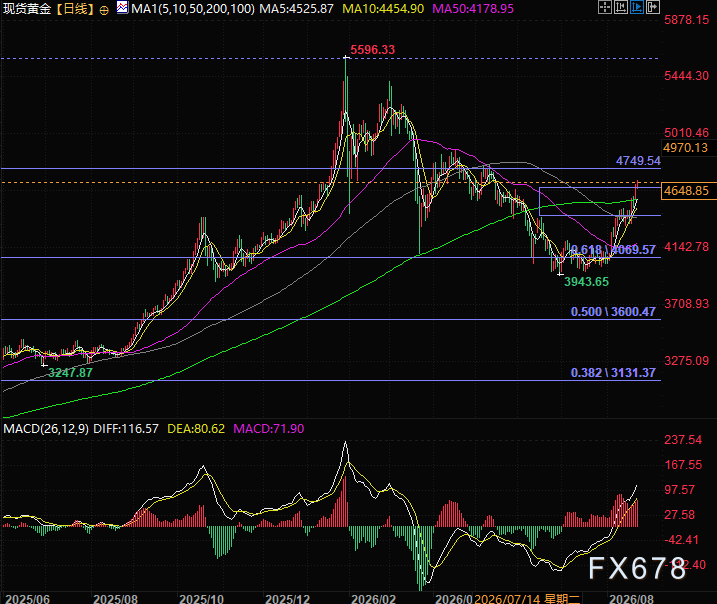
(Spot gold daily chart, source: E.Huitong)
As of 18:08 Beijing time, spot gold is quoted at $4,648 per ounce.
Disclaimer: The content of this article solely reflects the author's opinion and does not represent the platform in any capacity. This article is not intended to serve as a reference for making investment decisions.
You may also like
Breaking the Deadlock or Reshaping the Rules? Saudi Capital Market Regulator Changes Leadership, Investors Hope for Eased Foreign Investment Restrictions and Revised IPO Rules
The recent leadership changes at Saudi Arabia's Capital Market Authority have reignited hopes among investors and bankers, with the market anticipating further liberalization measures such as easing restrictions on foreign ownership limits.

XRP Records Explosive $15.4B Daily Volume in Biggest Trading Surge of 2026

XRP circulating supply rises 5.5% while XRPL revenue drops 81.6% in 2026
Pump.fun Price Prediction: PUMP Targets $0.006 as Open Interest Hits Record High
Crypto prices
More


