
Marvell: "Paying to Partner" with Google—Can It "Poach" from Broadcom?


Marvell Technology announced for the first time that the issuance of warrants to Google has directly driven Marvell’s stock price up by over 10%. Meanwhile, Broadcom’s stock experienced a significant drop, reflecting the market’s speculation that Marvell may be seizing Google’s TPU orders.
Here, let’s systematically review the two companies’ agreement plans and their impact:
I. The Agreement Between Marvell and Google
First, the specific terms signed this time between Marvell and Google: the commercial agreement is to be signed on July 29, 2026, with the warrant issuance date on August 18, 2026.The exercise price is set at $206.58 per share (the closing price on August 18 is $216, about a 4% discount).
This time, a total of 58.97 million shares of warrants are granted, which can be divided into two parts:
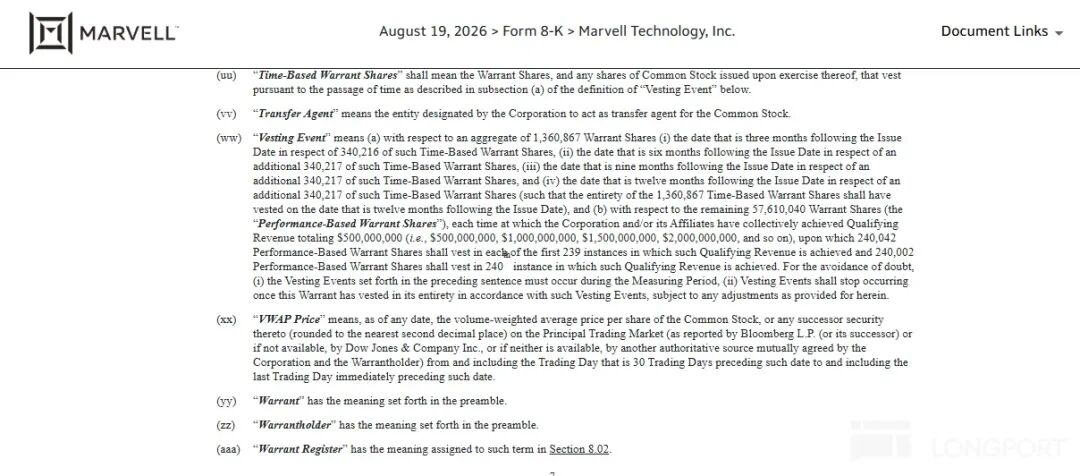
① Time-based vesting (outright grant): 1.36 million shares. About 340,000 shares will vest respectively in the 3rd, 6th, 9th, and 12th months following this issuance. This portion is an unconditional, direct grant.
② Performance-based vesting (performance unlock): 57.61 million shares, divided into 240 portions.From August 1, 2026 (up to January 29, 2033), for every $500 million in eligible sales revenue, one portion (240,000 shares) vests.
Eligible sales revenue must be from customized development products, including those purchased by third parties on behalf of Google. This also means thatgeneral products sold to Google by Marvell (optical DSP, DCI modules, general SSD controllers) do not count towards this sales revenue; only customized chips (ASICs) for Google are included, such as AI inference accelerators, storage controllers, network interface controllers, memory interface controllers, and near-memory computing products.
It is worth noting that the agreement also states:Google can unilaterally choose to exercise with cash or cashless; if in-the-money at expiration, warrants will automatically be exercised cashless. If Google opts for net share settlement, Marvell receives no cash; only net shares based on intrinsic value are delivered.
II. Impact of the New Agreement
Looking at the core terms above,Marvell is evidently the weaker party in this agreement:①"Gifting" 1.36 million shares in warrants up front to demonstrate sincerity, regardless of future revenue; ②Google does not have to pay cash and can directly choose net share settlement.
Given that the company defines "eligible revenue" as being in the ASIC field, this agreement aims, in my opinion, to"pry away" Google’s customized ASIC business from Broadcom.
As for Google, first, it gets to accept "free" warrants; second, there’s already existing customized ASIC cooperation with Marvell (Axion CPU), with follow-up plans for MPU (Memory Processing Unit) products, strengthening bargaining power with Broadcom.
For Marvell, this is not the company’s first equity-related plan, as it haspreviously signed similar deals with Amazon and NVIDIA.
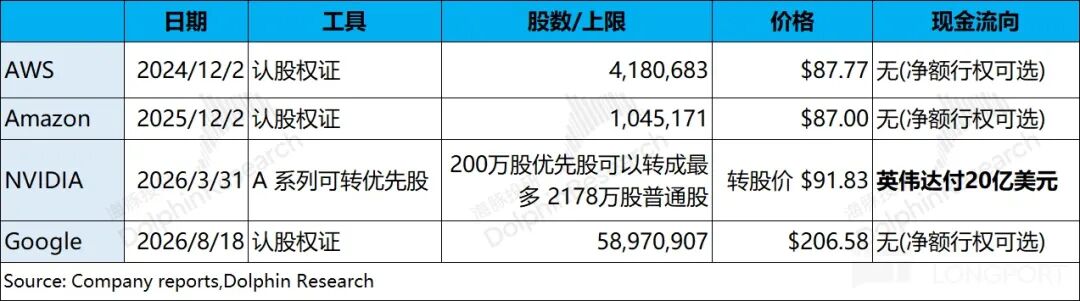
1) Amazon: Signed two warrant agreements
The first was signed on December 2, 2024, covering customized AI products, optical DSP, AEC DSP, PCIe retimer, DCI optical modules, Ethernet switching silicon and other products, totaling 4.18 million shares.
Vesting conditions: 280,000 shares are time-vested (awarded for free); 2.7 million shares are tied to custom AI product revenue, 1.2 million shares tied to other products revenue (including generic products),revenue counted up to January 5, 2030 (5 years).
The second was signed on December 2, 2025, as a client incentive synchronized with acquisition. Signed concurrently with the acquisition of Celestial AI (Amazon itself is its core client),vesting is tied to Amazon’s purchase of Photonic Fabric products, for a total of 1.045 million shares.
2) NVIDIA: Series A Convertible Preferred Shares
Signed on March 31, 2026, attached to the NVLink Fusion collaboration: Marvell provides custom XPU and NVLink Fusion compatible scale-up networking; NVIDIA provides Vera CPU, ConnectX NIC, BlueField DPU, NVLink, Spectrum-X switching and rack-level environment, and both parties will also collaborate on silicon photonics.
NVIDIA is the only one among these plans to pay $2 billion in "real money" and is a voting strategic shareholder, and can choose to convert their preferred shares into common stock.
Overall, the cooperation agreement between Google and Marvell is similar to the previous Amazon template, with the main difference being in scale:① Number of shares jumps from 4.18 million to 58.97 million shares (over 10x);② The exercise price is close to the issue date’s spot price, with Google’s exercise price ($206.58/share) far above Amazon’s ($87/share).
The two customers represent different roles for Marvell: the company is already a major supplier to Amazon, whereas Google is an "entrance" that Marvell is prying open from Broadcom (which has a decades-long TPU partnership with Google).
In general, Marvell and NVIDIA are more like mutually cooperative strategic partners; while agreements with Amazon and Google are more of Marvell proactively showing goodwill to win major client orders.
As for the TPU cooperation, the market may have some misunderstandings. I believe it is more likely that Marvell will gain supporting products for TPUs rather than the TPUs themselves. Google has already found a "backup" in MTK (collaborating for years with them) to supplement Broadcom, so in the short term Marvell will have a hard time "breaking into" the core TPU orders.
With this recent agreement with Google, Marvell has already offered very favorable terms, hoping to leverage this to break into Google and Broadcom's customized ASIC cooperation. Google and Marvell are already collaborating on the Axion CPU, and in the future may also co-develop products like custom MPUs, TPU supporting chips, etc.
From Marvell's perspective, the most important thing now is to gain the recognition of major clients and secure large orders. The company is itself a competitor, so this move is relatively proactive. If Marvell’s collaboration with Google and other large clients deepens over time, they might just "accidentally" land a major TPU order.
- END -

This article wasn’t easy to write—please click"Share" to support me~
Disclaimer: The content of this article solely reflects the author's opinion and does not represent the platform in any capacity. This article is not intended to serve as a reference for making investment decisions.
You may also like
XRP daily transactions jump 150%, price breaks above $1.48
Shiba Inu gains regulatory approval in Japan, joins Laser Digital’s approved coin list
Bitcoin holds above $77,000, analysts flag triangle pattern and $100,000 target
Solana holds above $95, targets $114 on bullish wave count, eyes $160–$180 zone
Crypto prices
More


