
Baidu and Google Both Bet on the Growth Potential of AI Search | Juchao

Written|Xiao Luyu
Edited by|Yang Xuran
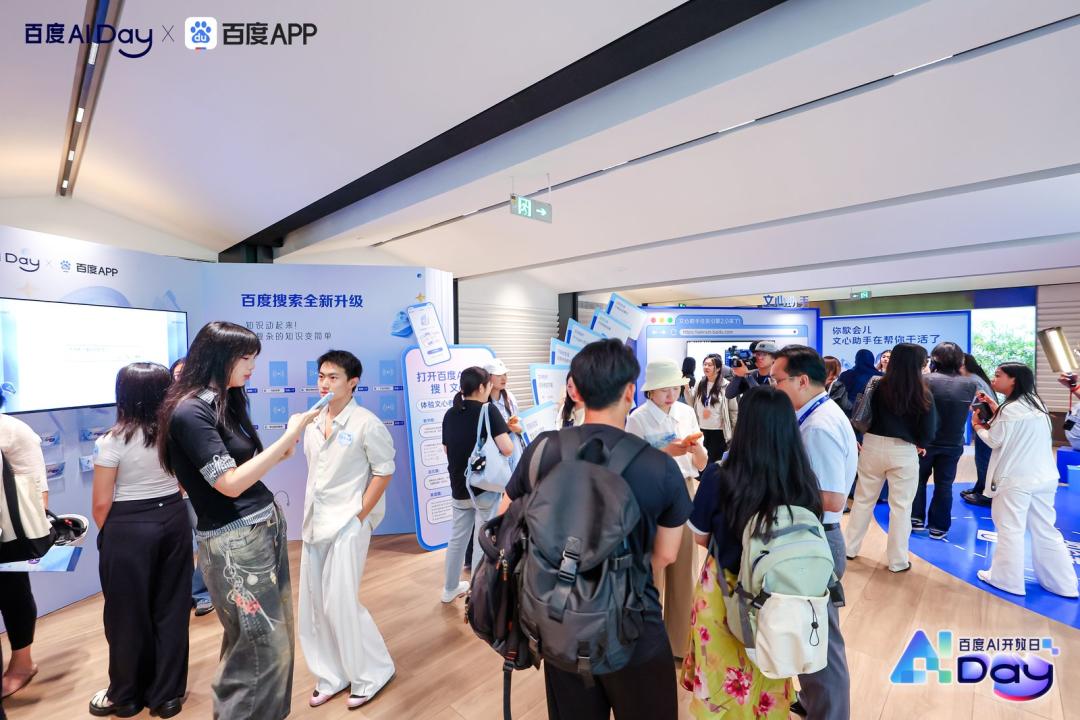
August 20 marked Baidu AIDay Open Day, during which Baidu APP announced multiple product upgrades, with the AI restructuring of Baidu Search standing out as a particular highlight.
On the surface, this is an iteration of product features; but on a deeper level, the real change is that Baidu is redefining the next phase of search: Baidu's search is shifting from “providing answers” to “helping users truly understand and directly delivering results.” Currently, these advanced AI features are all available to users free of charge.
Three years ago, or even now, people in the industry were still debating whether AI would disrupt search engines. Today, the answer has become increasingly clear—AI hasn't replaced search engines; instead, it has accelerated their evolution. With their advantages of user base, accumulated data, and use cases, search engines continue to be important gateways in the AI era.
Currently, both Baidu and Google—the two main search giants—have chosen to deeply integrate AI capabilities into their existing search portals, expanding the scope of search and creating incremental space that was hard to predict in the traditional Internet era.
After all, AI did not appear out of nowhere. The foundational services established prior to the AI era not only facilitated the emergence and prosperity of AI, but they will also undergo a thorough reconstruction by AI, gaining new growth opportunities.
This article is a deep-value feature by the WAVE Content Team. You are welcome to follow us across platforms.

Delivering Results
Baidu has spent three years on AI restructuring of search, during which a clear product logic has emerged: When users search, they are not just seeking “to know something,” but more so “to accomplish something.” Therefore, in the AI era, search engines must help users understand problems, complete tasks, and deliver results.
With this as the core, the two most notable upgrades at this AIDay both point in the same direction—providing users with more specific and usable “results.”
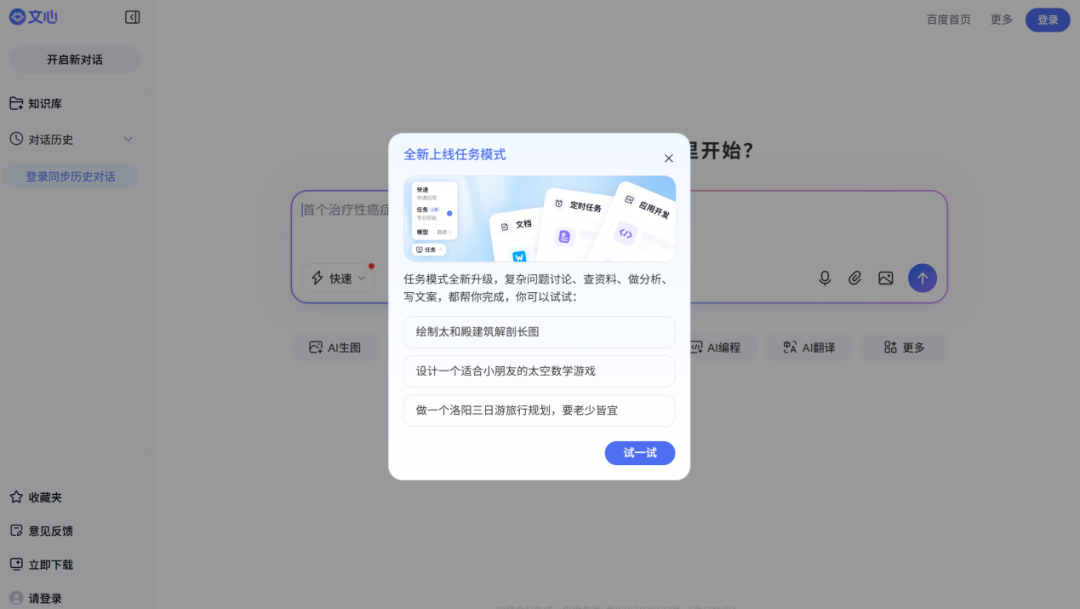
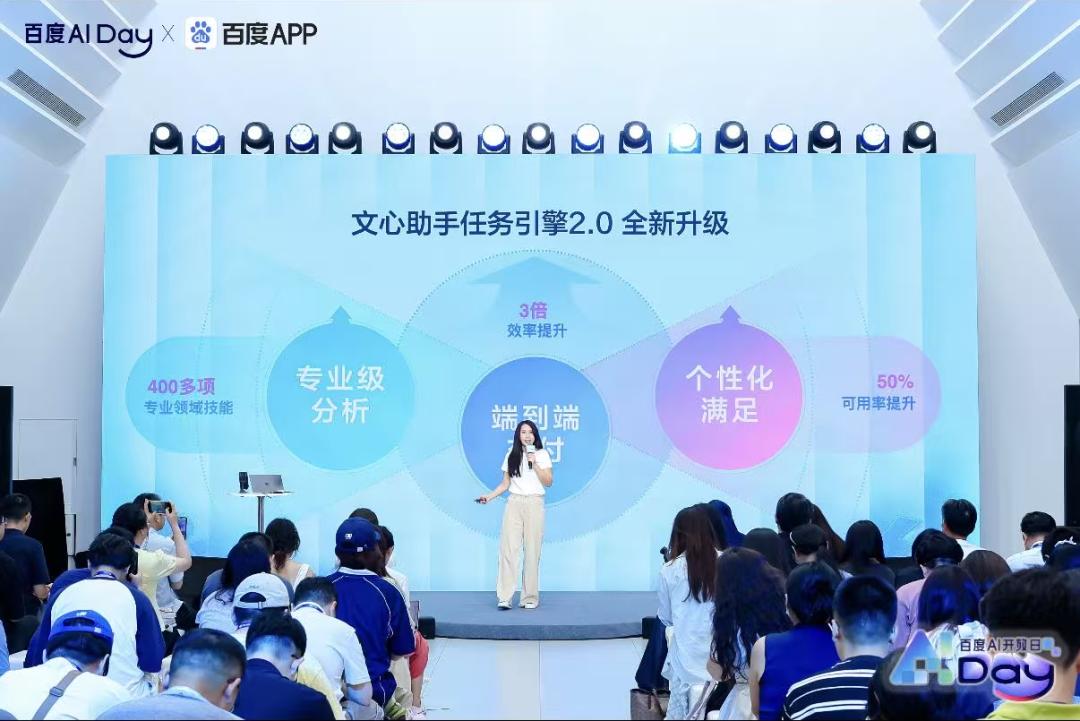
The first upgrade is the Wenxin Task Engine 2.0, which is no longer simply Q&A, but an end-to-end task delivery engine. It can independently plan, reason, and execute based on user goals, completing the entire workflow from information collection, processing, creative expression, to final delivery, all in a fully automated loop without human intervention.
According to public evaluations, this task engine already demonstrates strong capabilities in processing complex tasks. In July this year, the task engine ranked first on the global engineering-focused AI agent evaluation list PinchBench v2 with a comprehensive success rate of 94.6%. In August, it again ranked first in the SuperCLUE Lobster products evaluation with a score of 97.62.
But more important than the evaluation scores is that in task mode, the endpoint of search engines has been redefined.
Now, the outputs of AI search are no longer just web pages, URLs, or other intermediate products, but proactive task planning, content generation, and result delivery.
The second upgrade is the world's first “fully interactive page” search results format—GUI General Knowledge Cards. When faced with abstract or complex questions, users’ search results now go beyond just text and images, instead integrating structured knowledge cards, step-by-step diagrams, and interactive animations into a fully operable page.
For example, when searching “concave lens imaging laws,” users no longer need to decipher dry text but can manipulate objects by hand and observe in real time how image position and size change. When searching “using displacement method to calculate volume,” users can directly adjust parameters on the result page to visually see a dynamic demonstration of the water level change.
The evolution in search result format transforms “seeing the answer” into “understanding the answer,” as information has already been broken down, digested, and reorganized by AI, giving users ready-to-use, practical outcomes.
The combination of interactive pages and task execution leads to longer user engagement, deeper interaction, and more accurate recognition of user intent.
One noteworthy statistic: In June this year, daily active users of the Wenxin Assistant grew by 83% year-over-year, and average daily conversation rounds increased more than two-fold. This at least suggests that the relationship between users and search is changing. Rather than just entering keywords and leaving after browsing a few pages, people are willing to continue probing a question, engaging in repeated interactions, and leaving more tasks to be completed directly through the search portal.
As a relevant head of Baidu APP stated, for more than twenty years, Baidu Search has been shortening the distance between people and information; now it aims to continue closing the gap between people and understanding, and people and outcomes.
The deeper the AI restructure, the shorter the distance between people and understanding/delivery, and the stronger users’ willingness to complete tasks directly through the search portal.
If we view AI search through the old framework of search, we risk underestimating the significance of this change.
The old search logic was “keyword → links → users screen themselves,” while the AI search logic is “intent → understanding → interaction → execution → delivery.” AI-restructured search is no longer limited to merely being a portal for traffic distribution, but is transforming toward an entry point for understanding, interaction, and task execution.
After all, a search box capable of delivering complex task results can no longer be just a search box, can it?

Proving Value
Broadening our view to the entire industry, let’s examine the practical value of AI restructuring search through Google’s experience.
At this year’s May Google I/O conference, Google CEO Sundar Pichai announced the biggest revision to Google Search in 25 years, with AI at the core to completely reshape the search entry and interaction model. The new search box expands dynamically, supporting search initiated by text, image, video, files, and even current Chrome tabs.
Users can also ask follow-up questions directly within AI Overviews, with the system retaining context, creating an experience close to conversational Q&A.
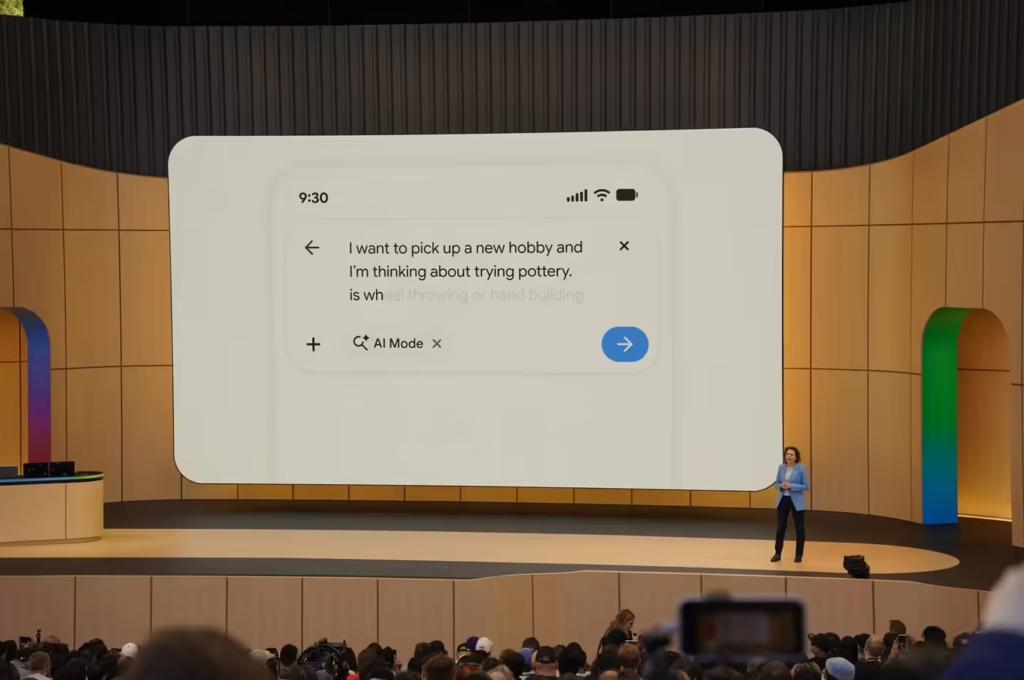
At the same time, Google plans for its search agent to run in the background 24/7, continuously scanning blogs, news, and financial data and pushing updates based on user preferences.
Google and Baidu are on the same path: not creating a parallel AI gateway to search, but restructuring search itself with AI.
This path was once met with skepticism. Some worried AI chatbots would replace search engines—if users ask questions directly to ChatGPT, would Google Search’s gateway and its business model be undermined?
Google’s latest data has already dispelled these concerns. According to a report from Bank of America this April, Google’s global search market share has not declined but in fact increased to 90%.
In terms of search queries, Google’s first quarter 2026 financial results show that AI-related queries contributed 22% incremental volume, and total search queries hit a new record. Pichai again emphasized during the earnings call that AI features are strongly driving growth in search queries, with AI-powered features sending billions of external clicks per week.
Even data from native competitors like OpenAI show their disadvantage, further highlighting search engines’ unique value.
Semrush research showed that only 34.5% of ChatGPT user interactions triggered real-time web search, down from 46% at the end of 2024. This means the majority of ChatGPT use cases are unrelated to information lookup. Chat, creation, and entertainment are the main battlegrounds for native AI platforms; and the portion of search-related queries that can actually be monetized is likely even lower.
In contrast, search engines serve more explicit, frequent, and decision- or transaction-oriented information needs. By comparison, Google’s strengths are clear: With over two decades of accumulated search data, user habits, and ecosystem, combined with new AI capabilities, the user value released far surpasses that of a pure AI chat assistant—and this is precisely Baidu’s competitive advantage as well.
However, compared to Google, Baidu faces fiercer gateway competition: short video, social, and e-commerce platforms have a longstanding hold over vertical content and users’ attention, while each new wave of AI apps competes to be the first and last stop for users’ questions in the AI era.
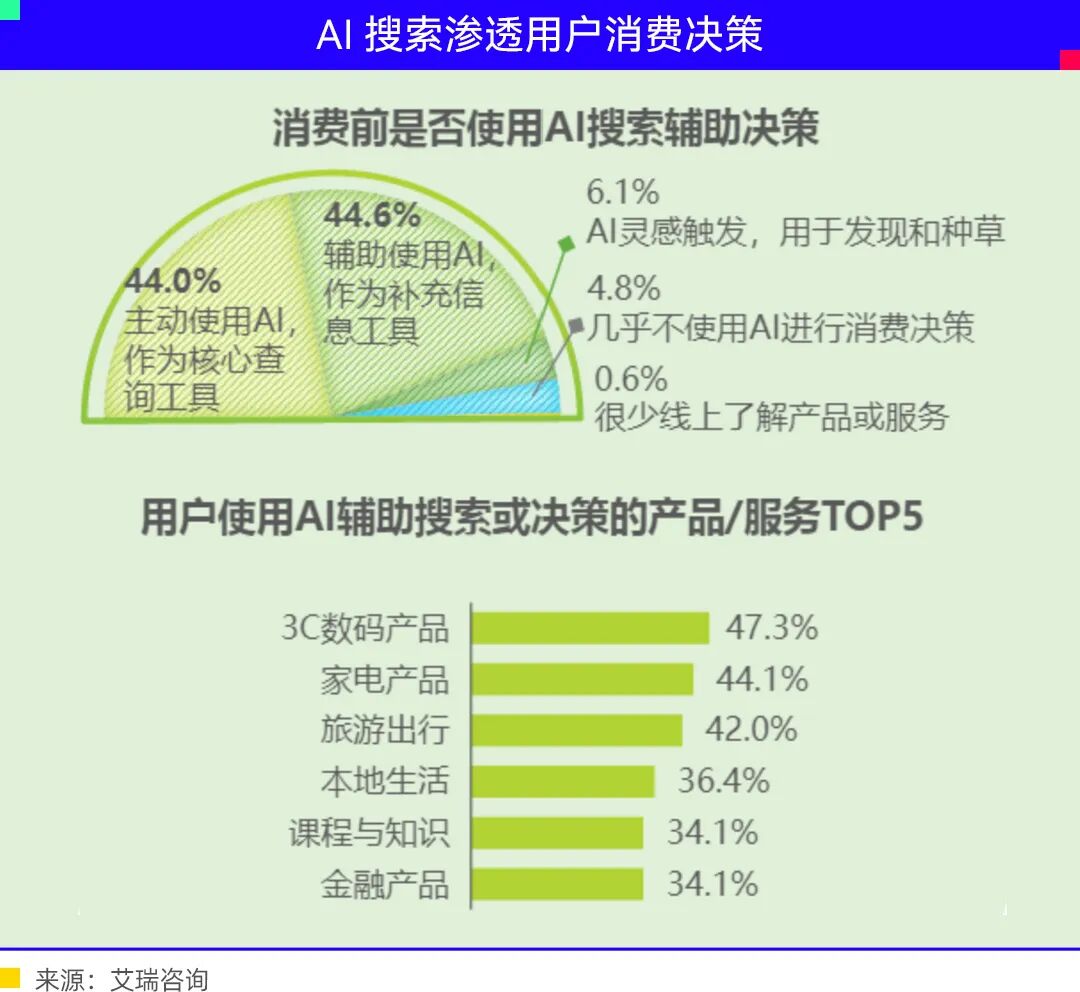
Therefore, Baidu’s AI search restructuring began earlier and is advancing more aggressively than Google’s.
As early as last year, Baidu completed the “biggest overhaul in a decade” of search, upgrading the search box to a “smart box.” This year, the restructuring has entered a critical stage for outcome validation. Judging by June’s daily active user data for Wenxin Assistant, the growth trend of Baidu AI Search closely mirrors Google’s: AI has not weakened the demand for search, but has broadened the boundaries for the demand search can accommodate.

Creating Incremental Value
Google is already proving to the market that AI is an amplifier for search, and traditional search giants possess even greater commercial potential due to AI.
Baidu is walking the same path, but exploring further and deeper into the more complex, competitive Chinese market, which has even richer application scenarios.
In the Chinese Internet industry, platform competition has long focused on capturing user attention and habits, ultimately targeting traffic monetization. Thus, the business model of traditional search has mainly been based on advertising and clicks.
But as AI search shifts toward delivering service results and value, the old business model of the Internet era will change as well. Users may eventually consume more than just a click—they may experience a complete content production or task execution. Consequently, the value created by search will extend from “traffic distribution” to “task completion.”
This is exactly where the future incremental space for Baidu AI Search lies. AI search can continue to expand into education, office applications, knowledge services, consumption decisions, enterprise services, and more. The more search acts as a task entry point, the broader its commercialization boundary; the richer the scenarios it can serve, the less its value will be limited to just traffic.
The foundation for the growth of search due to AI rests on three main pillars. Baidu’s “search DNA” provides an irreplaceable starting point with rich, real-life scenarios; continuous “AI capability iterations” drive ongoing evolution of the search product and experience; and the full-stack advantages of the “Chip-Cloud-Model-Agent” system grant Baidu system-level competitiveness from chips through to applications.
This combination of abilities is already being utilized in high-value, real-world scenarios.
Take the financial industry: Financial institutions must process massive amounts of high-value unstructured data (financial reports, research papers, regulatory documents, contracts, etc.). Baidu’s more than two decades of accumulation in knowledge enhancement and search technology gives its large models a natural edge in handling such professional documents efficiently.
Based on its understanding of financial scenarios, Baidu can deeply customize and quickly iterate on its AI capabilities. Baidu Intelligent Cloud provides full-stack infrastructure from computing power scheduling to cluster management, while its in-house developed Kunlun chips help ensure high concurrency and stability required by the financial sector.
According to a report by IDC, Baidu Intelligent Cloud held 16.6% market share and has topped China’s financial industry generative AI platform and application solution market for the second year in a row, covering 100% of systemically important banks.
For individual users, leveraging the Wenxin Task Engine to assist with quantitative trading or research tasks makes previously professional and time-consuming work possible at a single entry point.
The experience, technology, and solutions accumulated in finance are further fed back and replicated into other high-value sectors such as government, industry, and energy via the Baidu Intelligent Cloud platform.
All this constitutes a complete “Chip-Cloud-Model-Agent” Looping capability: chips, intelligent cloud, model capability, and agent applications strengthen each other across four layers, forming a cross-layer optimization loop that enables continuous evolution and reinforcement of the entire technology stack.
Looping, in turn, opens up growth for Baidu’s AI business including search.
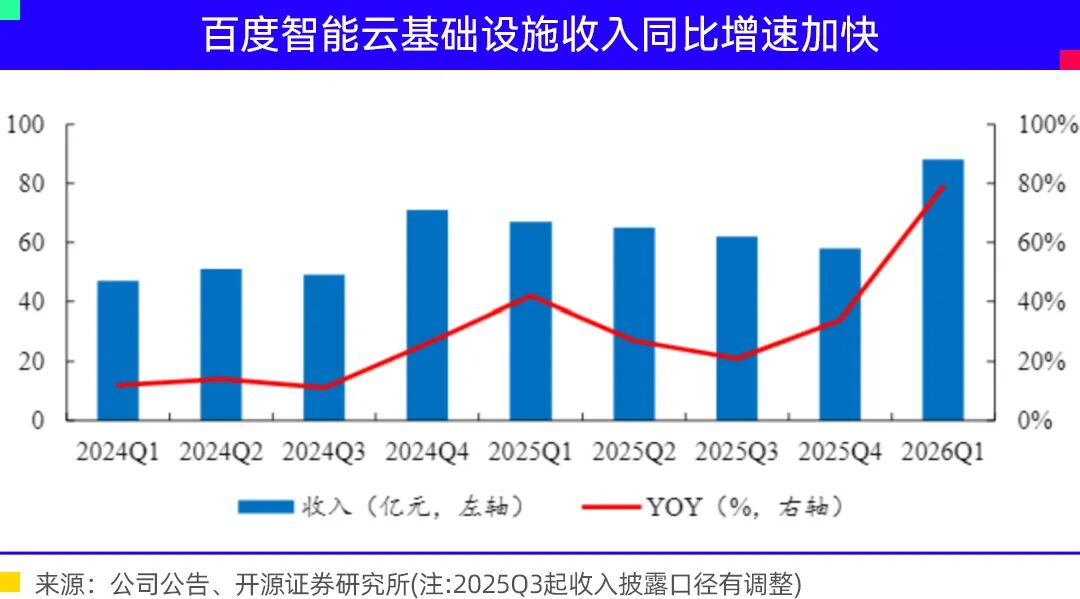
AI-driven business now supports half of Baidu’s core revenue and is establishing a new valuation logic for Baidu in the capital markets.
In the second quarter of 2026, legendary investor Stanley Druckenmiller began building a position in Baidu ADR, while top investment banks such as Morgan Stanley, UBS, and Bank of America also increased their holdings in Baidu ADR. These moves by capital suggest that the commercial value of Baidu’s AI upgrade has entered a stage of strong realization.
Long-term outperformance has never been about betting on a single trend, but rather about foundation, patience, and continuous evolution. Both Google and Baidu share a solid foundation in search, a first-mover advantage in AI, and strong full-stack capabilities. Consequently, in this long marathon of the intelligent agent era, Baidu and Google still have tremendous opportunities to succeed through cycles once again.

Disclaimer: The content of this article solely reflects the author's opinion and does not represent the platform in any capacity. This article is not intended to serve as a reference for making investment decisions.
You may also like
Eightco Holdings investments top $389M, anchored by 8.4% of Worldcoin’s supply
Spotify Stock Holds Uptrend at $533 as Hourly Momentum Fades
MARA Holdings, Inc. stock surges 15.54% to $11.15 on Clarity Act hopes
Dogecoin price today faces $0.08-$0.09 battle as daily RSI hits 77.98

Crypto prices
More


