
Surging global long-term yields suppress gold prices, gold returns to range-bound oscillation

FX168 Finance News, August 19— The rapid rise in long-term bond yields among major global economies has seen the 30-year US Treasury yield temporarily climb to around 5.33%, hitting its highest level since 2007, putting pressure on the non-yielding asset gold. Meanwhile, crude oil prices remain elevated, and energy costs may once again fuel inflation expectations. However, recent US inflation and retail data have been weak, significantly cooling expectations for further rate hikes by the Federal Reserve, and a weaker dollar continues to support gold prices. In the short term, gold faces a dual challenge of rising yields and improving monetary policy expectations.
During Wednesday's Asian session, international gold held near $4,350/oz after pulling back from its interim high of around $4,450 set in early June. In the previous trading session, gold endured heavy selling pressure, mainly not because of diminished safe-haven demand but due to violent moves in the global bond market. Long-term financing costs have spiked rapidly, reducing the relative appeal of gold as a non-interest-bearing asset. On August 18, spot gold once fell to around $4,365, with an intraday decline of approximately 1.1%.
This rise in yields has broadened from a single-market driver to a global bond market phenomenon. The US 30-year Treasury yield reached approximately 5.33%, the highest since 2007, and the 10-year Treasury yield also rose to about 4.74%. Meanwhile, Japan’s 10-year yield climbed to around 2.95%, the highest in nearly three decades, while long-term yields in Germany and France are also at multi-year highs.
From a market pricing perspective, the rapid increase in long-end yields does not simply mean investors are betting on further large-scale central bank rate hikes. There is now greater focus on structural issues like fiscal funding size, long-term inflation risk, energy prices, and increased global bond supply. In other words, the bond market is demanding higher term premiums, and the resulting pressure on gold differs from the conventional “higher real rates suppress gold” logic. If long-term yields continue to rise—even without obvious increases in short-term policy rates—gold may still be impacted by capital reallocations.
The energy market is amplifying this complex environment. Recently, crude oil prices remain high, with Brent crude on August 18 briefly approaching $91/barrel and WTI crude rising to about $85. Higher energy prices may revive market concerns about future inflation and drive bond investors to demand even higher yields, creating a transmission chain of “rising oil prices—heating up inflation expectations—increasing bond yields—short-term pressure on gold.”
However, not all factors are negative for gold. Recent weak US inflation data and retail sales have clearly cooled bets on further Fed tightening. Lower rate expectations typically favor a weaker dollar and improve gold’s valuation outlook. The market’s view on the September policy meeting has shifted from previously expecting a rate hike to a higher probability of holding rates steady, meaning the core issue facing gold is shifting from “will there be more rate hikes?” to “how much further can long-end yields climb?”
Meanwhile, geopolitical risks continue to provide a floor for gold. The status of global energy shipping channels remains highly watched by the market, as the number of commercial ships passing through strategic sea lanes is below average. If supply transport issues persist, oil prices may remain high, further increasing global inflationary pressures. From gold’s perspective, the impact of rising oil prices is double-edged: on one hand, safe-haven and inflation-hedge demand supports gold; on the other hand, if oil prices drive up real financing costs and bond yields, gold could be suppressed in the short term. Therefore, gold’s future price trend will likely depend on which of these two forces dominates.
From a capital flow perspective, structural changes are underway in gold demand. Some institutions believe investors now tend to view gold as a direct hedge against inflation risk, rather than merely betting on a return to global monetary easing. This suggests that even with high bond yields, as long as investors see persistent inflation risk, gold still has allocation value. What really warrants caution is if real yields continue to rise sharply while inflation expectations do not climb in tandem, gold’s cost-of-carry advantage will diminish significantly.
From a technical standpoint, the daily structure of gold remains in a phase of correction. After surging to around $4,450, gold prices have pulled back and are now retesting the zone above $4,300, with short-term bullish momentum weaker than before. Prices remain below the 100-day moving average near $4,385, indicating the medium-term uptrend has yet to be confirmed; however, gold is still near the middle band of the 20-day Bollinger Bands, suggesting this is more of an adjustment during an uptrend rather than a clear medium-term breakdown. The daily Relative Strength Index is still near the strong zone, and not yet in obvious overbought or oversold territory.
On the upside, the key focus is around $4,385, which is both an important technical barrier near the 100-day moving average and the critical level determining whether the current correction is ending. If gold can reclaim $4,385 and break through $4,450, the door to test $4,500 or higher may reopen. On the downside, watch $4,210, which corresponds to the 20-day Bollinger Bands’ middle line—a short-term support zone for bulls. If gold convincingly breaks below $4,210, the correction could extend further towards the lower Bollinger band support near $3,900–$3,920.
On the 4-hour chart, gold remains in a weak consolidation after the pullback from the highs, with prices repeatedly seeking support near $4,350. Should gold reclaim the $4,380–$4,400 area in the short term, it would suggest waning bearish pressure and possible retest of the $4,450 region; conversely, if rebounds continue to stall below $4,380 while losing the $4,300 whole number, the correction could extend toward $4,250 or even $4,210. In terms of technical indicators, short-term momentum has significantly cooled compared to previous periods but has not reached oversold extremes, so it is better to watch for confirmations of key breakouts rather than simply assuming a single-day drop reverses the trend.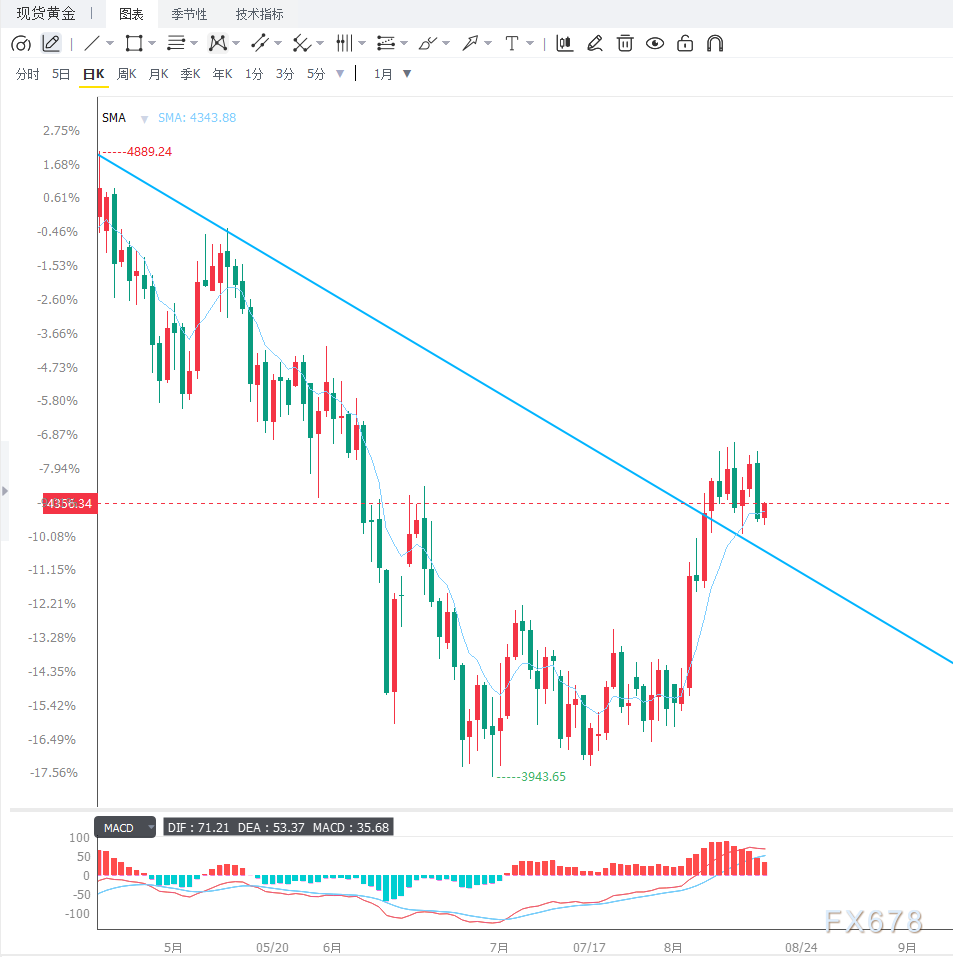
Currently, gold is at the intersection of three key forces: soaring long-end yields, energy-driven inflation risks, and weakening Federal Reserve policy expectations. In the short term, the roughly 5.3% yield on the 30-year US Treasury puts significant pressure on gold; if prices cannot reclaim $4,385, further correction risks remain. But in the medium term, the shift in US monetary policy expectations, along with persistent inflation and safe-haven demand, continue to provide fundamental support for gold. Going forward, the key market variables to watch are real US Treasury yields, the dollar’s performance, crude oil prices, and Fed policy signals. If yields retreat from highs while the dollar weakens, gold could resume its uptrend; but if yields continue to break previous highs, gold will face greater downward pressure.
Disclaimer: The content of this article solely reflects the author's opinion and does not represent the platform in any capacity. This article is not intended to serve as a reference for making investment decisions.
You may also like
TACO Returns! Trump Temporarily Delays 50% Tariffs on Canada; $20 Billion Worth of Goods Temporarily Spared from Tariff Storm
U.S. President Donald Trump announced on Tuesday evening that he will postpone by three days the new 50% tariffs on Canadian goods that were scheduled to take effect on Wednesday, stating that the two countries have reached an agreement.

Wintermute: Bitcoin Range Breakout Delayed by ETF Outflows and Miner Selling
Why not buy storage stocks? Here are the answers from two industry leaders
As the AI infrastructure boom drives up storage chip stocks, Ark Invest's Cathie Wood and tech analyst Ben Thompson have chosen to stay away. Wood warns that prices multiplying several times is a negative signal, pointing out that inference chips from companies like Cerebras and Groq have already circumvented high-bandwidth memory at the engineering level. Thompson uses Iran's blockade of the Strait of Hormuz as an analogy—playing this card will only accelerate opponents in finding alternatives. The highlight moment for storage may actually mark the starting point of its replacement.
'Aave will win' proposal clears temp check with 52.6% backing on revenue shift, V4 plan
Crypto prices
More


