At the same time, the US is pushing to bring crypto further into the mainstream financial system while simultaneously trying to stop Iran from using that same technology to get around traditional banking.
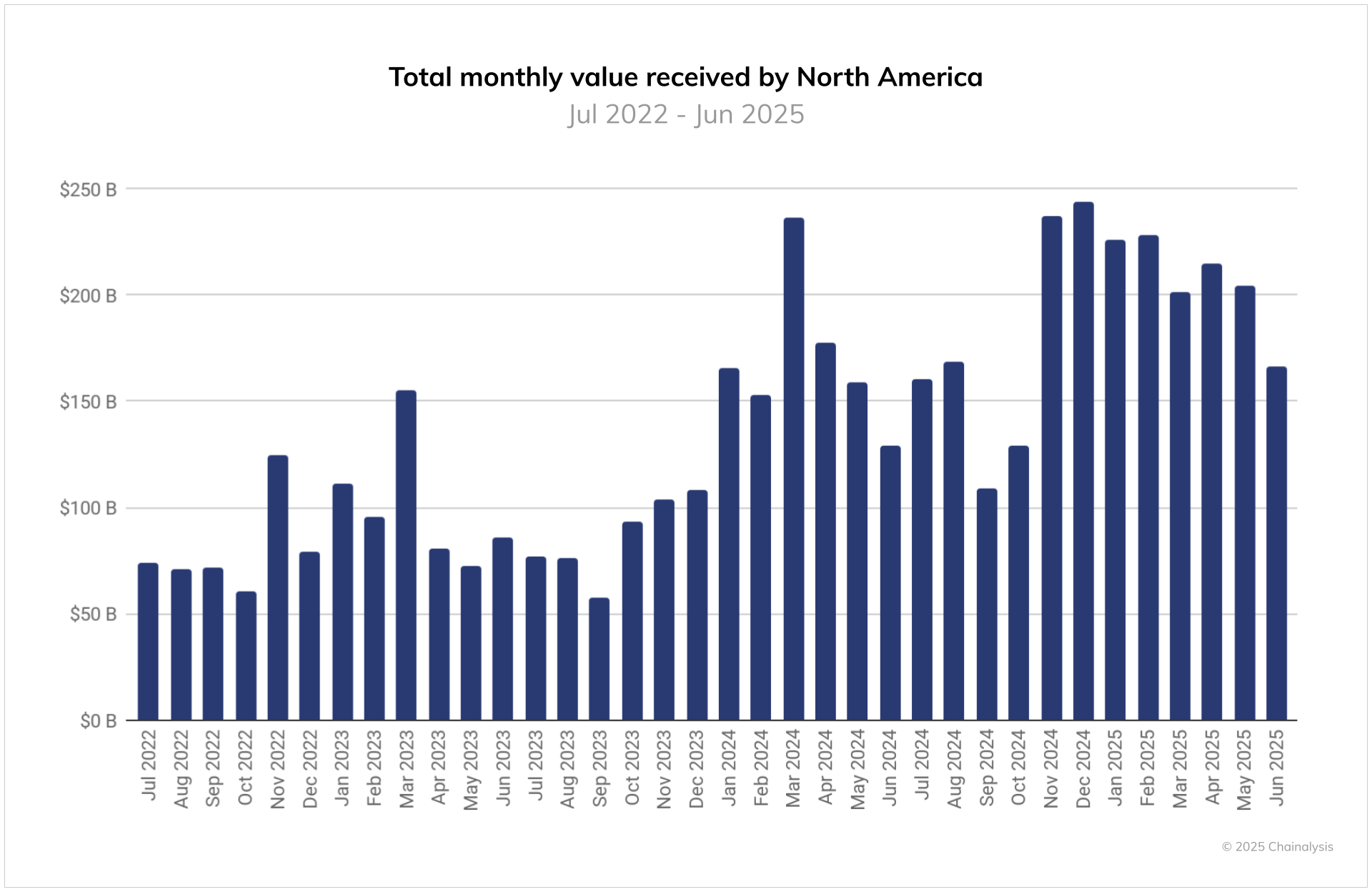
Chainalysis ranked the United States second globally in its 2025 crypto adoption index. Between July 2024 and June 2025, North America saw about $2.3 trillion in crypto transactions, which is around 26% of the global total for that period.
 Credits: Chainalysis
Additionally, crypto is becoming more institutional, as the rise of Bitcoin ETFs gave regular investors exposure without having to handle the wallets themselves. On top of that, banks and asset managers are rolling out custody and tokenization products, and US regulators are building frameworks to bring digital assets further into the mainstream financial system.
As such, the US approach seems to be a process where crypto gets regulated, then routed through institutions, and finally absorbed into the mainstream financial markets.
This is interesting, considering Iran’s approach is drastically different.
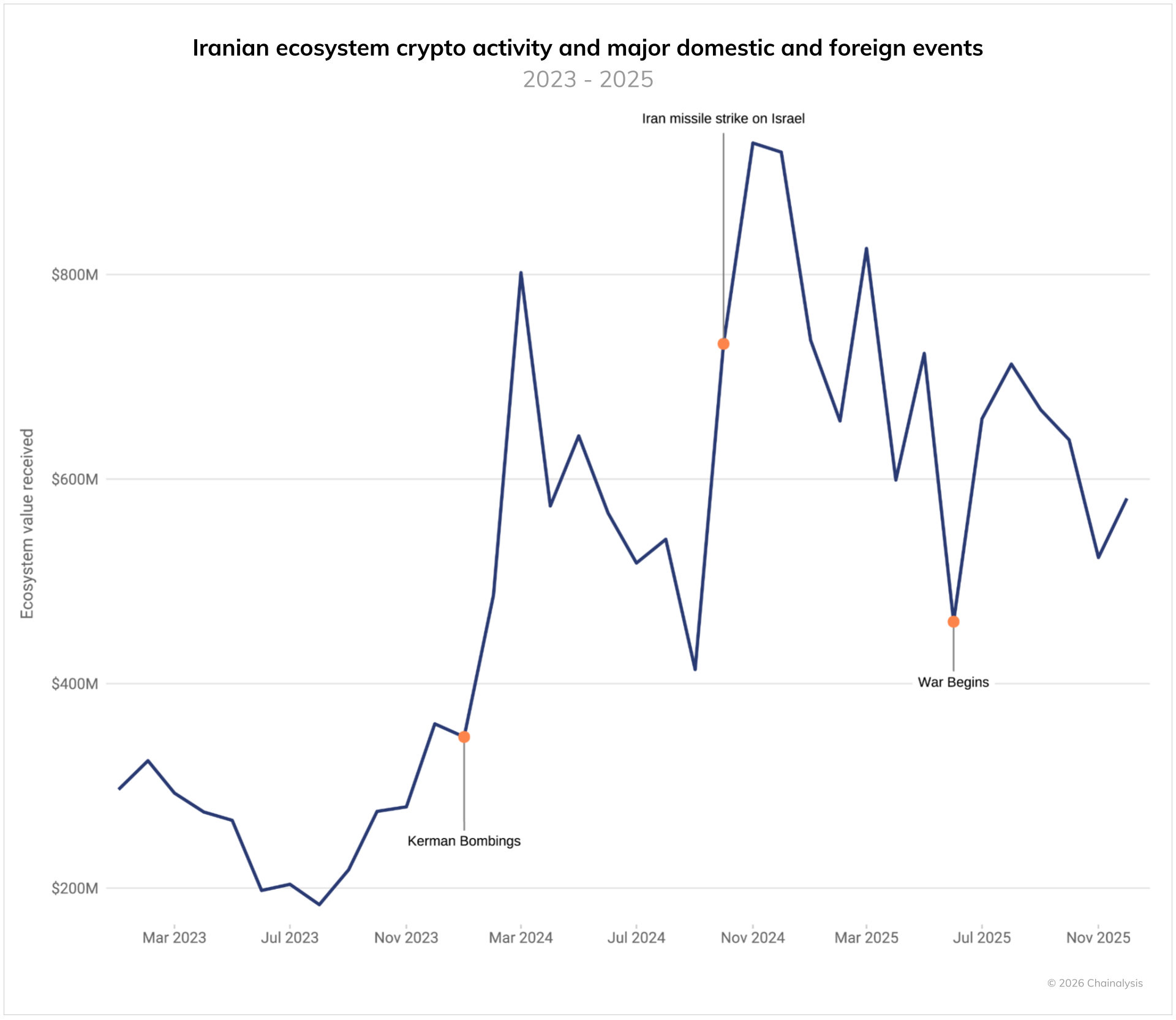
Chainalysis estimates that Iran’s crypto ecosystem exceeded $7.78 billion in 2025.
However, that doesn’t mean the Iranian government is sitting on billions in crypto, as the number represents the total value flowing through the country’s digital asset channels.
Notably, crypto activity in Iran is up 11.8% compared to the previous year by mid-2025, despite growing isolation from global trading platforms and exchanges.
 Credits: Chainalysis
Unlike in the US, the growth appears closely connected to economic and geopolitical pressure.
Since 2018, the Iranian rial has lost roughly 90% of its value and inflation has stayed high. Chainalysis notes that Bitcoin withdrawals to personal wallets went up during periods of unrest, suggesting some people used self-custody to move their money outside the local banking system.
This creates a very different chain of events when compared to the US, where an unstable economy weakens the currency, triggers capital controls and sanctions, and drives people toward crypto as a sort of workaround financial system.
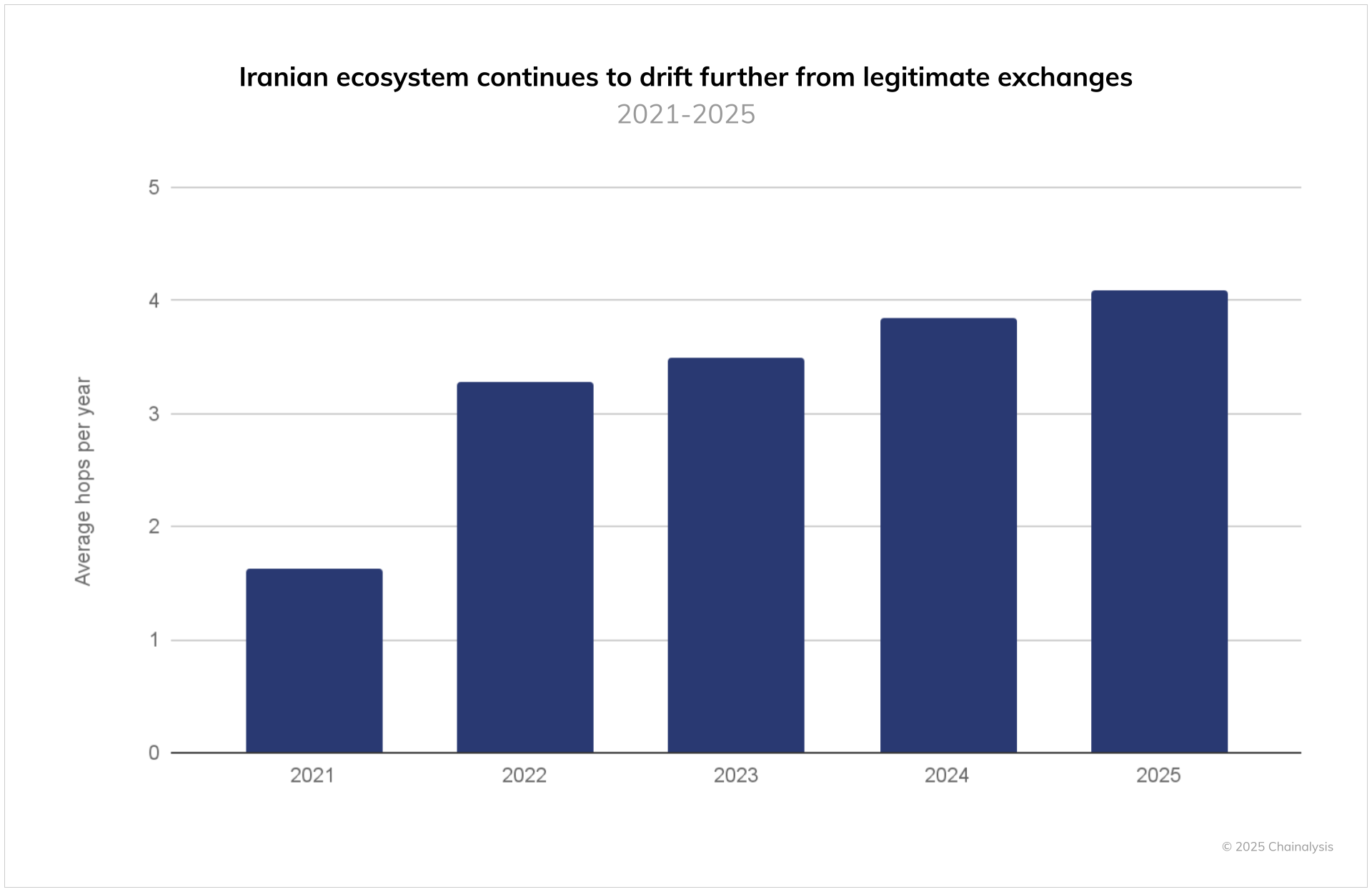
One of the more interesting stats from Chainalysis is the widening gap between Iranian crypto services and compliant global trading platforms.
To be more precise, the average number of transactional hops increased from 1.6 in 2021 to 4.1 in 2025. It suggests Iranian crypto use isn’t just getting bigger, but also becoming more cut off from the rest of the world.
 Credits: Chainalysis
With global exchanges tightening their sanctions screening, Iranian users and middlemen now have to use additional wallets and transactions to move funds between domestic platforms and the global crypto ecosystem.
This doesn’t affect only ordinary Iranian users either. Chainalysis found that in Q4 2025, approximately half of all crypto value received in Iran went to addresses associated with the country’s Islamic Revolutionary Guard Corps (IRGC).
The blockchain analysis company flagged over $3 billion moving to IRGC-related addresses in 2025. It also stated the number is likely a low-end estimate, as it’s not always possible to spot every wallet connected to an organization.
That explains why the US doesn’t see Iranian crypto activity as merely regular people buying Bitcoin. For Washington, some of that crypto infrastructure is now seen as part of the issue that helps Iran dodge sanctions and fund state operations.
Washington can’t realistically shut down Bitcoin in Iran. Instead, it can target exchanges, issuers, wallets, intermediaries, and financial systems that connect Iran’s crypto activity to the rest of the world.
For instance, on June 2, the US Treasury’s OFAC (Office of Foreign Assets Control) sanctioned Iran’s largest crypto exchange, Nobitex, as well as Wallex, Bitpin, and Ramzinex. The organization also warned that foreign banks and other non-US parties could face sanctions risks if they handled certain transactions involving those platforms.
Pressure kept building in July, when OFAC hit four crypto addresses tied to Iran’s Central Bank with sanctions. According to Chainalysis, those addresses had taken in more than $165 million in stablecoins, and Tether later froze roughly $131 million of that.
Additionally, on August 7, the US hit Shelbit (a Dubai-based crypto exchange) with sanctions, accusing it of handling transactions for the IRGC and other Iranian-linked groups. Reuters reports that investigators had tracked billions of dollars flowing through the wider network.
Such a development shows that going after Iranian exchanges might not be enough, since crypto moves across borders by design. Hence, funds can go from an Iranian exchange to another wallet, through a bridge or DeFi protocol, into an offshore service, and eventually out into global markets.
In the end, we have two completely different crypto adoptions found in the US and Iran. The US is pushing to bring crypto into the mainstream financial system, while Iran is showing what happens when that system is closed off – crypto becomes a workaround.