
In July, the gold market in major Asian countries steadily recovered, with gold ETFs experiencing a reversal and sustained net inflows.

Huitong Network, August 18—— In July, the domestic gold market in the Asian country saw an overall recovery, gold prices remained stable, gold ETFs ended their outflows and realized continuous net inflows, and bullish sentiment in the futures market recovered. Due to the seasonal off-season and high gold prices, physical jewelry consumption remained sluggish. The central bank continued its 21-month streak of gold purchases, and gold imports surged, strengthening the market fundamentals. Although physical jewelry consumption remained lukewarm due to seasonal factors, the strong performance on the investment and official reserve sides completely stabilized the domestic gold market base and further bolstered support for future gold price trends.
Benefiting from both the weakening of the US dollar and the recovery of market investment sentiment, coupled with the strategic support of the Asian country's central bank's continuous gold accumulation, the gold market in the country showed a steady recovery trend in July. Although the decline in gold price volatility led to a slight drop in futures trading activity, institutions significantly increased allocations, gold ETF funds continued to flow back, and bullish sentiment steadily recovered. Despite physical jewelry consumption remaining tepid due to seasonal factors, robust investment and official reserve activity stabilized the domestic gold market base and further strengthened support for subsequent gold price movements.
Gold Price Remains Stable, Macro Factors Continue to Support the Market
Ray, Research Director for China at the World Gold Council (WGC), stated that in July, the London Bullion Market Association and the Shanghai Gold Benchmark Price remained basically stable, with minimal overall fluctuations. Market performance attribution analysis indicates that the weaker US dollar and optimized investor positioning provided positive support, effectively offsetting the negative pressure from rising US Treasury yields and keeping gold prices within a rangebound pattern.
Entering August, softer US labor market data and cooling inflation data delayed market expectations for further Fed rate hikes, further pushing gold prices upward.

Gold ETF Funds Flow Back, Institutional Allocation Increases
After consecutive capital outflows in May and June, Gold ETFs in the Asian country
Ray noted that this round of capital inflow boosted the total AUM of domestic gold ETFs by 3% to 250 billion yuan, with total holdings increasing by 5 tons to 282 tons. Gold price stability also attracted many institutional investors to enter the market. From a yearly perspective, between January and July, domestic gold ETFs saw a cumulative net inflow of 45 billion yuan, equivalent to 34 tons, marking the second-highest annual increase on record.
Futures Sentiment Recovers, Physical Consumption Weak, Clear Market Divergence
Due to the decline in gold price volatility, average daily trading volume of gold futures on the Shanghai Futures Exchange dipped by 4% from the previous month in July, with short-term speculative activity cooling off. However, medium- and long-term market sentiment steadily improved, with the top 20 main members’ net long gold futures positions increasing by 24 tons month-on-month to a total of 117 tons at month-end, indicating optimism among funds regarding future gold prices.
In contrast to the rebound on the investment side, domestic wholesale gold demand was weak; affected by the seasonal consumption lull between Q2 and Q3, July's gold shipment volume from the Shanghai Gold Exchange decreased by 8% month-on-month and 15% year-on-year. High gold prices suppressed general consumer demand, with weak consumer confidence, sluggish jewelry purchases, and regular investment demand failing to provide an effective offset, resulting in overall pressure on the physical side.
Central Bank Continues Gold Hoarding, Imports Surge, Strengthening Long-term Fundamentals
The core support for the country’s domestic gold market comes from continued expansion of official reserves. According to Ray, the central bank increased its gold reserves by 20 tons in July, marking the largest monthly addition since October 2023. The central bank’s gold-buying streak has reached 21 months, setting a new record for the longest streak, with current official gold reserves totalling 2,366 tons. Against a backdrop of a changing geopolitical landscape, the central bank continues to buy gold on dips, steadily advancing the diversification of its foreign reserves.
At the same time, domestic demand for gold imports remains strong, with net gold imports in June reaching 152 tons, a new high since March 2024. Total imports for the first half of the year surged to 764 tons, up 138% year-on-year, fully demonstrating the robust recovery of domestic gold investment demand.
Market Outlook
Overall, the gold market in the Asian country shows a clear divergence with strong investment demand and weak physical demand; long-term central bank gold accumulation and ETF inflows form a solid foundation. If gold prices continue their upward trend, domestic investment allocation demand is expected to be further unleashed. As the traditional consumption peak season approaches, jewelers’ restocking demands are likely to rebound, supporting a marginal pick-up in physical gold demand.
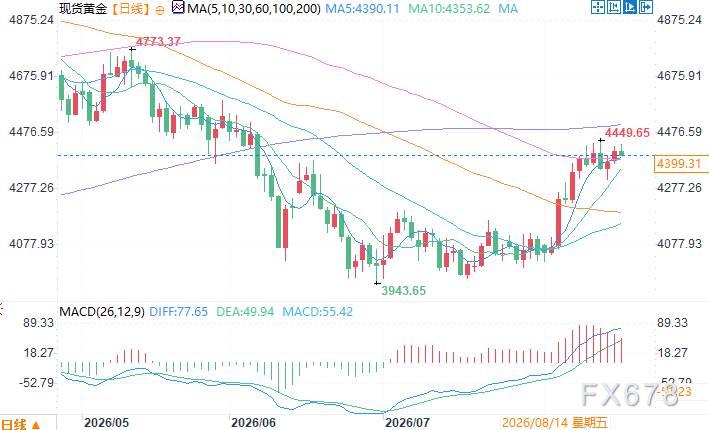
Spot Gold Daily Chart Source: E- Huitong
GMT+8 August 18, 11:00, Spot Gold quoted at $4,400.31/oz
Disclaimer: The content of this article solely reflects the author's opinion and does not represent the platform in any capacity. This article is not intended to serve as a reference for making investment decisions.
You may also like
Is the Fed's Policy Actually Already "Leaning Dovish"? San Francisco Fed's New Neutral Rate Model Provides Theoretical Ammunition for the Hawks
A report from a regional Federal Reserve bank indicates that an estimate of the neutral interest rate suggests the Federal Reserve's policy stance is accommodative.

AI inference sparks NAND supercycle! After SanDisk (SNDK.US) surged 629% this year, JPMorgan still sees it rising to $2,250
JPMorgan analyst Harlan Sur recently resumed coverage of SanDisk with an "Overweight" rating and a target price of $2,250, representing nearly a 26% upside from the stock's closing price of $1,786.85 on Monday.

Sticky inflation, AI debt, and fiscal disorder create a triple threat: 30-year US Treasury yield hits highest level since 2007, triggering a "duration storm" in global bond markets
Long-term bonds are becoming the focal point of investor anxiety—concerns about inflation outlook, the debt-burdened artificial intelligence (AI) boom, and other issues are converging here, and governments around the world are paying the price.

Budget Crisis Overlaps with Approaching Election! Political Risk Premium Continues to Rise as French Government Bonds Face Short Sellers
As French politicians prepare for intense battles over the 2027 budget and with next year's presidential election approaching, investors are turning bearish on French government bonds.

Crypto prices
More


