
Institutions: New Allocation Strategies as Stock-Bond Portfolios Fail, Gold's Value as a Defensive Asset Becomes More Prominent

FX168 Financial News, August 18—— Morgan Stanley strategist Mike Wilson believes that the traditional 60/40 stock-bond portfolio has lost its effectiveness as a defensive strategy, while gold's role as a defensive asset has become more prominent. Gold has already undergone a 25-year bull market. The commodities team remains cautious; central bank gold buying remains resilient, but ETF inflows are restricted by interest rates and the US dollar. Geopolitical tensions that drive up inflation will suppress expectations for rate cuts, thereby weakening gold's safe-haven appeal. The future performance of gold prices will depend on the Fed's implementation of rate cuts. Whether conflicts persist or ease, there are corresponding trading risks.
The traditional 60/40 stock-bond allocation has long been considered a solid investment paradigm, but in a market environment with rising asset correlations, the protective effectiveness of this strategy is greatly diminished.
Morgan Stanley strategy analysts engage in in-depth discussion around gold's allocation value, driving logic, and potential risks, analyzing the opportunities and concerns for gold amidst the commodities rotation, providing asset allocation references for long-term investors.
The Stock-Bond Portfolio Fails, Gold Becomes a Key Defensive Alternative
Mike Wilson, Morgan Stanley Chief US Equity Strategist and Chief Investment Officer, pointed out that during the market downturn in 2022, both equities and bonds declined simultaneously, breaking the historical pattern of stock-bond hedging. Many pension investors suffered losses in both stocks and bonds, and many chose to exit and stay on the sidelines.
Wilson emphasizes that long-term investors should avoid chasing highs and selling lows. Systematic investing and diversified allocation remain meaningful in practice. Even after the extreme volatility of 2022, investors who held their positions ultimately saw satisfactory results. Currently, as the correlation between stocks and bonds rises and bonds lose their ability to diversify risk, investors need to seek new defensive assets. He noted,
In his view, gold has already gone through a 25-year bull market, although it wasn't until early 2026 that the market broadly recognized this trend. At the end of last year, the Federal Reserve expanded its balance sheet through its reserve management program, triggering a major commodities rotation. Capital first flowed into precious metal-related stocks, then rare earths and energy, and later moved to semiconductors, with money actively seeking commodity-like assets to hedge equity risks.

Constraints on Gold's Price Upleg and the Long-Short Tug of War
However, the firm's internal commodities team offers a more cautious view on gold's prospects. On June 22, Morgan Stanley commodity strategy analysts Amy Gower and Martijn Rats released a research report stating that while central bank gold buying remains resilient, gold ETF inflows are highly dependent on Fed policy, real yields, and the US dollar. Without significant ETF inflows, it's difficult for gold to reach the target of $5,200/oz.
Gower said that geopolitical tensions disrupt energy supply and fuel inflation, cooling market expectations for rate cuts. Gold's safe-haven attribute is suppressed by monetary policy, shifting the main driver for gold prices to Fed policy; the policy responses after geopolitical events matter more than the events themselves. High oil prices force the Federal Reserve to reassess its stance on policy easing, and as market rate-cut expectations are continually lowered, the holding costs for non-yielding assets like gold rise.
The team originally forecast the Fed would cut rates in January and March 2027, with such moves supportive of gold ETF inflows and thus gold prices. But ongoing geopolitical conflicts also plant the seeds for risk. Gower warns that if the market trades interest rates at elevated levels or expects further rate hikes, gold will face significant pressure; even if conflicts are resolved, current high gold prices will curb buying from central banks, ETFs, and physical consumers, capping any further upside.
Conclusion
To sum up institutional perspectives, the foundation for gold's long-term bull market remains intact, but short-term performance depends heavily on the pace of Fed rate cuts and ETF fund dynamics. Geopolitical situations are a double-edged sword: they spark safe-haven demand while simultaneously pushing up inflation and forcing monetary tightening. Investors cannot simply treat gold as an unconditional safe-haven and must combine macro policy analysis for comprehensive judgment.
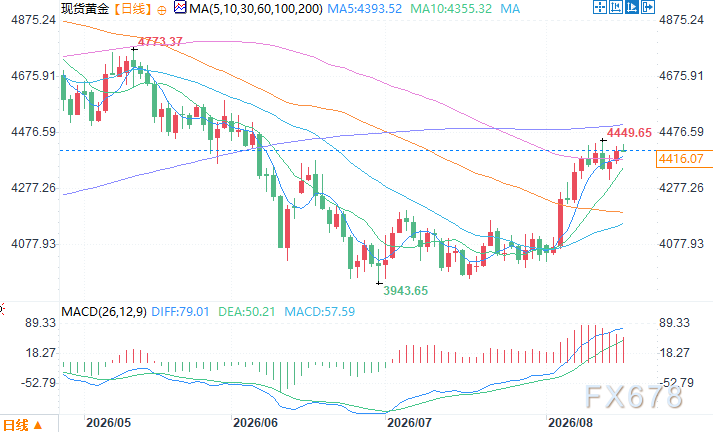
Spot Gold Daily Chart Source: EasyForex168
GMT+8 August 18, 9:57 Spot Gold quoted at $4,408.07/oz
Disclaimer: The content of this article solely reflects the author's opinion and does not represent the platform in any capacity. This article is not intended to serve as a reference for making investment decisions.
You may also like
Is the Fed's Policy Actually Already "Leaning Dovish"? San Francisco Fed's New Neutral Rate Model Provides Theoretical Ammunition for the Hawks
A report from a regional Federal Reserve bank indicates that an estimate of the neutral interest rate suggests the Federal Reserve's policy stance is accommodative.

AI inference sparks NAND supercycle! After SanDisk (SNDK.US) surged 629% this year, JPMorgan still sees it rising to $2,250
JPMorgan analyst Harlan Sur recently resumed coverage of SanDisk with an "Overweight" rating and a target price of $2,250, representing nearly a 26% upside from the stock's closing price of $1,786.85 on Monday.

Sticky inflation, AI debt, and fiscal disorder create a triple threat: 30-year US Treasury yield hits highest level since 2007, triggering a "duration storm" in global bond markets
Long-term bonds are becoming the focal point of investor anxiety—concerns about inflation outlook, the debt-burdened artificial intelligence (AI) boom, and other issues are converging here, and governments around the world are paying the price.

Budget Crisis Overlaps with Approaching Election! Political Risk Premium Continues to Rise as French Government Bonds Face Short Sellers
As French politicians prepare for intense battles over the 2027 budget and with next year's presidential election approaching, investors are turning bearish on French government bonds.

Crypto prices
More


